Daniel Korski

Talking to the Taliban is key – but no magic formula

From our UK edition

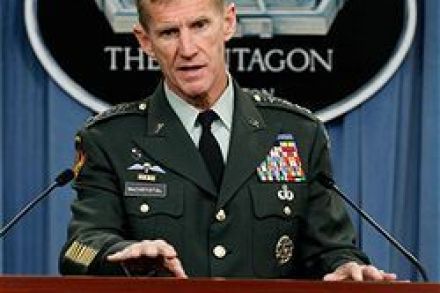
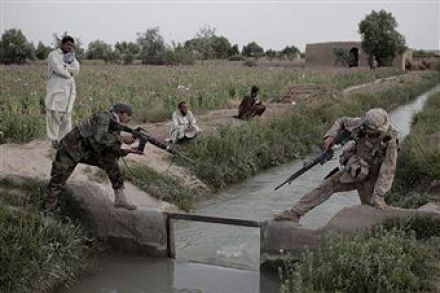
The proverbial shoe is dropping. Following General Stanley McChrystal’s forced retirement, a consensus is forming that President Obama's Afghan strategy is not working. The Economist says: ‘Since November, when Mr Obama promised 30,000 more of his country’s soldiers to the campaign, little has gone right. General McChrystal’s plan was for a “surge” that would seize the initiative from the Taliban and create the scope for Afghanistan’s government, backed by its army and police, to take charge. In practice that has not happened.’ In the Financial Times, Ahmed Rashid makes a similar point, arguing that the military strategy in Afghanistan is "failing".
Hail to the chief

From our UK edition

How wrong I was. President Obama, lambasted by his critics for being ponderous, has acted with lightening speed: less than 24 hours after that Rolling Stone article, General Stanley McChrystal was forced out of his job in place of the only person that could pick up where he left off, namely General David Petraeus. In acting swiftly, the US president has moved to restore the authority and respect his position as Commander-in-Chief deserves; and he has begun to re-establish the kind of civil-military relations that need to exist in militarily-capable liberal democracies like the United States.   What effect the change of commander will have in Kabul remains unclear. But it will have a long-term positive effect on US democracy.

General concern

From our UK edition

The Taliban are expanding their area of influence, NATO allies are eager to leave Afghanistan, the forthcoming parliamentary elections are likely to be even more fraudulent than last year’s presidential election – in other words, how can it get any worse for President Obama’s AfPak strategy? Oh yeah, the man the US president has trusted to execute the strategy, the man whose name is now synonymous with the international community’s’ plan, General Stanley McChrystal gives an interview to Rolling Stone magazine (in itself a dubious choice), which paints a picture of the commander as insubordinate, unwise or simply not in control of his headquarters.

Pakistan: friend or foe?

From our UK edition

One of the biggest obstacles for NATO in Afghanistan has been the role of Pakistan and its intelligence apparatus in supporting the Taliban insurgency. Officially, the Pakistani government deny backing the Taliban insurgency, but even Admiral Mike Mullen, chairman of the U.S. Joint Chiefs of Staff, and General David Petraeus, head of U.S. Central Command, have said they suspect Pakistan's Inter-Services Intelligence service of being engaged in anti-NATO activities. Now, a new report by the Harvard-based analyst and former head of OXFAM in Kabul, Matt Waldman, takes the accusations to a new level.

RAB

From our UK edition

ABC was the acronym used for meetings of Madeleine Albright, Sandy Berger and William Cohen when they all worked for the President Bill Clinton. RAB will hopefully in future be an American-style acronym for the cooperation of the three people voted to chair the parliamentary committees for foreign affairs, defence and international development: Richard Ottaway, James Arbuthnot and Malcolm Bruce. If the government succeeds in welding together the different perspectives of the FCO, DFID and the MoD – a prerequisite of modern crisis management - then the three MPs will have to find new ways of working together too as parliament will have to scrutinise this new dynamic.

The end of BP

From our UK edition

BP is in trouble. Deep trouble. American lawmakers are threatening to take away its dividends and now President Obama is huffing and puffing in order to deflect attention from the role of his administration. BP is struggling to get a word in with the media, pundits, talking heads, politicians and environmental experts monopolising the airwaves.      Not a lot of people will be sympathetic to BP’s plight. The Deepwater Horizon explosion and oil spill is first and foremost a human and natural tragedy: 11 workers were killed, others were injured and now many Gulf Coast residents will end up losing their homes and livelihoods while their natural environment will be polluted for years to come. BP should, rightly, share much of the blame for this.

Did the bureaucrats lose the war?

From our UK edition

The Times went big on their story of Britain’s campaign in Helmand, and all the mistakes made in 2005 when the deployment was being planned. It is a good piece of reporting, which adds to the volume of stories about the war, its planning and execution. Britain’s effort Helmand, like the one in Basra, will in time need a magisterial study, a sort of multi-volume study like Winston Churchill’s The Second World War, which can weave the front-line experience together with the turning of the bureaucratic wheels. But at least the first draft of history is now being written.

Who could Britain place in the UN’s humanitarian department?

From our UK edition

After Sir John Holmes retires as the head of the UN’s humanitarian activities later in the year, the Cameron government will have the chance to make its first high-level international appointment. Officially, the job is appointed by UN secretary-general Ban ki-Moon, but the unpopular South Korean is likely to want to keep the new British government on board as he seeks re-election for a second term. So the UK is likely to get its pick. Rumours have it that three people are on the short list drawn up by officials:  Valerie Amos, the Labour peer and former International Development Secretary; Dame Barbara Stocking, the head of OXFAM, and Martin Griffiths, the head of the Centre for Humanitarian Dialogue and formerly Deputy UN Humanitarian Relief Coordinator.

Achtung, Liam

From our UK edition

Defence Secretary Liam Fox is used to looking across the Atlantic for military inspiration and across the English Channel to France for the future of defence cooperation. But he might do well to look somewhere else – namely to Germany where the young defence minister, Karl-Theodor zu Guttenberg, has launched one of the Cabinet’s most ambitious cost-cutting programmes. He is planning to cut the number of active-duty soldiers from 250,000 to 150,000 as part of a an effort to find  €1bn (£840m) worth of cuts as part of the government’s €80 billion austerity programme. He is even contemplating an end to compulsory military service -- something normally seen as a fundamental principle for the CDU and CSU.

Taliban talks

From our UK edition

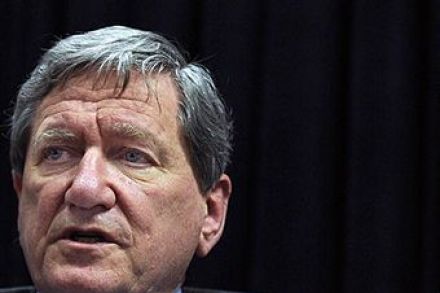
Richard Holbrooke, the U.S. diplomat in charge of Afghanistan and Pakistan affairs said Washington has now publicly made clear the US government is serious about negotiating with the Taliban. Speaking at a conference in Madrid, the US envoy said: ‘Let me be clear on one thing, everybody understands that this war will not end in a clear-cut military victory. It's not going to end on the deck of a battleship like World War Two, or Dayton, Ohio, like the Bosnian war It's going to have some different ending from that, some form of political settlements are necessary ... you can't have a settlement with al Qaeda, you can't talk to them, you can't negotiate with them, it's out of the question. But it is possible to talk to Taliban leaders.

Lord Ashdown’s the right man for the Balkans

From our UK edition

Last week, Europe’s foreign ministers gathered in Sarajevo under much fanfare – and did very little except issue a repetitive press release about the region’s future in the EU. The only highlight of the event was William Hague’s speech, which was excellent.   Enlargement, however, is deeply unpopular among European elites, and the gathered foreign ministers seemed to be acutely aware of how little the market will bear by way of new ideas and initiatives.   So the ideas I put out in a brief in the run-up to the summit for improving the EU’s accession process went nowhere. Only Austria and Estonia openly defended proposals at the meeting. Germany joined France as a major opponent of any change in enlargement policy.

Politicize aid? It already is – and good too

From our UK edition

On Thursday, Andrew Mitchell rolled out the government’s first overseas aid initiative – a transparency watchdog – and took to the airwaves to explain the idea. It makes particular sense in a downturn to ensure that taxpayer’s money is well spent but also to give voters the feeling that independent assessments are carried out to guarantee value for their money.   On Newsnight, the International Development Secretary ran into a criticism, often voiced by the aid community – that the Conservatives are too willing to “militarise” aid or to “politicise” it. He dealt with the criticism  robustly – but I want to have a go too. Because while these are snappy sound bites they miss a number of fundamental points.

Post-2011 Afghanistan: Plan B

From our UK edition

Having returned from Washington DC, where I spoke to a range of senior policy-makers about Afghanistan and Pakistan, I am struck by how much confusion there is about what President Obama meant when he said that he wanted US combat troops return home in 2011. Did he mean that 2011 would allow the first assessment of the progress and his strategy and a tokenistic reconfiguration or forces? Or did he genuinely mean that the date would see the beginning of a real, if drawn-out withdrawal? For what it is worth, I am convinced the US president meant the former. This is crucial to the UK, since so much of what the Britain does – and presumably much time was spent on this at the recent Chequers discussion – is about staying close to the US.

Noises off, officers

From our UK edition

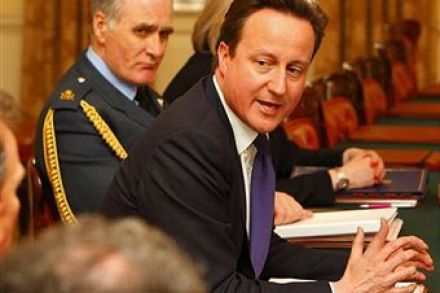
David Cameron is caught between a rock and a hard place. His government is rightly committed to its AfPak policy and the need to keep ties with the United States strong and close. But the Prime Minister and his aides probably also know that the assessments offered by a number of senior military officers of the campaign are rose-tinted, and suspect that the US administration may pivot and head for the exit far quicker than is comfortable for its allies. This is a tough choice; a wrong move could damage transatlantic ties and set back the fight against Jihadism. Staying the course will mean greater opposition from both Right and Left.   Unhelpfully, the government is also beginning to see signs of the kind of sniping from the Army that beset the Labour government.

Flotilla follies

From our UK edition

Two groups in the Conservative party that have worried most about Con-Lib government are the social conservatives and the neo-conservatives. The latter have been particularly worried about UK relations with Israel. There is a real concern in parts of the Conservatives Party that three factors would come together to sour Anglo-Israeli relations: what the neo-conservatives see as the Foreign Office’s knee-jerk Arabism, the presence of many supposed Arabists in Cameron-Hague’s teams, and the anti-Israel bias exhibited by many leading Liberal Democrats. Whatever the truth of these allegations, they are held with considerable fervour.

The Department for Fragile States?

From our UK edition

The Department for International Development (DFID) should forsake peaceful but poor countries and instead turn into “a world leader in tackling the problems of fragile states.” That’s what a new Chatham House report by Alex Evans, who used to be an adviser to Hilary Benn, and his colleague, David Steven, argue: 'If the UK wants to deepen its commitment to backing the challenges posed by fragile states, it needs to remodel DFID extensively, with the department concentrating on developing a coherent preventive agenda for fragile states.

Trans-Atlantic  powwow

From our UK edition

I’m in Washington DC at a high-level seminar on trans-Atlantic relations with the “who is who” of Europe and the US, talking about issues of common concern. The Germans are here in force, as are the French, with high-ranking officials speaking about topics like Russia and Iran. Interestingly, the Brits are notable in their absence. It is probably a sign that the British government is still in transition mode, unable to explain any new policies, unready to stake out new positions. Or they may not be bothered with unofficial events such as these given the privileged access they have. But it is worth noticing nonetheless.

Avoiding Groupthink

From our UK edition

I hope CoffeeHouse readers will forgive the attention I am heaping on the Afghanistan War these days, but the campaign is moving into a decisive phase with a July donor’s conference in Kabul that Hillary Clinton is reportedly attending, a “peace jirga” scheduled to consider plans to negotiate with the Taliban and only a year to go before the first US combat troops begin heading home. No 10 is now letting it be known that the Prime Minister, his key Cabinet ministers, generals and aides will gather shortly to discuss the mission. A sort of condensed Obama review of the UK contribution.

War, Statesmen and Soldiers

From our UK edition

Fifteen days ago Newsweek had an extract, no not from Alistair Campbell’s diaries, but about something that actually matters – Jonathan Alter’s book about President Obama’s AfPak strategy. I have only just read it – apologies -- but a soggy May weekend is just the time to snuggle up on a sofa and read about warfare. Alter charts the discussions in the ten meetings on last year in the Situation Room in the basement of the White House when the Obama administration settled on a new strategy. Three things spring to mind when reading the passages. First, that the maintenance of civilian control over the military is not automatic; it is a constant struggle, particularly in a media-lacked environment.

Organising for national security

From our UK edition

Four weeks into the new government and the National Security Council machinery is still being put in place and ministers are still getting read into their briefs. The visit by William Hague, Andrew Mitchell and Liam Fox to Afghanistan was important, despite the brouhaha over the Defence Secretary’s comments. Such a visit was simply not imaginable under the Brown government. On the other hand, insiders say there is no real difference yet from the NSID committee that Gordon Brown created and the National Security Council that David Cameron has convened - except that the latter meets weekly, producing a torrent of tasks for officials. Permanent Secretaries are meeting regularly to support the NSC, but the subordinate structures are still not in place.