Xi jinping

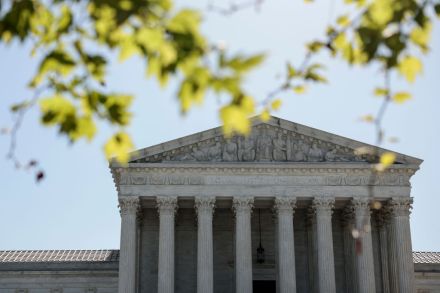
The Supreme Court is under fire — again

Some weeks it feels like the line between politics and the law has all but vanished. From Hunter Biden’s plea deal and Donald Trump’s ongoing criminal woes to the brouhaha surrounding gifts accepted by Supreme Court justices and John Durham’s appearance before the House Judiciary Committee to defend his report on the FBI and Russiagate, this is one such week.  For more on the Hunter story, check out my colleague Ben Domenech’s latest. Meanwhile, a fresh row about the Supreme Court bubbled up in an unusual way overnight.

Is it too late to save America?

Regular readers may recall how fond I am of a mot from the British diplomat, author and art collector Edgar Vincent, the first (and, as it happened, the last) Viscount d’Abernon: “An Englishman’s mind works best when it is almost too late.” When I first encountered Lord D’Abernon’s saying, I was impressed by its slightly disabused cheerfulness. “Whew,” I thought. “As usual, some impending disaster was neatly avoided at the last moment by the wit and pluck of the doughty Brits.” The drama of the near-escape added to the sweetness of relief. Surely we Yankees — most of whom, until recently, were basically displaced Brits — could also be counted on to display the requisite derring-do at the critical moment. Could we though? “Almost too late.

america
syria peace

After decades of waiting, China goes on the diplomatic offensive

China has been an epicenter of diplomacy over the last month and American officials can’t help but take notice of the shift. Statesmen flying to China, hat in hand, to sign business deals with Chinese firms or enlist Chinese diplomats to assist in solving international disputes gives the foreign policy graybeards ulcers. The general rule seems to be: what’s good for China is bad for the United States. There’s no question that China’s Xi Jinping has had a good few weeks. After being occupied with a nationwide Covid-19 disaster that lasted for three years, Xi, a man whose entire legacy depends on China transforming into a superpower on par with or perhaps even surpassing the US, isn’t wasting any time before injecting his country back into the diplomatic arena.

Macron tries to be the Xi whisperer

God bless Emmanuel Macron for his perseverance and self-confidence. The French president seeks to lead Europe and turn the continent into a strong, independent player in its own right. And he is eager to take on the hard, thankless diplomatic work that few of his peers are willing to do. Whether it was his ploy in 2019 to connect then-US president Donald Trump and then-Iranian president Hassan Rouhani on the phone or his months-long, intensive personal dialogue with Russian President Vladimir Putin before the war in Ukraine, Macron invests a lot of time and capital into these gambits. Unfortunately for him, many of them fail to accomplish anything of substance. Macron wasn’t able to convince Rouhani to speak with Trump (although Trump reportedly agreed to the call).

napoleon macron tantrum diplomacy

Putin and Xi: authoritarian bros

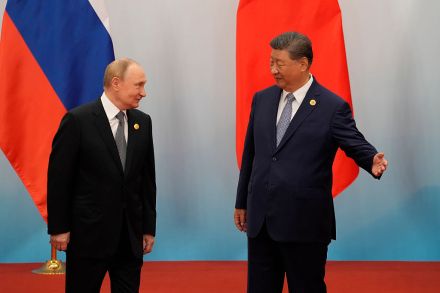
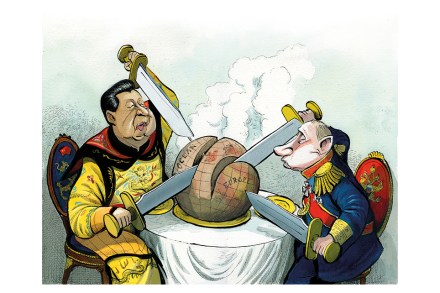
Relationships between dictators are bound to be a bit strange, but Xi Jinping and Vladimir Putin’s stands out for its theatrical quality. Meetings are carefully choreographed for maximum propaganda effect. Lavish gifts and gilded state rooms are the norm. Fluent in the language of autocratic flattery, the two always have gushing praise for each other. In 2019, before traveling to Russia, Xi said that Putin was his “best and bosom friend,” while just a year earlier Putin praised Xi as being a “remarkable thinker” and “a good friend I can count on.” Leading up to this week’s visit, Putin referred to Xi as his “good old friend,” and recalling Confucius, wrote, “Isn’t it a joy when a friend comes from afar!

putin xi authoritarian bros

TikTok may be the real test of the China Select Committee

The primetime launch event for the House China Select Committee shows the bipartisan consensus that has formed in Washington on the threat represented by China. It also illustrates the priorities for members of Congress, and their divisions over the appropriate response to Chinese influence as a military, economic and cultural adversary. Witnesses, including former Trump deputy national security advisor Matthew Pottinger and retired Lieutenant General H.R. McMaster, encouraged members to take Xi's words at face value — and emphasized that for too long Washington has looked the other way while China ate America's lunch.

china select committee

China is playing the US for fools over the spy balloon

The Chinese balloon debacle has shone a light on America's security vulnerabilities, but it has also revealed just how audacious and deceptive the Chinese Communist Party is. As with their reaction to Covid-19's origins, they have brazenly lied from the day that the balloon’s presence was made public. It is abundantly clear that the craft was not a weather balloon, not least because of its uncharacteristically massive size. Yet China opted to construct a tall tale about a wandering weather balloon that somehow ended up over America. Oh, and the balloon over Latin America? That was just another errant storm tracker. Sure, China regrets the mishap, but there is no need to overreact. What makes the lie so extraordinary is that it is so easily debunked.

xi

Biden’s State of the Union went quiet on China

Joe Biden's meandering State of the Union left out a great many things, as his voice toggled between insincere whisper and frail bellow. The loudest moment of the night was when, going off-script from his prepared remarks, he insisted that really — c'mon, I really mean it! — China's Xi Jinping is being isolated from the world for some reason. https://twitter.com/greg_price11/status/1623157950654078977 "Name me a world leader who would change places with Xi Jinping! Name me one! Name me one!" Biden yelled. The comment had an air of frustration given that the humiliating Chinese spy balloon was fresh in the minds of all on Capitol Hill. "I’ve made clear with President Xi that we seek competition, not conflict," Biden said in his prepared remarks.

Mike Gallagher’s China challenge

Twenty-five years ago, bipartisan American consensus about China was built on hope, spin and money. Despite the trauma of Tiananmen Square and caution about China’s true economic intentions, many believed in the potential of capitalist principles to move the Chinese Communist Party into a more open, less aggressive posture. Henry Kissinger wrote books about it; pundits and think-tank scholars gave speeches about it; Republicans and Democrats alike parroted the line well into the twenty-first century. Tom Friedman even dreamed ambitiously of what the United States could accomplish if only it were willing to be “China for a day.” What followed? As Harold Macmillan put it, “Events, dear boy, events.

Gallagher china ccp confucius institutes china

Germany’s Faustian entanglement with China

Back in November, German Chancellor Olaf Scholz met with Chinese Communist Party (CCP) chairman Xi Jinping. His visit to China was the first by a G7 leader in three years. Facing heated domestic and international pushback, Scholz framed his visit as an effort to “further develop” economic cooperation between Berlin and Beijing. In this context, such “further development” means further cementing Germany’s Faustian bargain with China, one in which European-based players, like Airbus and Volkswagen, claim immediate revenue — but at their long-term expense and at great strategic cost.

Why China’s budding relationship with the Saudis spells trouble

Joe Biden’s chickens are coming home to roost as Chinese President Xi Jinping visits Saudi Arabia. The trip itself has not been especially revolutionary. But it is another indication of America’s declining prowess in the region. Xi was given a welcome befitting an ambitious leader (and notably different from how Biden was greeted in July). Beijing and Riyadh signed numerous economic agreements worth about $29 billion in total, including with Huawei, which will only further the Chinese technology giant’s control over global telecommunications infrastructure. Xi also advanced his desire to make the yuan a competitor to the dollar in the global economy, pushing for the use of the yuan in the oil trade with Saudi Arabia.

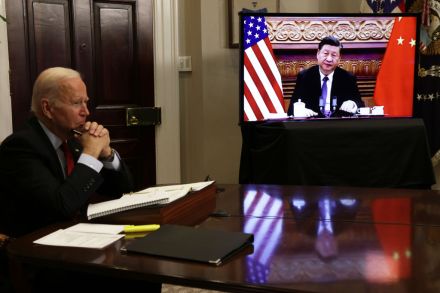
The Biden-Xi meeting was long overdue

The bilateral relationship between the United States and China is arguably the most important in the world today. The two countries make up approximately 42 percent of the world’s economic output and more than half of global military expenditure (at $801 billion, the US share of that total dwarfs China’s). The Biden administration’s recently released National Security Strategy names China as "the only competitor with both the intent to reshape the international order and, increasingly, the economic, diplomatic, military, and technological power to do it." The central objective from Washington’s standpoint is to compete vigorously with Beijing, prevent China from attaining hegemonic status in the Asia-Pacific, and ensure this competition doesn’t slide into conflict.

WaPo calls out Biden’s lies with ‘Bottomless Pinnochio’ award

Cockburn’s monocle popped out of his head and plopped into his oatmeal yesterday morning as he perused the Washington Post. “A Bottomless Pinocchio for Biden — and other recent gaffes,” read the headline. Surely “gaffe” has come to mean “lovable quirk” when applied to Democrats? And “Pinocchio” must refer somehow to the way in which Italian puppets are marginalized? But no — the Post straight-up published “a roundup of some of the president’s recent errors of fact” and reiterated, a day before the midterm elections mind you, the “gaffe machine” nickname Joe Biden gave himself. First on the Post’s fact-check list is Biden’s repeated claim that he “spent a lot of time — more time with Xi Jinping than any other head of state.

America’s military isn’t ready for a war with China

China’s 20th Party Congress concluded on October 23, and President Xi Jinping secured a norm-breaking third term as leader of the Chinese Communist Party (CCP). With the Politburo Standing Committee stacked with close confidants and dissent virtually wiped out, Xi is the strongest he has ever been. Xi has also redoubled the Party’s commitment to taking the island of Taiwan, by force if necessary. Secretary of State Antony Blinken recently said that China “was determined to pursue reunification on a much faster timeline.” The alarm has been repeatedly sounded by American military officials, with speculation that a Chinese invasion of Taiwan could occur as soon as 2023.

Welcome to the age of nuclear blackmail

Vladimir Putin’s recent announcement that he was not bluffing about using nuclear weapons against the West in his war on Ukraine is one of the strongest indications yet of the risks the liberal world now faces in opposing authoritarian aggression. In the face of Russian aggression, or in committing the United States to defending Taiwan, as President Joe Biden did yet again recently, Washington and its partners face the possibility of direct confrontation with the world’s most powerful, nuclear-armed militaries. For the first time in a generation, Western powers risk being checked by adversaries willing to threaten massive conventional and nuclear warfare. The era of cost-free intervention to uphold the liberal world order is over.

nuclear

It’s time for the US to revoke China’s ‘normal trade’ status

In April 2022, six weeks after Moscow’s invasion of Ukraine, President Biden signed legislation to suspend Russia’s Permanent Normal Trade Relations (PNTR) status. “Revoking PNTR from Russia,” he said, “is going to make it harder for Russia to do business with the United States… The free world is coming together to defeat Putin.” PNTR status, also known as Most Favored Nation (MFN) status, is a designation granted among World Trade Organization members. Receiving nations are awarded all trade advantages that any other nation receives. Revoking PNTR status from Russia was a strategic move. It opened the door to deliver comprehensive economic strikes against Moscow and sent a clear signal to markets.

America’s chip war with China

There is a joke in Taipei that if China invades Taiwan the best place to shelter is in microchip factories, the only places the People’s Liberation Army can’t afford to destroy. The country that controls advanced chips controls the future of technology — and Taiwan’s chip fabrication foundries (“fabs”) are the finest in the world. Successful reunification between the mainland and its renegade province would give China a virtual monopoly over the most advanced fabs. Given that Xi Jinping has made clear his intention to take control of Taiwan by 2032, it is no wonder that the American government is worried about the concentration of cutting-edge semiconductor technology on the island.

semiconductors

Is Amazon’s newest competitor a Trojan horse for China?

Chinese e-commerce is synonymous with one company: Alibaba. With a market cap of $400 billion, the multinational tech giant is responsible for 80 percent of online sales in China. Yet while Alibaba is ridiculously popular in China, it’s not popular in the US. It’s notorious, yes, but it’s not popular. That’s why there’s another e-commerce giant trying to penetrate the American market. As TechCrunch’s Rita Liao recently noted, Pinduoduo, a sort of Alibaba 2.0, “has quickly gained momentum for its first international endeavor in the U.S.” Headquartered in Shanghai, the financial capital of China, Pinduoduo recently launched Temu, an American online shopping site. The site, we’re told, seeks to challenge Amazon, the king of online shopping.

Putin and Xi herald a rising authoritarian axis

Russian President Vladimir Putin and Chinese President Xi Jinping met in Uzbekistan during this week’s Shanghai Cooperation Organization (SCO) summit — and a lot had happened since their last meeting. With the Russian Army on the back-foot in Ukraine and its economy forecasted to contract by over 4 percent in 2022, Putin is in a far worse position. Whether this impacted the meeting is hard to tell, though Putin indicated that Xi had “questions and concerns about [Ukraine].” Nevertheless, both countries expressed support for one another, touching on their respective concerns. Xi stated that China wanted to work with Russia “to set an example of a responsible world power,” a jab at the Western powers that both countries are positioning themselves against.

America is forgetting how to make stuff

Articles about the future and “progress” have been popping up a lot lately, with conversations revolving around the inevitable advancements in technology and automation. Where we should head next is the collective theme. To the metaverse? To outer space itself? But instead of setting our sights on colonizing Mars or creating a perfect alternate reality, we should slow our roll, focus on the here and now and consider whether the frenzied “progress” we’re in such a rush to make has demonstrated any benefit to real-life people. Manufacturing is a good place to start. Let this startling reality sink in, reported in 2017 by the Organization for Economic Co-operation and Development: Between 2000 and 2010, US manufacturing experienced a nightmare.