Witchcraft

An ill-fated romance: Dark is the Morning, by Rupert Thomson, reviewed

From our UK edition

As a prolific writer of literary fiction, Rupert Thomson has had plenty of practice in creating a good story. In Dark is the Morning, he seems drawn to the question of whether a satisfactory narrative structure can be imposed on life. The tug between the meaningless, chaotic nature of reality and the more conventional art of storytelling is at the centre of the novel, which concerns the ill-fated romance between the narrator, Gino, and the enigmatic Franca. Thomson even appears awkward about how neatly fabular this tale turns out to be in his opening chapter: ‘I still find the whole thing hard to believe.’ This self-consciousness is apparent throughout, with Thomson making repeated reference to the power of storytelling in his characters’ lives.

Hysterical outbursts: Bewitched, by Jill Dawson, reviewed

From our UK edition

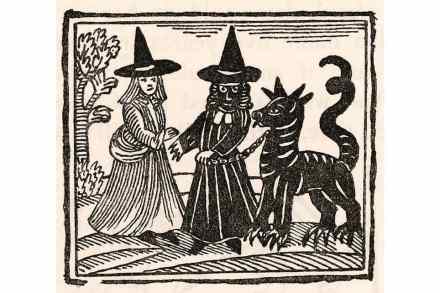
‘Witch-hunt’ has become a handy metaphor for online persecutions, especially of women, though these days it is reputations that go up in flames rather than bodies. The mob mentality behind the phenomenon may not have changed as much as the medium or the mindset. In retelling a celebrated case from Elizabethan England, Jill Dawson enters thoroughly into her characters’ religious world view, while giving a meaningful glance at the issues of today. The fate of the Warboys witches – three members of one family – was recounted in prurient pamphlets of the time, but Dawson colours in the crude woodcut of history with passionate emotions and plausible motivations.

Hex appeal: the rise of middle-class witches

From our UK edition

In King James VI of Scotland’s Daemonologie, written in 1597, he vigorously encourages witch-hunting and, in particular, the tossing of witches into the sea. Only the innocent would sink. As a way of identifying witches, it was clear and presumably efficient. These days, we have no such clarity. But witches walk among us. I’m not talking about women in black pointy hats, but something far scarier: the middle-class witch. In the past, she might have been called a depressive, a spinster or a divorcée. Now, she’s probably a middle-aged woman in the Home Counties with a TikTok account, a litany of spells and deep trauma. Modern witchcraft has always invited confusing cliches. Blame L. Frank Baum.

A season of strangeness: The Hounding, by Xenobe Purvis, reviewed

From our UK edition

‘Summer was the season of strangeness,’ muses Temperance, the barmaid at Little Nettlebed’s only alehouse. ‘People behaved peculiarly then.’ Temperance’s aside anchors the dramatic irony at the heart of Xenobe Purvis’s debut novel The Hounding, set in an 18th-century Oxfordshire village in the grip of a drought. In the villagers’ eyes, through which much of the story is told, this strangeness starts with the Mansfield sisters, five orphaned girls leading a reclusive life on a farm across the river, in the sole care of their blind grandfather, John. The girls’ free manners, in flippant disregard of the era’s orthodoxies, fill onlookers with mistrust.

Vampires, werewolves and Sami sorcerers

From our UK edition

I have to be honest: I’ve never been much concerned with what happened in the Grand Duchy of Lithuania in 1387. I suspect that may even be true for many Lithuanians. In Silence of the Gods, Francis Young pinpoints this year – of the conversion of the duchy to Christianity – as the official triumph of Christianity in Europe over paganism and idolatry. But he then goes on to examine the debris – and the survivors of paganism and their traditions in the northern regions of Europe. The first difficulty is defining and identifying paganism. The book is published by Cambridge University Press, so there is an unmistakably academic, seminar-ready, conference-hardened edge to the text.

A warm welcome in Salem from women and witches

Pulling up at Marblehead’s Harbor Light Inn, my oldest friend and I wasted no time securing two counter seats at the Tavern tucked inside. A Christmas tree twinkled incongruously as we planned the hallowed pilgrimage most travelers reserve for spooky season: the next day we’d make the twenty-minute drive to Salem, the scene of the infamous witch trials of 1692. Peeling ourselves away from this glorious little seaside B&B, replete with canopy beds and resplendent fireplaces, would be harder than expected. “Excuse the smell! We’ve been baking all day,” said general manager Carolyn as we caught a waft of banana bread.

Mysteries and misogyny: The Empusium, by Olga Tokarczuk, reviewed

From our UK edition

Nothing is ever quite as it seems in the world of Olga Tokarczuk. Her latest novel starts with an epigraph taken from Fernando Pessoa: ‘The visible world goes on as usual in the broad daylight. Otherness watches us from the shadows.’ Wild deer were murder suspects in her surreal and beautiful 2018 novel Drive Your Plow Over the Bones of the Dead. This time nature itself plays a significant role. A daily glass or three of schwarmerei restores good cheer, sometimes generating hallucinogenic euphoria Though the novel describes itself as ‘a horror story’, it’s more a salutation to the power of the natural world and a celebration of difference.

Witchcraft is not Gen Z’s new religion

Everyone’s ringing the alarm bell: is witchcraft the new religion for Gen Z? If #WitchTok, the named used to describe witchy content on TikTok, is any indication — no. #WitchTok is a digital fortune-teller; it’s a place to find aesthetic inspiration; it’s sometimes a stand-in for political engagement. For some, it’s even a hobby. But it’s not a replacement for religious faith. On TikTok, witchy content falls under three broad categories. There is predictive content like tarot card readings, manifestation instruction and “good luck” videos, and there’s #WitchTok. The first two categories of video almost exclusively cater to people who are looking for something — usually good news.

witchcraft

Accusations of racism have lost all meaning

From our UK edition

The War on the West is Douglas Murray’s latest blast against loony left wokery, chiefly in the areas of race and ‘social justice’. ‘This is not like earlier wars,’ he writes. ‘It is a cultural war, and it is being waged remorselessly against all the roots of the western tradition and against everything good that the western tradition has produced.’ The meticulous, measured way that Murray presents his arguments and evidence suggests a man who knows he’s in for a lot of flak. For instance, he has the audacity to suggest that the death of George Floyd, however brutal and inept the policing, doesn’t actually bear any signs of racism.

Mass hysteria in Massachusetts: the 17th-century witch crisis in America

From our UK edition

One September day in 1649, in the frontier town of Springfield, Massachusetts, Anthony Dorchester returned from church to the house he and his wife shared with a couple called Hugh and Mary Parsons. He went to check on a cow’s tongue he was boiling for dinner but to his surprise it wasn’t in the pot. He searched high and low but couldn’t find it. Mary told him that her husband had sneaked off mysteriously on the way to the meeting house and was now nowhere to be seen. Given that the two men had argued about possession of the tongue, the obvious conclusion would surely be that Hugh had stolen it. But for Dorchester and his neighbours a more plausible explanation was that Hugh had made it disappear through the ‘juggling’ of witchcraft.