Wine

The world is a mess. Why not find escapism through wine? 

From our UK edition

In most children’s stories, the good characters live happily ever after. Works suitable for older readers tend to greater realism. Even ‘Gaudeamus Igitur’, that most joyous of drinking songs, presses the case for carpe diem. ‘Get stuck in to your pleasures laddie,’ it seems to be saying, ‘before it is too late.’ With the world in such a mess – less carpe diem than dies irae – the case for a vinous route to escapism might seen persuasive. Housman seemed to think so. ‘Could man be drunk for ever,’ starts one poem, then all would be well. Not for long. ‘But men at whiles are sober/ And think by fits and starts/ And if they think they fasten/ Their hands upon their hearts.

New wines from Devin Nunes

What’s the next big thing in California wine? Everyone knows about the great Cabernets and Chardonnays of Napa. Most people would say that Sonoma is a close runner-up, with some excellent Cabs and Chards and Pinot Noirs, especially in the Russian River Valley. There are Zinfandels, the original plus-size wine, which is the sort of thing people like who like that sort of thing. But let’s travel south to the Central Coast, between San Francisco and Los Angeles. There is plenty of good (if not great) Cabernet and Chardonnay there as well. But the region is perhaps best known for Rhone-style, Syrah-favoring wines. Get ready for something new: some luscious red wines built largely around Touriga Nacional and Tinta Cão, two of the grapes used to make Port in the Douro region of Portugal.

nunes

It’s time to take Italian wine seriously 

From our UK edition

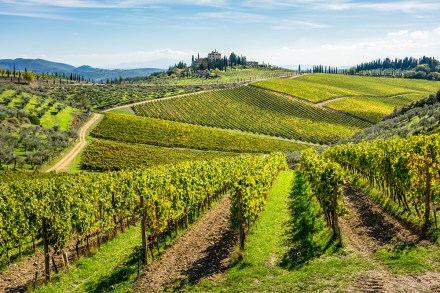
Tuscany: earth has not anything to show more fair. The landscape is charming. The gentle hills seem to smile down upon humanity. The inhabitants give the impression that they were already civilised when we British barely had enough woad to paint our backsides blue. There are also the grapes. From early on, Tuscany sent its vinous plenitude to Rome. Today, it still does, and to Orbi as well as Urbi. There was a time when Italian wine was not taken seriously in the world, and Italians themselves seemed to concur with this patronising assessment. That is no longer the case. One of the most interesting intellectual disputes in vinous matters now concerns Italian wine. There was a time when Italian wine was not taken seriously.

Tories know how to find themselves a good drink

From our UK edition

I feel old, and feelings are not always wrong, This eheu fugaces mood came on me at the Conservative party conference in Manchester. I realised that it was 46 years since I first attended this gathering, before the present Prime Minister was born and when his predecessor was barely old enough for Father Christmas. The trouble is that she still believes in him. Jeroboams loves nothing more than finding small growers who produce good bottles There have been changes in the near half-century. In the old days, the conference hotel was dominated by knights of the shire, or the grander esquires of the suburbs. They were all at least 55 and identically attired. If it was not Savile Row and Lobb it was something similar and almost as expensive, with a hint of eau de cologne grand cru.

Champagne and America is a love story without end

From the beginning, Champagne has never been just a drink, or a region: it’s a celebration, an occasion, a trophy, a reward; a symbol of joyful decadence and glamorous debauchery; the overflowing drink of the American Dream. In short, it’s a boozy cheat sheet for the zeitgeist and the anxieties and dreams of the people who sip it. And, for the past seventy-five years or so, that zeitgeist has been driven by the United States. “American culture pervades everything,” says Christian Holthausen, a dual French-American citizen and founder of the Paris-based Champagne consulting firm Westbrook Marketing Partners. “Driving through Paris just now, I saw a Coca-Cola machine on one street, and a billboard for Apple on the next.

champagne

Why dry Sauternes are the next big thing

It is my sense that the popularity of sweet wines like Sauternes, Port, Tokaji and all the German Auslese wines is on the upswing. I am here to tell you about the Next Big Thing: dry Sauternes. Yes, that’s right: dry Sauternes. The supersnazzy, superexpensive Château d’Yquem is the only Sauternes to boast the designation “Premier Cru Supérieur” from the 1855 classification of Bordeaux wines. That exclusive label — along with the probably apocryphal but oft-repeated story that Michel de Montaigne, born Michel Eyquem, had something to do with the property — helps account for its astronomical price. But Yquem has been making a blanc sec since 1959.

It’s always Chablis weather

It is very hot here in New England at the end of July. It was hot a week or two ago in old England, too. I arrived in London via the Eurostar after a week clambering over rotting German gun emplacements and gazing out at the D-Day beaches in Normandy. Sobering. In London, I had taken a small house in a quiet mews in Kensington. After a quick shower, my first act was to nip down to the local Oddbins and collar a couple of bottles of the 2022 Maison Dousset Chablis. It is about £20 (you can get it in the States for around $20-$25), and it was the perfect entry wine. Chilled, it was tartish, citrusy, refreshing: a confident but undemanding tipple.

chablis

The beauty of a serious Burgundy

From our UK edition

It was the English summer at its most perverse. We were drinking Pimm’s while hoping against hope for better news from Old Trafford. As the clock ticked and the rain was unrelenting, one of our number emitted a groan which seemed to start from his boot soles. ‘Why can’t there be a bit of global warming in Manchester?’ The girls were growing restive. ‘I can just about put up with you lot discussing cricket, but not if it’s an excuse to talk about the weather’ was one eloquent complaint. A fair comment, so we changed the subject, while keeping a surreptitious weather eye on Manchester. All unavailing. The caravan of tension now moves on to the Oval. How much more can the human nervous system endure?

David Bruce, a doctor in the vines

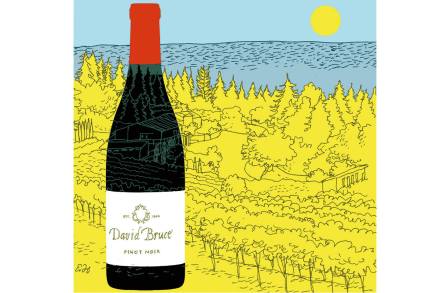
Every good vintner deserves a good origin story. David Bruce, the founder of the eponymous winery in the Santa Cruz hills, has one of the best. When he was at medical school at Stanford in the 1950s, he chanced upon Alexis Lichine’s classic book The Wines of France. Lichine said some fancy and evocative things about the great wines of Richebourg in Burgundy. Bruce padded down to a wine shop in San Francisco and collared a bottle of 1954 Domaine de la Romanée-Conti Richebourg. “The minute I opened this bottle of wine,” he recalled, “the whole room was pervaded by this floral, spicy aroma.” Here’s the kicker: “I remember thinking, I guess you get what you pay for.” Oh yeah? He paid $7.50 for the bottle.

David bruce

Road trips out of Lisbon: a slice of tranquilidade

Forget Barcelona. Say sayonara to San Fran. And so long, London. Post-Covid, Lisbon has become a hub for the creative, hungry and cosmopolitan. A throng of new restaurants, wine bars and buzzy co-working spots has formed a playground for the young and ambitious.  They’re squeezing every last drop out of their free time, too, joining the tourists in thumping nightclubs before escaping to beautiful  beaches. But plenty of weekend visitors don’t know (or have time to discover) that the city is flanked by bucolic countryside, dotted with world-class hotels and agriturismos. A forty-minute drive can take you to pristine white sands, enchanting pine forests, retro beachfronts and sprawling national parks. Next time you’re in town, tack a road trip onto your city break.

road trips lisbon

Where to drink Tuscany’s finest summer tipples

From our UK edition

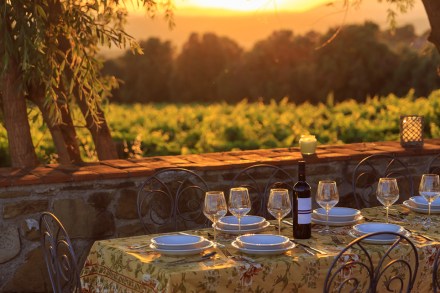
Some subjects invite an eternal recurrence. One such is Tuscany. The other day, I wrote about that glorious region: its mastery of la dolce vita, its almost effortless command of civilisation. Indeed, Tuscan civilisation is a tautology. Since then, I have paid a brief visit. There was only one shadow. How can one find the words to equal the subject matter? Wine was produced here long before we Brits had even discovered woad My host was Grahame McGirr, a successful banker who has always been fascinated by wine, which led him to buy a vineyard near Monte-pulciano. I commented on some of his wines after a tasting in London. They were impressive: promise, stimulated by ambition. He pressed me to report on the promise in situ – the things one does for friends.

The insidious creep of plastic glasses

From our UK edition

It was the afternoon of the first day of the second Ashes test at Lord’s. In the brief lull between overs, the camera panned, as it often does, to a recognisable face in the crowd: Jacob Rees-Mogg. The traditionalist Tory presented exactly as you’d expect: Savile Row suit, tie and cufflinks. But there was one wrong note: he was drinking from a plastic glass.  Say what you like about Mr Rees-Mogg – and people do – but one attribute that I think we can all agree he possesses in abundance is that he’s in touch, almost viscerally, with his own sense of how things should be done. And this sense, as I perceive it, would very much preclude drinking from a plastic cup.

What’s so super about Super Tuscans?

From our UK edition

In Fellini’s La Dolce Vita, the hopes embodied in the title dissolve into grimness and black irony. It was all Mussolini’s fault. Despite the endless opportunities Italy offered for enjoyment, Fellini never trusted his own country, or his countrymen. He could not relax into dolce far niente. For decades, many Italian wine-makers churned outa mass-market product to sell cheaply Perhaps he should have spent more time in Tuscany, surely the most civilised region on earth. Venice may claim to be La Serenissima, but among Tuscany’s gentle hills, hill villages and glorious cities, nature and man are in a harmony so serene that one can almost hear the music of the spheres.

The 10 best wines for a summer barbecue

From our UK edition

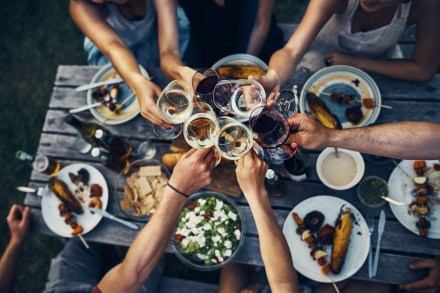
The days when ‘barbecue’ meant a lukewarm beer, bun and burger are long gone.  We’re putting more effort than ever into our outdoor dining – from whipping up zingy marinades with ingredients you’d barely heard of five years ago to diligently waiting for that perfect halloumi char.  All this extra effort on the food front surely warrants some attention to your drinks choices, too. Here are the ten best wines to whip out for a summer barbecue – and the foods to pair with them.  A Growers Touch Durif 2020 Wickhams, £12.20 (or £10.

A drinker’s diary

It is a crisp, beautiful spring day as I write. The air is light and clear. The skies are a color I have always thought of as Virgin Mary blue, punctuated here and there by attractively arranged puffs of clouds at their whitest and least threatening. The greens of the verdure are at their most flashing and emerald-like. That freshness will be enveloped by summer fullness by the time you read this, a contingency that makes me conclude that something like an abbreviated wine-diary — some of what Kimball drank during the month of May — might appeal to the connoisseurs and aficionados of the column. Let’s start at the tip-top.

wine drinkers diary champagne

The beauty of rosé and roses

From our UK edition

What an idyllic setting. We were amidst the joys of high summer in England, with just enough of a breeze to save us from the heat of the sun, and the further help of a swimming pool. Water without, wine within. We were also surrounded by roses, England’s flower, luxuriating in their beauty and innocence. Experts have applauded my friends’ rose-husbandry. It seemed to this non-expert that they have not merely created a good rose garden; they have triumphed with a great one. Yet other thoughts intruded. Godparents are supposed to abjure the devil. Might Satan not sue for breach of contract? Roses makes one think of Henry VIII. I have recently been reading C.J. Sansom: so much better than Hilary Mantel. His Henry is wholly convincing as a study of corruption and evil.

The Britishness of Bordeaux

From our UK edition

Burgundy or Bordeaux? We were discussing that unending question during dinner over the weekend. I think that there is only one answer: ‘Yes.’ ‘But which, you clot?’ ‘Either. Better still, both.’ It is so much a matter of sentiment, and of which great bottle you have been lucky enough to drink most recently. But there is an argument, which is nothing to do with quality, that Bordeaux – claret – is more British. This is as true in North Britain as in England. There are various versions of a well-known piece of doggerel. My favourite is: ‘Proud and erect the Caledonian stood / Auld was his mutton but his claret good.

What to do when you only have modest wine on hand for a decorous guest

So, I’ve have been rooting around in Horace’s Epistles, which are full of amusing things. They really are not “epistles” in the conventional sense, since they were make-believe letters, artfully wrought jebux d’esprit that employ the convention of addressing a friend in order to entertain not (or not only) that friend (who may or may not exist) but one’s readers. Horace wrote two books of Epistles, one circa 21 BC when he was in his early forties, one a decade later, a few years before his death in 8 BC at the (it seems now) tender age of fifty-six. One that caught my eye when sitting down to write this column was Epistle 1.

horace

Tinta de Toro: the Spanish red that helped Columbus make waves

From our UK edition

I am assured that this is not a legend. But a few years ago, an Irishman’s life was twice saved by a raging bull. The Irish fellow was running with the bulls at a town near Pamplona. He tripped and was virtually impaled. The bull’s horn went into one side of the chap’s stomach and out of the other. He was rushed to a neighbouring hospital, which was accustomed to bull wounds, and the surgeons saved his life. While they were doing so, the aeroplane that he should have been catching took off. There were no survivors. Fifteen years later, the Irishman developed gut rot. One doctor wondered whether scar tissue from the horn wound might be causing the problem. So the patient was opened up. Scar tissue was indeed present and was excised, as was pancreatic cancer at a very early stage.

The Loire Valley is the place for bargain hunters

North of Cognac and Bordeaux, due west of Burgundy, the valley of the Loire River, attended on the second half of its journey east by the Cher River, stretches from the Pays Nantes and the Atlantic Ocean to Orléans in the heart of France. It is not quite right to say that this area is like Hamlet’s “undiscovered country from whose bourn no traveler returns,” but it’s my sense that Americans tend to overlook it in favor of its flashier neighbors. This is a pity, not only because the Loire Valley boasts lots of excellent wine, but also because the region still offers many conspicuous bargains, something you will look long and hard for in Bordeaux or Burgundy.

loire