Wine

The green, green wines of Portugal

If I am going to talk about summer wines, I am going to have to introduce you to Gaius Plinius Secundus, known to us as Pliny the Elder. Pliny was a busy chap. Army commander and admiral in the Roman navy. Gourmand. Pal of the emperor Vespasian. Pliny did not have writer’s block. He published the first 10 books of his sprawling Historia Naturalis in 77 AD. Despite its title, the book is about a lot more than natural history. Really, it is a sort of proto-encyclopedia. Pliny hadn’t finished revising the rest when he went to investigate the strange things that were happening down at Mount Vesuvius in 79. He died in the conflagration. The chap we know as Pliny the Younger — the elder Pliny’s nephew and heir — was with him.

vinho verde green

My ongoing war with the ‘vinfluencers’

‘Slut-shaming’, ‘sexist’, ‘garbage writing’, ‘offensive towards women’, ‘aggressively distasteful’, ‘nipple-ist’ ‘old bitch’ that I am, I stand by the article I wrote in the April issue of The Spectator about influencers and the social-media celebrities who use their looks to sell wine — despite the outrage of those who are so clearly and irreparably under the vinfluence already. My take on the new advertising powerbase that is ‘influencing’, and the media-doping tactics that are often used to gain that influence, remains the same.

Vinfluencers

Pahlmeyer’s proprietary perfection

When Jayson Pahlmeyer left the practice of law in the mid-1980s in order to devote himself to winemaking, he said, ‘All I wanted to do was to create my own “California Mouton” — a rich, powerful Napa Valley Bordeaux blend, a wine that would drop wine lovers to their knees.”’ He did it in 1986, the first vintage of his Proprietary Red, a luscious Cabernet blend that won plaudits throughout the world of wine. Pahlmeyer’s Merlot and Chardonnay have been similarly decorated, and I may return to them in a future column. For now, I want to focus on the Proprietary Red.

Pahlmeyer

A tale of two tapas

In 146 BC, Scipio Aemilianus laid siege to and destroyed the city of Carthage, thus bringing the third Punic War to an end. Scipio made a gift of what remained of the Carthaginian library to the kings of Numidia, Rome’s old ally against Carthage. At the direction of the Senate, however, he held back one book, the agricultural treatise of Mago, which he sent back to Rome. It was duly translated into Latin, but all that remains are fragments, which is too bad, for Mago apparently had a lot to say about many exigent matters, including the cultivation of grapes and making of wine. It appears that it was the Phoenician precursors of the Carthaginians who, around 1500 bc, first planted grapes in the Iberian peninsula.

Tapas bar

Thirst trap: how ‘vinfluencers’ took over the wine world

The first time I saw the Instagram feed of Georgie Fenn I thought she was a model stooge. Utterly gorgeous, Fenn regularly poses in carefully picked diaphanous clothing, ‘nipple poke’ a specialty. Paid brand collaborations offer excellent returns. Her artfully shot images tagged with maxims as trite as ‘It doesn’t matter what you’re drinking as long as you’re enjoying it’ are a marketeer’s wet dream. Miss Fenn is an up-and-coming ‘vinfluencer’ — that is, she uses her considerable social media presence (31k and rising @winingawaytheweekend) to sell wine.

vinfluencers

Georgians on my mind

Long before Achilles chased Hector around Troy and Homer wrote about the οἶνοψ πόντος, the ‘wine-dark sea’, people living in what is today the republic of Georgia were making wine. Archaeologists have found evidence of wine making there dating from 8000 BC: an impressive statement to the inventiveness to which necessity gives birth. Stretching from the Black Sea to the Caucasus Mountains, Georgia is home to a wide variety of climates, types of soil and geographical physiognomies. Today it is home to some 500 varietals, few of which are familiar to westerners (even though many if not most western grapes probably have precursors in Georgia and the Black Sea ‘cradle of wine’).

georgian wine

Why Grüner is my go-to

The first person ever to tell me something true about wine was my first real boss, a generous and wise woman who toted me along to the Frankfurt Book Fair with her for several years in my early twenties. At the time I drank mostly sweet red blends that came in denominations of ‘box’ or ‘jug’. When she sensed (or perhaps shared) my fear of humiliating us both when I was asked for my wine order at a long, formal luncheon in a rather famous hotel, she leaned across the many forks of her place setting and whispered to me, ‘Get the Grüner.’ She elaborated that the American white wines I’d had were probably sweet or buttery, but German whites, like dry Rieslings and Grüner Veltliner, were mineral and fresh and lovely. They paired well with all foods.

grüner

The Judgment of Paris

What’s the most famous story about wine in the last 50 years? My candidate is the so-called ‘Judgment of Paris’ of May 1976. It was actually two judgments, one of American and French Chardonnays (the subject of the movie Bottle Shock), the other, more consequential, of American and French Cabernets (well, French Bordeaux, which are predominantly Cabernet). The competition was organized by Steven Spurrier, now one of the world’s most renowned wine connoisseurs, then a 35-year-old British bundle of energy who in 1970 had moved from London to Paris and acquired a small wine shop off the Rue Royale.

paris

Nietzsche and Wagner

Before he was a celebrated travel writer, Patrick Leigh Fermor (who died in 2011 at 96) was a celebrated special operations soldier. In February 1944 he commanded a raid to kidnap General Heinrich Kreipe, the newly installed German commander of Crete, and take him to Egypt. Leigh Fermor, his fellow officer William Stanley Moss and three members of the Cretan resistance commandeered the general in his car and made a daring trek across the island pursued by the German occupiers. They spent one chilly night on the slopes of Mount Ida.

wagner

Wines of turkey

Thanksgiving is probably my favorite holiday, and not only because it offers an excuse to dine lavishly among friends. It also provides an occasion to live up to its name and give ourselves the pleasure of correcting Aristotle. Man, the old Greek said in a distracted moment, is the rational animal, ζῶον λόγον ἔχον. Clearly, what he meant to say is that man is the ungrateful animal, ζῶον αχαριστίαν ἔχον. Since Thanksgiving is all about enumerating one’s blessings, it is one of those rare opportunities in which everyone’s favorite pastime, virtue-signaling, can be indulged while thoroughly enjoying oneself.

turkey thanksgiving

How to spot good French wine

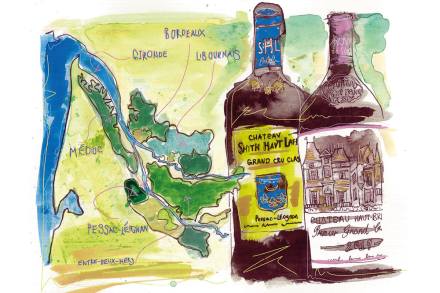
‘If you swill it around, you look at the legs of the wine — we’re in the Naughty Room, so I’m sorry to talk about legs again!’ exclaims Prince Robert of Luxembourg, alluding to our saucy surroundings. We are tucked away in a bijou risqué room at 67 Pall Mall, a London private members’ club for wine lovers. The Naughty Corner, as it’s known, is adorned with erotic paintings, and a miniature sculpture of a naked man has been turned away from us. While members must be approved, there was little chance of Prince Robert being blackballed. His family owns the French wine estate Chateau Haut-Brion, the oldest of the great growths of Bordeaux.

good wine

Born Toulouse: varietals, vermouth and verse

I like vintners with a sense of humor. When Vern and Maxine Boltz retired — he from the Oakland Fire Department, she from flying the friendly skies of United — they decided to try their hands at making wine. That’s intrepid, not necessarily funny. But in 1997 they found a sweet parcel of 160 acres above the Navarro River in the Anderson Valley of Mendocino County and started planting. ‘Go forth and multiply,’ they said to the grapes and the grapes (Pinot Noir, mostly) did just that. In 2002 they produced 400 cases for sale and Toulouse Vineyards was launched. ‘Toulouse’? Yes, they reasoned, ‘What to do we have to lose?’ Fair warning: their publicity deploys variations of that homophonic witticism early and often.

toulouse

Cellar’s market

I met Kingsley Amis only once. It was in the bar of the Garrick Club at about three in the afternoon. He had clearly been there for some time. I was with a friend who knew him, so cadged an introduction. I cannot say that we had a truly meaningful exchange. More like 1 Corinthians 13:12: ‘through a glass, darkly’. But the encounter did put me in mind of General Principle Number 1 from Amis’s amusing book on drink, candidly titled On Drink. ‘Short of offering your guests one of those Balkan plonks marketed as wine,’ he advises, ‘go for quantity rather than quality.’ If you had asked my opinion about that advice a couple of months ago, I might have demurred.

cellar lockdown billecart

Wine is for lovers: mein Gott and yours

Ovid’s little how-to manual, The Art of Love, is full of good advice. Let’s say you are interested in a girl. Take her to the games. Sit close to her. If a speck of dust falls on her lap, ‘flick it off with your fingers. If none falls, flick off — none.’ The Art of Love is full of such useful tips, elegantly expressed. Practical chap that he was, Ovid knew that even so subjective a pursuit as love could be helped along by the mastery and deployment of certain techniques. Among the many impressed by Ovid’s handbook was the German Renaissance humanist Vincent Obsopoeus. In 1536, he published De Arte Bibendi (The Art of Drinking), an allegro poem deeply inspired by Ovid’s Ars Amatoria.

joel gott cabernet sauvignon

Cab and conversation

This article was originally published in The Spectator’s UK magazine. Subscribe to the US edition here. I had to go to Hillsdale, Michigan, home of Hillsdale College, to make my first visit to Healdsburg, the Sonoma County town that is the epicenter of about 100 California wineries and tens of thousands of vineyard acres. On this first, virtual trip, I dipped my toe into the Alexander Valley, the region north-northwest of Healdsburg. There are more than 40 vineyards in the Alexander Valley and I sampled two of the best, Silver Oak and Jordan. At least since Plato’s Symposium (Greek for ‘drinking party’), it has been understood that the essential accompaniment to wine is not food, though that is nice, but conversation.

silver oak alexander valley

Vintage Brooklyn: the wines of Red Hook

Close your eyes and think about the word ‘winery’. What image comes to mind? I’m guessing you will say, ‘A large stone pile from the 17th century or before surrounded by lovingly tended gardens and row after row of neatly staked vines.’ That is not wrong, but it is incomplete. There are plenty of wineries in France and elsewhere that feature modernist architecture. And there is one in Brooklyn, New York at 175 Van Dyke Street, towards the end of Pier 41 at the old Navy Yard. With a spectacular view of the Statue of Liberty and the New Jersey waterfront, Red Hook Winery — a retail tasting room in front, barrels and vats in the back — occupies a fetching but improbable spot. Red Hook was started in 2008 by Mark Snyder.

red hook winery

California bound

This article is in The Spectator’s February 2020 US edition. Subscribe here. I think it was from the late Roger Scruton, back when he was writing about wine for another magazine, that I learned the importance of being a terroiriste — not, nota bene, a terrorist. That, as Qasem Soleimani learned to his sorrow, is something else entirely. No, what Sir Roger had in mind was the importance of environment to the production of delicious wine. Terroir means the composition of the soil, yes, but it also means so much more. One dictionary sums it up as the ‘complete natural environment in which a particular wine is produced, including...the soil, topography, and climate’.

Award winning bottles of wine

They may take our wine, but they’ll never take our brie-dom

I was poking at a dessicated branzino at the Union League yesterday, half-listening to a schoolmate drone on about international alternatives, when he mentioned off-hand that the United States and France are gearing up for a trade war. Bordeaux could cost a bomb; brie could break the bank. I dare say, it shook me to my coeur. Thank God it’s not Sancerre season. They’re decorating the club for Christmas, so I worried I was delirious from the smell of brass polish. I excused myself and discreetly logged on to see that, alas, the dreadful news is true. It’s bad enough that they’re banning foie gras in New York, which is as civilized as burning churches. Now the feds are getting in on the act too.

wine brie

California drinking: forgive them their granola

This article is in The Spectator’s November 2019 US edition. Subscribe here. Cyril Connolly famously opined that every young man of spirit wants to do two things: start a magazine and start a chicken farm. That’s about half right, I think. It would have been more accurate if he had included a true, if often unspoken, heart’s desire: to be a wine critic. Do you know anyone — anyone you still speak to, I mean — who hasn’t wanted to be one? Every Sunday, my family and I participate in an august ceremony that extols a beneficent God through whose ministrations we accept the gift of vinum...fructum vitis et operis manuum hominum: ‘wine… fruit of the vine and the work of human hands’.

pax mahle california

Why do Americans and Brits write about alcohol so differently?

This article is in The Spectator’s inaugural US edition. Subscribe here to get yours. ‘No nation is drunken where wine is cheap,’ Thomas Jefferson famously said, laying the blame for insobriety firmly on ‘ardent spirits’. The third president was a notorious wine-fancier with a particularly soft spot for Sauternes, yet it is true that countries with a long history of winemaking tend towards more easeful drinking. Despite the ghastly interregnum of Prohibition, America has become a serious wine-producing nation — and yet ardent spirits seem to have left far stronger a mark, on the national mindset and on the nation’s prose.

liquor american alcohol