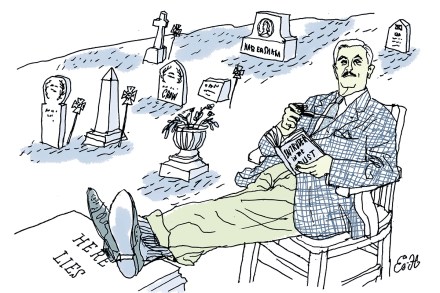
William Faulkner

A sip of the Vieux Carré

It’s 1951 and the Hotel Monteleone burns bright, a gilded island of light and liquor adrift in the New Orleans dark. Inside, the air is thick with the sweet tang of cigar smoke and the murmurs of polished conversation. Over in the Swan Room, the trumpets blare, their brassy notes cutting through the gentle chatter, their absence filled with the lively, gravelly voice of Louis Prima. The crowd sways in rhythm, caught between the pulse of jazz and the flicker of chandelier light. Outside, the French Quarter is still alive.


Vieux Carré

Lorrie Moore explores the thin veil between life and death

Very few of us could evade accusations of pretension if we quoted Faulkner in everyday conversation. The characters conjured up in Lorrie Moore’s fiction are granted an exception, though not always solely by virtue of their earnestness. In her novel I Am Homeless If This Is Not My Home, which traces a journey toward a final burial in the American South, allusion to As I Lay Dying is particularly apt. Moore has made a name for herself as one of America’s masters of the short story, with her inimitable style on display ever since her first work of fiction, “Raspberries,” was published in 1977. In this, her first novel for fourteen years, she once again wields her wordplay playfully and powerfully, striking a balance between levity and gravity.

Moore

Modern English

The English language as written today is often nearly incomprehensible on first reading, and as spoken almost unintelligible and unpleasant to the point where the civilized listener disengages himself in frustration and disgust from the speaker and his speech. The problem in the first instance is the readiness of people who know better to embrace demotic usage in semi-formal literary venues, such as respectable journalism; the second, the bizarre combination of pretension and illiteracy and its results, the jargon and barbarisms ubiquitous in the 21st century.

English

Is caste the American class system?

John Dollard (1900-80), trained in sociology at the University of Chicago and in psychoanalysis at the Berlin Institute, brought the sensibility of a novelist to a five-month study in Indianola, Mississippi, which he wrote up as Caste and Class in a Southern Town (1937). Dollard went south, but what he found applied in the other direction: The ‘caste line is drawn in the North as effectively, if not as formally, as in the South,’ which meant ‘We are still deliberately or unwittingly profiting by, defending, concealing or ignoring the caste system.’ Caste, Dollard argued, had far-reaching implications: ‘Our social system has come under world inspection and is literally being looked at by several billion people or their competent agents.

caste