Westminster

David Amess was killed doing one of the most crucial parts of an MP’s job

From our UK edition

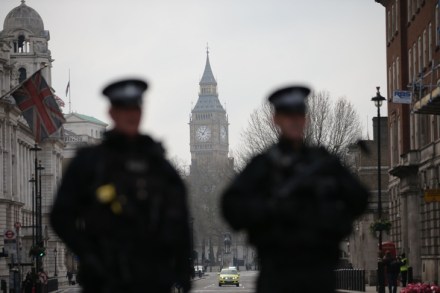
Sir David Amess was killed in the line of duty. He was doing one of the most important – and vulnerable – parts of an MP’s job, and he was killed while doing it. Most of the week, MPs go to work in a palace under armed guard. They live in houses with CCTV, panic alarms and rapid police response mechanisms in case of trouble. These measures have gradually been added to their lives as the perceived threat has increased. But in just over a decade, three serious attacks against MPs have taken place in the one place where they lack such security: their constituency surgeries. Stephen Timms was stabbed at his surgery in 2010. Jo Cox was murdered leaving hers five years ago. Today, Amess was killed at his.

No. 10 director of communications: runners and riders

From our UK edition

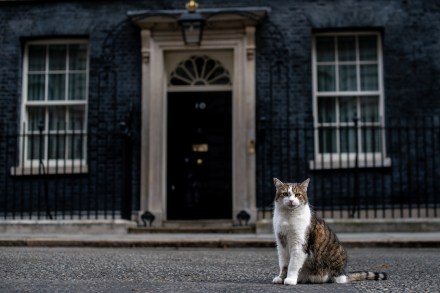
Last month Mr S was first to report that Downing Street veteran James Slack was off to the Sun after four years in No. 10. Slack, who survived the transition from May to Johnson but had only served as Lee Cain’s replacement since January, was well-regarded from his time as the Prime Minister’s official spokesperson and viewed by the lobby as a ‘safe pair of hands.’ Attention now turns to who will replace Slack in the role. Key attributes needed for the role will be the strength to work gruelling 18-hour days, unflappability under relentless questioning about interiors and the experience to manage Westminster’s unruly press pack.

Don’t blame private schools for failing to tackle ‘rape culture’

From our UK edition

The allegations levelled against some of Britain’s top private schools have been deeply troubling. Dulwich College turns boys into sexual abusers, one former pupil has claimed. A ‘dossier of rape culture’ has been compiled by ex students at Westminster School; Latymer Upper School has reported sex abuse allegations to the police. These are just a handful of examples: Everyone’s Invited – an online campaign which invites young people to post anonymous testimonies of sexual assault and harassment – has over 4100 testimonies from girls as young as nine. For teachers like me who have taught sex education to 14 and 15 year old boys, these allegations are shocking but perhaps not surprising.

The dangers of televising lobby briefings

From our UK edition

Like a tongue searching for an absent tooth, I keep wondering if I’m missing anything from my two decades as a lobby hack. Friends, of course, and perhaps the vast, grey field of sloping slate as seen from the Times’s parliamentary office. That empty and silent space, the roof of Westminster Hall, seemed austere and indifferent, a mental refuge from the babble beneath and within. The opposite aspect, towards the crumbling guts of the Palace of Westminster, elicits more complicated memories. I arrived in the press gallery aged 30 to take a job as Westminster correspondent for a clutch of provincial papers. On my first day my new colleagues took me to tea at 4 p.m. in the dining room. There was also a bar with its own barflies and a barman named Clive.

‘I wish her well’: inside Westminster’s secret language

From our UK edition

An Apology An apology is a series of words strung together to absolve one of sins committed in private or in one's professional life, usually uncovered by a newspaper, which allows one to carry on one’s duties as if nothing had happened, and very often to repeat the sins for which one has apologised. It needn’t be sincere — indeed, that is considered rather poor form — and it is only ever to be used as a measure of last resort. If in doubt, simply apologise for how you have made someone feel rather than the action itself.

My run-in with Westminster’s TV news circus

From our UK edition

Leaving an evening meeting in Westminster on Monday night, I walked to Charing Cross. Approaching the public path which runs across College Green by Parliament, I found, as so often nowadays, that it was fenced off to allow those pop-up studios which the big television channels erect to create their instant news circus. Fed up that the normal way was yet again blocked by what Psalm 84 calls ‘the tents of wickedness’, I lifted the barrier open and walked through. Two security guards leapt out of the nearest hut and tried to block me. I pressed on, however, and they could only scamper after me calling out ‘Health and safety! Health and safety!

Britain is following in the footsteps of Africa’s former failed states

From our UK edition

Kenya   ‘In the past months the people of Uganda have been following with sorrow the alarming economic crisis befalling on Britain,’ Uganda’s President Idi Amin telegrammed the Queen in 1973. ‘The sad fact is that it is the ordinary British citizen who is suffering the most… I’m sending a cargo ship full of bananas.’ Back then Fleet Street hooted with laughter at this African buffoon trying to patronise the United Kingdom and its leaders. Yet I wonder what Idi Amin would be able to say about Britain and its leaders today.

The unbearable pointlessness of Parliament

From our UK edition

Christmas books pages usually invite columnists to nominate their publishing event of the year. Well, here’s a corker: The Ties that Bind: Citizenship and Civic Engagement in the 21st Century, published by the House of Lords Citizenship and Civic Engagement committee. That obscure body has 12 members and takes itself seriously. The Ties that Bind was the fruit of hearings it held into ‘civic engagement through the prism of the civic journey each one of us who lives in Britain will undertake’. Its 168 luxuriant pages of red and black print, published ‘by the Authority of the House of Lords’, has nine chapters, bullet points, footnotes, boxes, appendices and a further wodge of evidence online.

Paper chasers

From our UK edition

Christmas books pages usually invite columnists to nominate their publishing event of the year. Well, here’s a corker: The Ties that Bind: Citizenship and Civic Engagement in the 21st Century, published by the House of Lords Citizenship and Civic Engagement committee. That obscure body has 12 members and takes itself seriously. The Ties that Bind was the fruit of hearings it held into ‘civic engagement through the prism of the civic journey each one of us who lives in Britain will undertake’. Its 168 luxuriant pages of red and black print, published ‘by the Authority of the House of Lords’, has nine chapters, bullet points, footnotes, boxes, appendices and a further wodge of evidence online.

Causes without a rebel

From our UK edition

One of the better plays at the National Theatre in recent weeks has been about a 21st-century banker, Judy, who quits her job to become a 1950s-style housewife. In Laura Wade’s Home, I’m Darling, Judy ditches her corporate wardrobe for a kitchen pinny and feather duster. She could have stepped from the Good Housekeeping domestic guide my mother was given after her wedding in 1954. Judy scorns modern technology and she dislikes coarse language. She is, at initial view, a faux-nostalgic figure, to be mocked. Yet the word used for her stance is ‘rebellion’ and by the end of the play she may, to a small extent, have made us re-examine today’s assumptions about work and happiness. Judy, though slightly mad, is fresh.

Theresa May’s Westminster correspondents’ dinner speech: Cameron, Rudd and Press Commissar Milne

From our UK edition

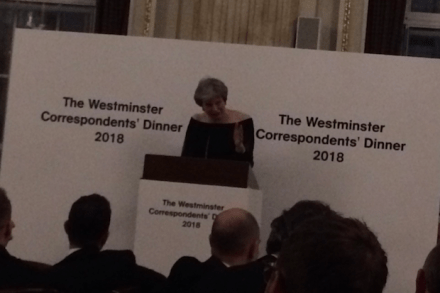
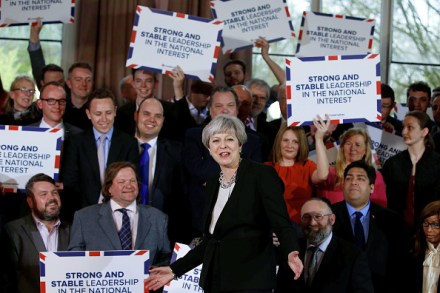
What says ‘Theresa May’ more than a comic speech at a boozy dinner for a room full of journalists? That was the question the Prime Minister found herself asking a room of well hydrated hacks at last night's Westminster Correspondents Dinner. May took a break from the Irish border to regale journalists with a speech poking fun at her former colleagues, current colleagues, the lobby and ... Theresa May. To some surprise, May cracked several – successful jokes. She even found time to praise the Spectator's James Forsyth. Alas, not everyone was in such a jolly mood – Labour's Barry Gardiner was overhead muttering warnings to the press about what will happen to them (spoiler: not good) come PM Corbyn.

The sex scandal is what psychologists call ‘displacement activity’

From our UK edition

There are three reasons why Britain’s political and media world finds itself in the present ludicrous uproar over sexual misbehaviour at Westminster, and only one of them has anything to do with sexual misbehaviour. But let us start with that. And, first, a caveat. Can there be an organisation anywhere in discovered space which, subjected to the intense media scrutiny that the House of Commons now attracts, would not generate a comparable stock of report and rumour? Imagine a workplace — indeed imagine a workplace like our own august Spectator offices – peopled by a lively mixture of creatives, eccentrics, wannabes, rascals, saints, absolute bricks, total pricks and drones.

Sex, truth and politics

From our UK edition

This one goes out to all the male MPs I’ve taken to lunch. I want to apologise to each and every one of you. Some of you know who you are and what went on. Some of you were so tipsy you may not have been fully aware of how shockingly you were being exploited. I estimate there are dozens, if not hundreds, of you whom I’ve taken to lunch, dinner and drinks during my time as a political correspondent. In dark bars and expensive restaurants, or just casually in Commons corridors, I’ve sidled up to you in a designer outfit and pretty much said ‘Howdy, right honourable!’ Look, it was a long time ago and I’m practically an old lady now, in media years.

Tory MP Charlie Elphicke has the whip suspended

From our UK edition

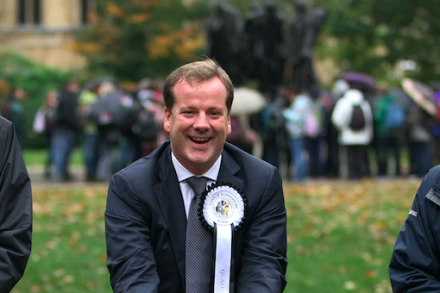
The Tory MP for Dover, Charlie Elphicke, has had the whip suspended this evening. In a statement the new chief whip Julian Smith says that this follows ‘serious allegations that have been referred to the police’. In response, Elphicke has tweeted that the party tipped off the media that he was having the whip suspended in advance of telling him. He continued, ‘I am not aware of what the allegations are and deny any wrongdoing’. There are allegations against other MPs in the papers tomorrow. Clive Lewis has been accused of groping a woman at Labour conference this year. He strenuously denies the allegation, telling ITV’s Paul Brand that his accuser is either ‘mistaken’ or ‘lying’.

The Michael Fallon story distracts from more serious allegations of Westminster sleaze

From our UK edition

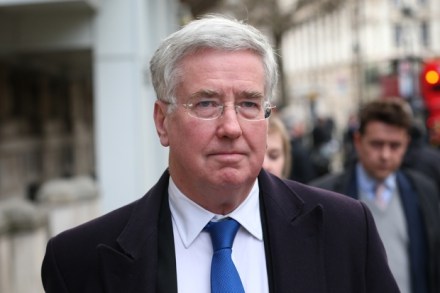
The Westminster sleaze row shows no signs of dying down with today's papers filled with more tales of MPs behaving badly. The Telegraph warns that the Parliament sex scandal ‘could be worse than expenses’ – reporting that two female staff stopped working for a minister over claims of inappropriate behaviour. Meanwhile the Sun leads on Michael Fallon's admission that he once touched a female journalist's leg. That journalist – Julia Hartley-Brewer – has since come forward to say that she does not count the incident as harassment.

Why the Westminster ‘sex pest list’ has existed secretly for so long

From our UK edition

Westminster is agog with whispers about who the Tory MPs are on a list of men and women alleged to be guilty of inappropriate sexual behaviour, sexual harassment and worse. Some names have been circulating for years, with many women across the Parliamentary Estate saying they have their own story about this MP or that minister. So why is it only now that there’s a threat to make the list public? The Harvey Weinstein allegations have prompted women - and men - in every industry to realise that they don’t have to just grin and bear bad behaviour as though it’s just an unfortunate side-effect to having your dream job.

Terrorism teaches a lesson that some still refuse to learn

From our UK edition

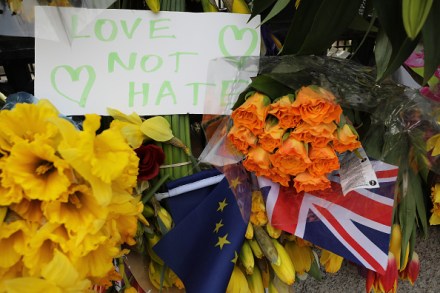
Another knife-attack was thwarted yesterday in Westminster. Overnight there were anti-terror raids in Kent and London. These were unconnected, but police say that they have foiled an ‘active terror plot.’ All this will blend into the background soon, as much as last month’s attack in Westminster already has. Not because we don’t remember anything, but because we never learn anything. After last month’s attack in Westminster there seemed to be an even more concerted effort than usual to say that the perpetrator – a Muslim convert called Khalid Masood – probably suffered from some mental illness, was a mere madman, criminal or drug addict.

Man arrested in Whitehall on suspicion of terrorism offences

From our UK edition

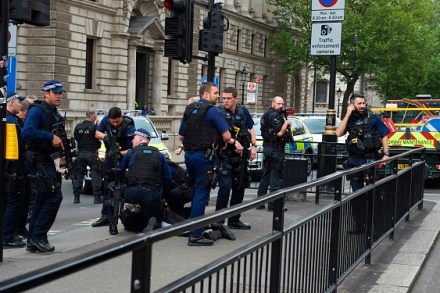
A man in his late twenties has been arrested on Whitehall today and is being detained under the terrorism act. The BBC are reporting that the man was known to the police. Photos from the scene appear to show a knife on the ground. The police are saying that following this arrest there is no immediate known threat. There doesn’t seem to be any particular concern inside the Palace of Westminster; everything here seems pretty calm right now. But, obviously, following the appalling murder of PC Palmer and four others just over a month ago there is a heightened sense of the risk of a low-tech terrorist attack. It is important, though, that life continues as normally as possible. After all, one of the aims of terrorism is to disrupt our way of life.

There is something grubby about Theresa May’s snap election

From our UK edition

Since I suggested last July that Theresa May, newly anointed as leader of the Conservative and Unionist party and Prime Minister of the United Kingdom of Great Britain and Northern Ireland, should call an election to both establish her own legitimacy and allow the country an argument over the kind of Brexit it preferred, it would be unseemly to now deplore her belated decision to go to the country.  Happily, there remain many other things that may be deplored. Far from the least of these is the manner in which the Prime Minister has made her case for an election. It’s not her fault, you see, that she has (correctly, in my view) gone back on her word. She remains a pretty straight kinda gal, you know.

When our armed police open fire have we got their backs?

From our UK edition

I walked past Parliament, five days after Khalid Masood’s fatal attack. I looked at all the armed policemen on all the gates visible to the public. All were talking to one another rather than surveying the scene in front of them. As I write, the only person, so far as we know, being actively investigated by the authorities for his part in the events of last week is Sir Michael Fallon’s close protection officer, who shot Masood dead. Under our rules, it is automatic that the Independent Police Complaints Commission investigates any officer who shoots anyone. It is hard to know whether to admire this as a mark of civilisation or gasp in exasperation.