Vaping

The disposable vape ban has changed nothing

From our UK edition

I felt a mixture of annoyance and relief when I bought my first non-disposable Elf Bar last weekend, ahead of the disposable vape ban. Relieved, because to all intents and purposes, the new vape is identical to the old one. It looks the same, tastes the same and costs the same. The only difference is that when you give it a tug, a ‘reusable’ pod slides out. Annoyed, because after all the fuss over the ban over the past few years – panicked headlines, furious parents, relentless lobbying – vaping is effectively unchanged. What a waste of time and energy. In the next few days, a third emotion started to creep in: fear. I can’t be the only one to have noticed that the new vapes are just as delicious and, in practice, as disposable as the old ones.

Exploring the rise of vaping

For those of us with a poor grasp of time, who can still recall when a night at the bar could be sharply revisited by a Proustian wave of stale smoke arising from yesterday’s clothes, it can almost feel as if vaping crept up on us out of nowhere. One moment, it seemed, all the authorities had firmly agreed that pushing for vaping was creepy, and were pledging to legislate and tax cigarettes into oblivion; the next, great hordes of schoolchildren were apparently free to suck constantly on little vials of liquid nicotine with sugar-rush names such as Cherry Fizzle and Blue Razz Lemonade. What happened?

vaping

How we became addicted to vaping

From our UK edition

For those of us with a poor grasp of time, who can still recall when a night at the pub could be sharply revisited by a Proustian wave of stale smoke arising from yesterday’s clothes, it can almost feel as if vaping crept up on us out of nowhere. One moment, it seemed, all the authorities had firmly agreed that Nick O’Teen was a creepy pusher hooking innocent kids on gaspers, and were pledging to legislate and tax cigarettes into oblivion; the next, great hordes of schoolchildren were apparently free to suck constantly on little vials of liquid nicotine with sugar-rush names such as Cherry Fizzle and Blue Razz Lemonade. What happened?

Juul developing age-restricted e-cigarettes

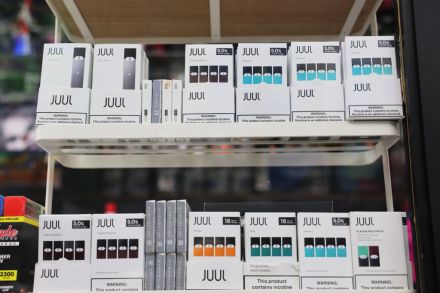
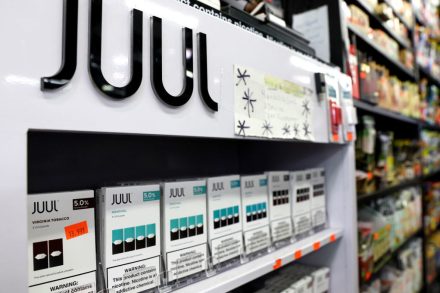
Juul, the once dominant e-cigarette company, is back with a new proposed product that it hopes will rescue it from the brink of bankruptcy: age-restricted vapes.   In their attempts to make smoking less accessible for minors, the company is prepared to make the simple pleasure a pain for everyone. Users first must buy a new e-cigarette that pairs with a phone app. They will then upload their government ID or a real-time selfie to the app and have a third-party database verify their identity. A unique Pod ID chip within the Juul device will detect counterfeit cartridges made by other companies, who have flooded the market with illegal fruity flavors that appeal to minors. To further combat the problem, the new device only comes with just one flavor—Virginia Tobacco.

juul

A condensed history of ‘vape’

From our UK edition

Last year, Oxford Languages’ word of the year was goblin mode. Apparently 300,000 voters decided upon it, but I haven’t heard anyone use it. It rocketed into view after someone posted online a fake headline about the break-up of Julia Fox and Kanye West after a month together. ‘He didn’t like when I went goblin mode,’ it read. Fox later made it clear she had said nothing of the kind. It means ‘self-indulgent, lazy, or greedy behaviour that rejects social norms’. I suspect goblin mode is a vogue term that will disperse like the morning mist. Talking of mist, vape has made another advance in establishing itself in the language. The Local Government Association has called for disposable vapes to be banned by next year.

The environmental cost of vaping

From our UK edition

A few months ago I wrote a piece for The Spectator about the surge in popularity of Elf Bars and the potential health risks of these colourful e-cigarettes. But disposable vapes are now posing a different kind of problem – for the planet.  These single-use devices, which last for around 600 puffs, head straight to landfill after users suck out their smoke. The vapes which don’t make it to the dump can be found lining the gutters of our cities, having been cast aside. In Britain an estimated 4.3 million people use vapes today, up from around 800,000 a decade ago, according to YouGov data.

The real reason for Biden’s war on Juul

I was in a South Carolina dive bar, the type recent graduates cheekily show off to the parents who subsidized their six-figure educations. I stepped into a courtyard — for even the states tobacco built have banned indoor smoking — and was greeted by thick plumes of poisoned air. Those shades came from manicured hands holding glorified USB memory sticks, not the fingers stained yellow by 70-millimeter Marlboros. I gathered with the only people holding the latter — a bar manager and pair of fathers no doubt looking to calm the nerves after realizing this is what they took out a second mortgage to pay for.

smoking juul e-cigarettes biden

The dangerous rise of Elf Bars

From our UK edition

Have you seen the colourful sticks with blue lights hanging out the mouths’ of most teens and many adults? Elf Bars are the colourful and sweet disposable vapes causing a wave of dependence across all age groups.    While the government is looking to rid the nation of tobacco smokers, electronically delivered nicotine is becoming a new frontier.   People who have not smoked before are getting addicted to Elf Bars. And ex-smokers are turning back to cigarettes to wean themselves off the potent pens.  Costing between £4 and £12 depending where you buy them — they are cheap. Watermelon, Grape, Cola and Cotton Candy are a few of the 28 flavours on offer, and each user knows the flavours they love and the flavours they hate.

The WHO’s bizarre war on e-cigarettes

From our UK edition

When the COP26 climate change conference hits Glasgow at the end of October, the media will be out in force to discover how world leaders are going to meet their ambitious carbon emission targets. It will be on the front pages. Edited highlights will be on television. Boris Johnson and Nicola Sturgeon will be elbowing each other out of the way to get in the limelight. Extinction Rebellion will be performing their doomsday japes outside. But when COP9 begins in November, few will notice. Admittedly, this event is being held online this year, but it would have flown under the radar even if it had been held in the Hague, as planned. It always does. Like COP26, it is a United Nations conference, but that is where the similarities end. You probably haven’t even heard of it.

Beware the COVID-19 nannies!

COVID-19 has suddenly made much of the western public health establishment effectively redundant. Unused to dealing with infectious disease, we have a legion of epidemiologists who have never studied an epidemic and a horde of public health professionals who are more comfortable discussing soda taxes than virology.If you’ve spent your career believing that drinking, smoking and obesity are the real epidemics, a potentially fatal virus forcing billions of people into hiding could make you question your priorities. But if the nanny state lobby was disoriented at first, it has quickly learnt to adapt. The public are temporarily willing to sacrifice a bit of liberty for safety and the lifestyle regulators sense fresh opportunities.

jerome adams nannies

How many Britons now vape?

From our UK edition

Talking Turkey David Cameron again accused the Leave campaign of ‘lying’ about the prospect of Turkey joining the EU. A reminder of what he himself has said on the subject: — ‘I’m here to make the case for Turkey’s membership. And to fight for it… I will remain your strongest possible advocate for EU membership and for greater influence at the top table of European diplomacy.’ (Speech to Turkish parliament, 2010) — ‘In terms of Turkish membership of the EU, I very much support that. That’s a longstanding position of British foreign policy which I support. We discussed that again in our talks today.

Dispersing the clouds of the vape panic myth

The Great American Vaping Panic is reaching its ghastly conclusion. As I write this, five people have died in hospital and the Food and Drug Administration (FDA) is investigating 450 reports of people going into seizures after vaping. Politicians are demanding a renewed clampdown on an e-cigarette industry that was being blamed for a youth ‘tobacco epidemic’ long before these events unfurled. The market leader, Juul, is under investigation by the FDA, its products are banned in the company’s hometown of San Francisco and it may not be long before they are banned nationwide. Moral panics rarely come out of nowhere and there is a grain of truth in this one. Dozens of people, mainly young men, have been hospitalized after vaping in recent weeks.

vape

Dear Mary | 24 January 2019

From our UK edition

Q.A senior colleague, on discovering that I’m a friend of someone who has become quite famous, engaged with me warmly for the first time. In their youth, she alleged, she and the ‘celebrity’ had been great friends — could I arrange a reunion? My celebrity friend drew a blank, even when I supplied a photograph and CV of my colleague. Although the celebrity is a kind woman, she’s also super busy and I don’t feel I can lean on her to have a reunion with someone she may never have met. I don’t want to insult my colleague by suggesting she must be mistaken. What should I do? — Name and address withheld A. Let’s say the colleague’s name is Jane Smith and the celebrity’s Liz Black.

Vaping’s appeal isn’t about the nicotine. It’s about the gadgets

From our UK edition

Probably you never visited the flats of middle-class student drug dealers in the 1990s, because crikey, neither did I, and look, let’s just move along. Even so, were there ever to be found a Platonic form of such a place, or, as the beer adverts might put it, If Heineken Did the Flats of 1990s Middle-Class Student Drug Dealers, then I now know precisely what such a place would look like. It would look like a vape shop. To be more specific, it would look like the vape shop I visited a few weeks ago in north London. It was perfect down to the last detail. Paraphernalia all over the place. The main wallah — the dealer, I suppose — had dreadlocks and bohemian clothes, and the bearing of an alpha male, and almost no vocabulary whatsoever.

She was Ariadne to my Theseus

From our UK edition

My contempt for vaping deepened as vaping contraptions became more ostentatious and people started hanging them from lanyards around their necks. When Trev starting vaping, I lost what little hope for the future of humankind that I had left. He puffs on his elaborate dummy non-stop when we go out. The first time I gave it a sceptical look, he took it out of his mouth and offered me the wet end. ‘Have a taste,’ he said. ‘Blueberry and cream flavour. Nice, isn’t it?’ ‘Ponce,’ I said. During this summer’s Spectator cruise, smoking was banned except on the starboard side of two decks. It was a bit of a nuisance, especially on windy nights. One day we berthed at Heraklion, Crete, and took a taxi to visit the archaeological site of Knossos.

If you believe the internet, I was the Israeli army’s answer to Jason Bourne

From our UK edition

One of the strangest and, in a weird way, best things to have happened to me in the past year was the emergence of a firm conviction among a quite large collection of internet weirdos that I spent my youth fighting for an elite unit of the Israeli army. It started after a boozy pre-Christmas lunch almost exactly a year ago, when a woman tweeted me. I vaguely recalled that she had tweeted me before, probably about Jews or bankers or Palestine or Dolphin Square or Jimmy Savile, all of which I get quite a lot and normally ignore. This time, though, she had a question. She wanted to know about my Twitter profile picture, and whether the olive-green shirt I’m wearing in it was my uniform from my time in the IDF. This amused me.

Spontaneous recombustion: how vapers have re-invented pipe-smoking in electronic form

From our UK edition

A fascinating newcomer on the British high street is the vape shop. These were perfectly described by my friend Paul Craven as ‘like a cross between an Apple Store and an Elizabethan apoth-ecary’. In the splendid All About da Vape in Deal, there is a glass cabinet full of new, hi-tech ‘mods’, ‘tanks’ and ‘coils’, while on rows of shelves behind the counter is a Cambrian explosion of coloured bottles containing e-liquid in many strengths and flavours, hipsterishly labelled Suicide Bunny, Jimmy the Juice Man or Miss Pennyworth’s Elixirs; I recently bought a bottle of something called Unicorn Puke.

‘Quitting is suffering’

From our UK edition

Few people have heard of Hon Lik, which is a pity because he’s probably saved more lives already than anybody else I have met. Twelve years ago, he invented vaping — the idea of getting nicotine vapour from an electronic device rather than a miniature bonfire between your lips. Vaping is driving smoking out at an extraordinary rate, promising to achieve what decades of public health measures have largely failed to do. And it is doing so without official encouragement, indeed with some official resistance. Via an interpreter, and sucking on an electronic pipe, Mr Hon told me how it happened. And here is the key point, the one that panjandrums of public health still seem to miss. He invented vaping in order to stop smoking, and that’s what it’s used for today.

A lightbulb moment at the self-checkout

From our UK edition

I spent the last few days in Deal and Folkestone with Professor Richard Thaler at Nudgestock, Ogilvy’s seaside festival of Behavioural Science. On my way home I decided to stop off at M&S to buy some runny scotch eggs and a pie, accompanied by some unwanted green things to make my basket look middle-class. Finding a long queue at the main checkout, I grudgingly took my goods to the self-checkout machines. (For the uninitiated, Richard Thaler is the co-author of Nudge, and more recently the author of Misbehaving.

Vapers deserve to be angry – they are under attack

From our UK edition

There is a perception - on Twitter at least - that vapers are angry and abusive. Ben Goldacre recently described ‘e-cigarette campaigners’ as ‘vile... obsessive, vindictive, abusive, and to an extent that is clearly dubious’. This inevitably led to a string of replies from bewildered vapers that may have confirmed his view, although the vast majority were polite. From what I’ve seen, vapers are no more likely to be offensive than any other punter on social media, which is admittedly a low bar.