Us politics

Cameron and Obama’s mutual appreciation has its limits

From our UK edition

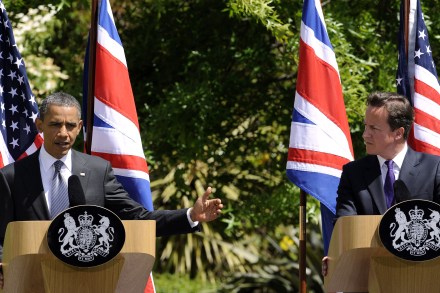
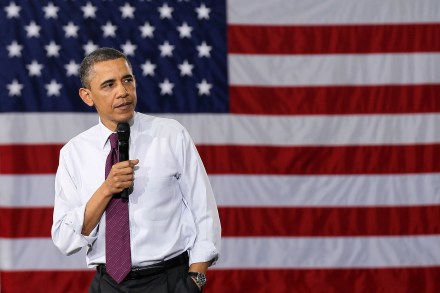
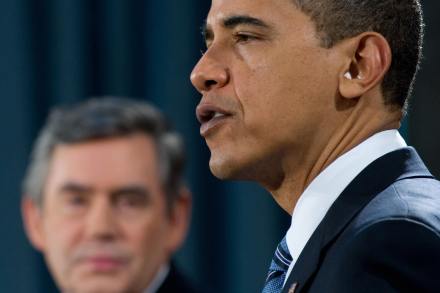
And the Word of the Day is "we". Both David Cameron and Barack Obama deployed it liberally in their joint press conference just now, as they ran through all the mutual pleasantries and backslapping that attends these events. "We have discussed the two things we care about the most," flushed Cameron, "getting our people jobs, and keeping our people safe." From there on in it was first name terms — "thank you, David" — and claims about the strength of our two countries' special, essential, unique relationship, etc. With the sun blazing down on the garden of Lancaster House, I'm sure the photos will turn out nice. Cameron appeared to be the more eager of the two men, however.

The X Factor

From our UK edition

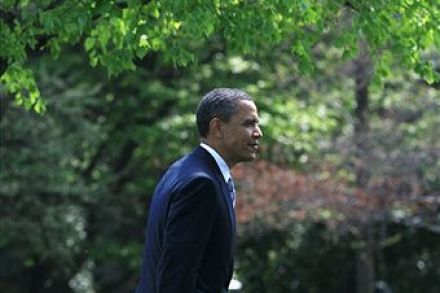
They say power is shifting from the United States, but I'm standing outside of Westminster Abbey having joined an enthusiastic surge of people keen to see the US president. People of all ages have snuck out of their offices to catch  a glipse of Barack Obama. And here he comes: 30-odd cars, with his big-windowed limousine in front, zip pass the Speccie offices and we get a wave from the President and the First Lady. I never see the Chinese president getting this kind of rock star treatment. In fact, I don't see many people getting kind of reception, except the Queen and maybe Justin Bieber. This matters. The US may be indebted, overstretched and led by a man whose leadership is less sure-footed than his public personality. But its leader draws an impromptu crowd of well-wishers.

Alan Greenspan doesn’t exist

From our UK edition

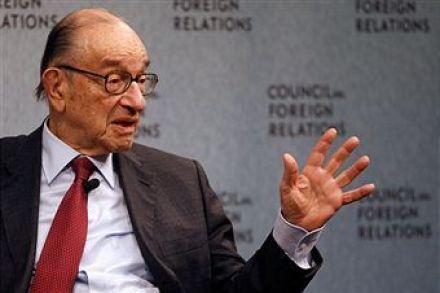
Five years have passed since Alan Greenspan stepped down from the most influential banking job in the world. (Now that’s how to leave at the right time.) Described in books, interviews and profiles too numerous to mention as ‘the most powerful regulator/person on earth’, he served as Chairman of the Federal Reserve for 19 years. For reasons of sheer longevity, perhaps Greenspan deserves to be called the architect of the modern global economy more than any of his elected contemporaries.

A special relationship | 22 May 2011

From our UK edition

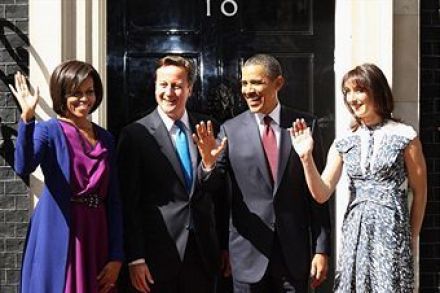
The visit of President Obama on Tuesday has not yet inspired rapid British soul searching about the ‘special relationship’, not by comparison to David Cameron’s trip to America last July at any rate. After an awkward beginning, the Obama administration has been at pains to stress that America’s alliance with Britain is inviolable even in a changing world. The administration’s deputy national security adviser, Ben Rhodes, said “there’s no closer ally for the US than the UK” last week. But like all close alliances, the two parties have their differences.

How the US presidential campaign will change American foreign policy

From our UK edition

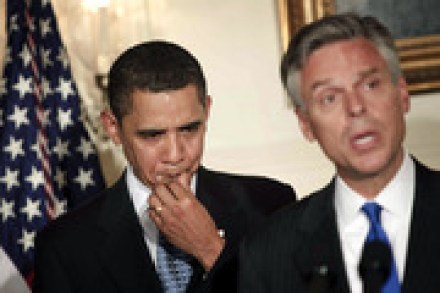
Whoever wins the Republican nomination and takes on Barack Obama in the 2012 presidential election is going to campaign hard on the issue of the US national debt and the idea that constantly running deficits is dragging the nation into decline. This is going to have a serious impact on the foreign policy debate in the US. It is striking that John Huntsman (pictured with Barack Obama), the former US ambassador to China who was governor of Utah and is running as a middle of the road Republican, has chosen to introduce himself to voters in New Hampshire with criticisms of the cost of the Libya mission. He said, ‘I think we have to be very careful about where we choose to spend our money and what we define as being important to our national security interest.

Keeping the States interested

From our UK edition

David Cameron has a good relationship with Barack Obama, which will be on display when the US president visits Britain shortly. They speak regularly and frankly and their senior advisers are in near-constant contact. The idea that the Lib Dems would foist a more "Love Actually" policy onto the coalition has come to naught. Yet Britain's influence in Washington has waned. This is no fault of the Prime Minister. In fact, his personal diplomacy has probably slowed-down the process. Instead it has to do with structural changes in the US: the coming to power of a "pacific" President, the importance of US-China ties, the emergence of the Tea Party.

Yes he Cain?

From our UK edition

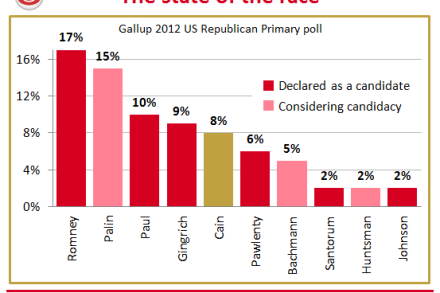
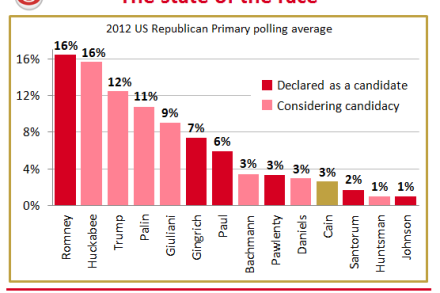
Watch the latest video at video.foxnews.com Have you ever heard of Herman Cain? Neither have most Americans. The latest Gallup polling shows that only 21 per cent of Republicans even recognise his name, despite the fact that he would like to be their candidate for the Presidency. Yet that could all be about to change for the man who used to run Godfather's Pizza, thanks to an acclaimed performance in the first debate of the primary season on Thursday night. Big names like Sarah Palin, Mike Huckabee and Donald Trump have yet to declare their candidacy, and so did not take part, while Mitt Romney and Newt Gingrich (who have announced their bids) decided to skip it.

How the US pulled it off

From our UK edition

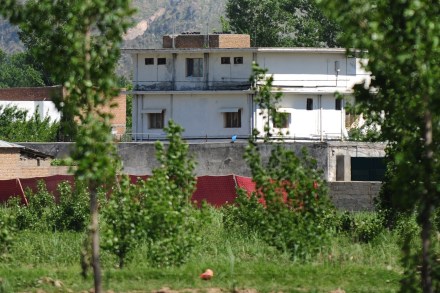
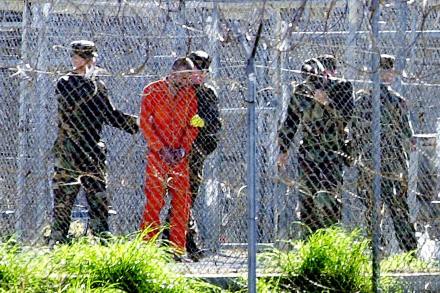
The veil is being pulled back on how the United States tracked down and killed Osama Bin Laden. The New York Times reveals that the intelligence trail started with information obtained from a Guantanamo Bay detainee about the courier that Bin Laden used to pass and receive messages to the outside world. This is proof that the public debate about the utility of Guantanamo is far too glib. This courier was then tracked down last August to the compound, in Abbottabad which was so secure and grand that the Americans realised that it could well be Bin Laden’s hide-out. These suspicions were reinforced when it became clear that this million dollar compound, built in 2005, had no telephone or internet connection and that its inhabitants incinerated their own rubbish.

What Obama said about Bin Laden and Pakistan before he became President

From our UK edition

After the events of today, the video above has fresh resonance. It is from the first presidential debate in 2008, and features Barack Obama defending his previously stated view that "if the United States has Al Qaeda, Bin Laden, top level lieutenants in our sights, and Pakistan is unable or unwilling to act, then we should take them out." Turns out, in this case, he was true to his word.

Obama contra Trump

From our UK edition

You thought Barack Obama had finished with Donald Trump by releasing a copy of his long-form birth certificate? Not nearly. At the White House Correspondents' Dinner last night — video above — the US Pres took every opportunity he could to bait his bouffant-haired baiter. From the tongue-in-cheek music video that kicks of proceedings — "I am a real American," it declares against clips from the Transformers and Karate Kid — to the even more tongue-in-cheek attack on Trump's credentials that follows; this was humour wielded as a weapon. And, yes, Trump was in the audience to witness it all.    Obama also runs through some of the likely Republican Presidential candidates, much as Richard Littlejohn did for The Spectator recently.

Why Gitmo ought to be closed

From our UK edition

It is hard to feel anything but nauseous when reading the Guardian's continuing special report on Guantanamo Bay, which started yesterday. The paper has released hundreds of classified files which were obtained last year by Wikileaks, including detainee assessments prepared between 2002 and 2009 to summarise what the government knew about each detainee — and they do not paint a pretty picture. Some detainees are clearly guilty as sin. But others seem to have been caught in the crosshairs of conflict. One example seems to be Abdul Badr Mannan, who was arrested in Pakistan and turned over to US forces in the belief that he was affiliated with al-Qaeda.

Obama’s budget: faster, but not further, than Osborne’s

From our UK edition

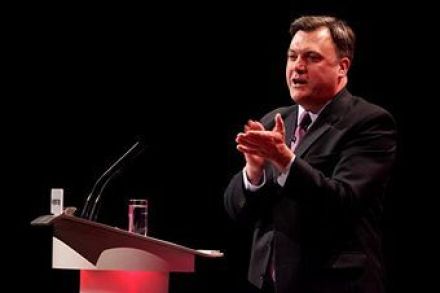
Barack Obama's budget plan has become a political debating point on this side of the Atlantic. Ed Balls set the ball a-rolling in an article for the Guardian this morning, which effectively claimed that the President isn't planning to cut the deficit as quickly as George Osborne is. "The truth is that it is Osborne himself who is isolated," is how he pugnaciously put it. But the Tories' Matthew Hancock has since responded — on Coffee House, as it happens — arguing that, actually, the Obama Plan is simpatico with what Osborne is doing. By way of hovering above the red-on-blue scrap, we thought we'd put together a comparison of Osborne's and Obama's budgets for the benefit of CoffeeHousers.

Labour are drawing the wrong lessons from America

From our UK edition

The global debate about how we live within our means is moving fast. I spent a week in Washington while Congress and the President hammered out their deal on this year’s budget. The deal was significant because all sides agreed on the need to cut spending now. After days of brinkmanship, they agreed to £38 billion in-year cuts. Significant, perhaps, because America has now started to tackle its huge deficit. But everyone agreed it is a small downpayment ahead of a much bigger debate to come.   What’s fascinating for us here is that President Obama’s proposals are to cut the deficit slightly faster than we are here. Congress would go faster still.

Standard & Poor’s bombshell

From our UK edition

A mute, almost disbelieving response (except on the Markets) has met Standard & Poor’s announcement that the US government’s fiscal profile may become ‘measurably weaker’. The credit rating agency has put a ‘negative outlook’ on the US’s AAA rating; the accompanying report said:    “We believe there is a material risk that U.S. policy makers might not reach an agreement on how to address medium- and long-term budgetary challenges by 2013. If an agreement is not reached and meaningful implementation does not begin by then, this would in our view render the U.S. fiscal profile meaningfully weaker than that of peer ‘AAA’ sovereigns.

Balls in fiscal isolation

From our UK edition

Ed Balls has long said that America is the right comparison for Britain when it comes to how to deal with the deficit, contrasting the Obama administration’s fiscally loose policies with Osborne’s plan for fiscal tightening. This comparison has always been flawed; the dollar is the world’s reverse currency which gives Washington far more fiscal flexibility than HMG. But, even leaving that aside, the Obama administration is now — albeit under Congressional pressure — about to start cutting.   By 2015, Obama’s plan will have reduced the US deficit by 8 percent of GDP. Osborne’s plan sees Britain reduces its deficit by 8.4 percent by 2015. Indeed, from next year the US will be tightening at a faster annual rate than Britain.

A word for Mitch

From our UK edition

In the magazine’s cover piece this week (read it here or subscribe from just £1/issue), Richard Littlejohn described the rather feeble assortment of Republican contenders for next year’s presidential elections. But he left out Mitch Daniels, the Governor of Indiana, who seems to be emerging as a favourite among American conservatives.   Daniels hasn’t yet declared his candidacy, and at first glance he comes across as a dweeb. But it would be foolish to underrate him. In 2008, against a tide of Obama-mania, Daniels won the Indiana governorship with ease. He got more votes, in fact, than any candidate in the state’s history. The secret of Daniels’s success is his winningly awkward Pennsylvanian manner.

Meanwhile, in America…

From our UK edition

We really oughtn't let the weekend pass without some mention of political events across the Atlantic. As you've probably heard, a US government shutdown was avoided on Friday evening, and all thanks to a budget compromise which saw Barack Obama slash a cool $38 billion from his spending plans. Although the debate over who has credited or discredited themselves is still ongoing, it's striking that the Republicans — urged on by the Tea Party corps — achieved around two-thirds of the cuts that they demanded. Yet disaster, or at least the prospect of it, has still not been averted. The Tea Party has already claimed several fiscal scalps along the way — and the next target for their administrations is the impending debate over America's debt ceiling.

Obama sketches out the limits to American involvement in Libya

From our UK edition

There was one aspect of Barack Obama's Big Speech on Libya last night that was particularly curious: for a President who is trying to downplay American involvement in this conflict, he sure went in for good bit of self-aggrandisement. The amount of references to his and his government's "leadership" — as in, "At my direction, America led an effort with our allies at the United Nations Security Council to pass an historic Resolution" — was really quite striking, at least to these ears. I suppose it's all about mollifying those voices who argue that the US Pres hasn't done enough, quickly enough. But it's hardly going to endear him to some of his more proactive partners in this fight.

Obama’s nervousness makes life difficult for him and his allies

From our UK edition

Gingerly, gingerly — that's how the Americans are approaching the presentational battle over Libya, if not the actual campaign itself. There is no bombast in the official broadcasts from Washington, nor categorical intent. Instead we have Robert Gates emphasising, as he did yesterday evening, that the US will soon handover "primary responsibility" for the mission to us or the French. Or there's Mike Mullen, the Chairman of the Joint Chiefs of Staff, saying that "potentially one outcome" is for Gaddafi to stay in power (see video above). The idea of regime change, or of deeper US involvement, is being downplayed all round. What's clear, perhaps even understandable, is that Obama & Co. are eager not to exhume the ghosts of Iraq.

Hillary the hawk

From our UK edition

Intervention it is then. Cue lots of politicians walking around with rousing West Wing music in their minds' ears. This is the part where they get to play the good guys. Until something goes wrong, and they are bungling idiots again. Of course, it's good for everyone to feel that a bombing campaign in Libya is a multi-lateral, UN decision – not an Iraq. But if this turns into a long campaign, American airpower will be expected to do the vast majority of the work. And while Obama may be reluctant to engage on a third front, there are plenty of enthusiasts in Washington – none more so than Hillary Rodham Clinton. It is becoming increasingly obvious that Clinton has been using Obama's indecision over Libya to promote herself.