Unemployment

Why the government shouldn’t be confident that employment’s rising

From our UK edition

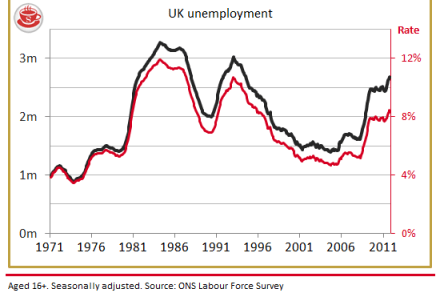
No two ways about it: today’s employment figures are difficult for the coalition. The unemployment figure’s up for the seventh month in a row, and now stands at 2.68 million — the highest since 1994. And the unemployment rate — up to 8.4 per cent — is at its highest since 1995. It doesn't look like getting better anytime soon, either: unemployment's predicted to carry on rising at least until the end of the year, possibly matching the three million peak of the early ‘90s. In its defence, the government claims that employment is rising too. Today's figure of 29.1 million in employment is about 150,000 higher than it was at the general election. That may seem odd — how come unemployment's up when more people are employed?

The lesson from today’s PMQs? Unemployment makes Cameron uncomfortable

From our UK edition

What’s the point of Ed Miliband? Does the Opposition leader have any purpose in life other than to provide ritual entertainment for the Tory wrecking crew at PMQs? Having spent the New Year listening to lethal attacks from his dearest supporters, Mr Miliband has now seen his leadership shrivel to a pair of policy statements which rival each other in desperation and barminess. The first, outlined by Liam Byrne this morning, is a fantasy tax on banking, ‘to create 100,000 jobs’. The second is Labour’s new position on the government’s austerity programme. This would baffle the dippiest and trippiest resident of Alice in Wonderland. We hate the cuts. We back the cuts. We oppose the cuts. We endorse the cuts. We accept the cuts.

Cameron endures his monthly unemployment grilling

From our UK edition

Downing Street is painfully aware that one PMQs in four is going to be about unemployment. Today, with the monthly figures having come out this morning, Miliband led on the subject. The Cameron-Miliband exchanges were not particularly enlightening. Miliband said ‘it really is back to the 1980s’ and Cameron mocked Miliband for being ‘so incompetent, he can’t even do a U-turn properly’. In the backbench questions, Cameron wasn’t put under much pressure. The news of the session came when he said in response to a question from Andrew Rosindell that the National Security Council had devoted a whole session to the Falklands yesterday.

Cutting immigration won’t help youth unemployment

From our UK edition

Reading the papers today, you could be forgiven for thinking that MigrationWatch’s new report was a smoking gun against immigration. Here we have a study that links immigration to unemployment, in the face of nearly all previous research that has found no such link. However, looking at the MigrationWatch piece itself, it quickly becomes clear how implausible these claims are. The MigrationWatch report centres on a comparison of rising youth unemployment and rising immigration from the ‘A8’ countries – the Eastern European states that joined the EU in 2004. The correlation between the two is remarkably weak. During the initial rise in immigration between 2004 and the end of 2008, there is no significant rise in unemployment at all.

The Autumn Statement: What you need to know

From our UK edition

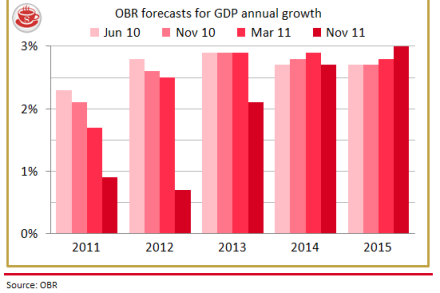
We've been posting some of these charts on Twitter, but here they are, collected, for CoffeeHousers. You can expect more as we mine deeper into the OBR's supplementary document. Do shout out, also, if you spot anything yourself. 1. Weaker growth — except for a very optimistic figure for 2015 2. Higher debt — both in real terms and as percentage of GDP   3. Osborne borrowing more than he'd hoped 4. More persistent — and deeper — ILO unemployment 5.

A Clegg-up for young workers?

From our UK edition

There was a time when Nick Clegg was the most agile and persistent defender of the coalition's deficit reduction programme. But now — although he's still got it in him — he is more often wheeled out to announce some spending wheeze or other. A couple of weeks ago, it was the next instalment of the government's regional growth fund. Today, it's a £1 billion scheme, spread out over three years, to encourage companies to take on young people. This latest scheme is one of those that looks very neat on paper. Put aside questions about how it will be funded, and what we have is a plan whereby £2,275 will be paid to companies for each young recruit they bring on. It means that, in effect, the state will cover half of the youth minimum wage for a six-month period.

Ed looks more dead than deadly

From our UK edition

If Roman Abramovich owned the Labour party, Ed Miliband would be toast by now. The floundering opposition leader gave the sort of inept, predictable and ill-organised performance at PMQs that would get a manager sacked in the Premiership. It scarcely helps that Mr Miliband seems to prepare for these sessions like a deluded psychic. He and his team of prophets at Labour HQ clearly believe they can foretell what the prime minster will say and how best to smash his answers to pieces. Referring to the rise in unemployment, Mr Miliband began by attacking the PM for scrapping the Future Jobs Fund in March. He boasted, rather weirdly, that ‘under Labour, youth unemployment never reached 1 million.

200,000 extra working pensioners

From our UK edition

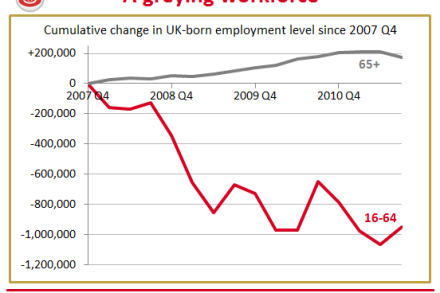
Despite – or perhaps because of – the recession, pensioner employment has increased dramtically over the past few years. In his Telegraph column today, Fraser remarks on this important but largely ignored trend in Britain's workforce. 'A million jobs have been lost since the Great Recession began', he says, 'but the number of pension-aged people in work has increased by 200,000.' Here's that phenomenom in graph form: Why has this happened? Fraser puts his finger on one important factor: 'Crucially, they pay less tax. A pensioner manning the tills in Tesco will take home 12 per cent more than a working-age colleague on the same salary.

Miliband’s ‘responsible capitalism’ requires deregulation

From our UK edition

Despite yesterday’s gloomy unemployment figures there is, it turns out, good news for the government buried in current labour patterns: the total number of hours worked in the last three months has risen by three million. The bad news is that employers are currently filling this demand by getting current employees to work longer hours (average weekly hours over this time period rose by 0.3 to 31.5), rather than taking on new workers. Presumably this is because it is so much cheaper, and less risky, to do so.   This should come as an encouragement to the government, as they search for ways to bring about growth.

Unemployment rate highest in 15 years

From our UK edition

Today's unemployment figures do not make for cheery reading. Youth unemployment is up to over a million and unemployment overall has reached 2.62 million, meaning that the unemployment rate is the highest it has been for 15 years. Laura Kuenssberg tweets one particularly striking statistic: 'Number of UK Nationals in work fell 280k compared to this time last year, number of non-UK Nationals in work increased 147k over same time' This suggests that it's a touch too simple just to say that there are no jobs out there. It also means that we really should think about why non-UK nationals are proving so much more adept at finding work than their British counterparts.

If Clegg wants to reduce youth unemployment, then he’s going to have to look at regulation

From our UK edition

Nick Clegg’s interview in The Times today presages a major Lib Dem effort to try and promote policies to reduce youth unemployment. With figures out on Wednesday expected to show youth unemployment going over a million, the Lib Dem leader is keen to show that the government is acting. But as The Times reports, the quad—Cameron, Osborne, Clegg and Alexander—are divided on what to do about the matter. The Tories are keen to do Beecroft for young people, removing some of the employment protections that make firms so reluctant to hire new staff. But given how the Lib Dems have set themselves so firmly against the Beecroft review and its principal idea of replacing unfair dismissal with severance pay based on length of service, they won’t accept this.

Labour aren’t capitalising on the government’s woes

From our UK edition

Ipsos MORI's latest monthly political monitor is just out, and it doesn't bring much good news for either the government or the opposition. 63 per cent of respondents are dissatisfied with the government and 54 dissatisfied with David Cameron — both the highest proportions since the election. On the public's number one issue — the economy — just 36 per cent say the government's done a good job. And even wose, a whopping 77 per cent say they've done a bad job of keeping unemployment down — hardly surprising considering unemployment has risen by 100,000 since the election. But while all this presents a great opportunity for Labour, other numbers show how bad a job they're doing at taking advantage of it.

Time to scrap the minimum wage?

From our UK edition

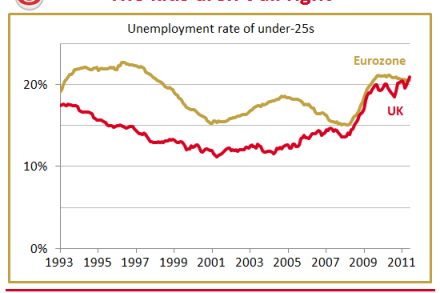
Today’s youth unemployment figures are simply appalling. It’s now 21 per cent amongst the under-25s, above the peak of 18 per cent seen under the 1990s recession. For the first time since then, Britain’s youth joblessness is worse than the European average. This is a tragedy, and not one we should accept as being a grimly inevitable aspect of the recession. Ed Miliband said in PMQs that a million young people are on the dole: a statistic everyone should get angry about. And we can think of what has gone wrong. The above graph shows how Britain has nothing left to boast about in unemployment. Blair used to love heading to Brussels and saying the real 'social model' was lower regulation which meant higher employment. What’s changed over the last 20 years?

The Winter Fuel Allowance is indefensible

From our UK edition

Freed from the shackles of elected office, Steve Norris remains an electrifying speaker. He is also refreshingly honest. So, when I met the 66-year-old former mayoral candidate at a Tory conference fringe on the future of London, he was only too happy to admit how spent his Winter Fuel Allowance: "I'm amazed by the Chancellor's annual gift. I spend it on Claret," he said. In fact, he said that when paid to the wealthy, the allowance is "a complete waste of money" and "a bribe to older voters". I mention this only because the Allowance was referred to again in a different context this week: during David Cameron's own address.

A brutal no score draw at PMQs

From our UK edition

Cameron and Miliband went six rounds on the economy at PMQs. Miliband tried to portray Cameron as just another Tory who thinks that "unemployment is a price worth paying". Cameron, for his part, wanted to paint the Labour leader as someone whose policies would send Britain tumbling into a sovereign debt crisis. At the end, it felt like a bit of a no-score draw. Interestingly, Cameron stressed that "every week and every month, we’ll be adding to that growth programme". We’ll have to see whether he’s talking about more small-bore measures, or something bigger on infrastructure investment. Labour had a new tactic today, trying to fact-check all of Cameron’s answers from last week.

Clegg sounds a dire warning on the economy

From our UK edition

Nick Clegg gave a speech on the economy earlier this morning. As Tim Montgomerie notes, Clegg came close to admitting that the economy is nearing crisis. He said, "The economic context is much worse than before. Yes, facts have changed" and added that the "government is not blind to deterioration in economic environment". These warnings tighten a knot in already sick stomachs; but, with the Eurozone mired in a crisis that is fast becoming existential, banks under mounting strain, rising unemployment, widespread talk of further Quantitative Easing and the very public internal debate in the coalition about the need for tax cuts, Clegg’s comments don’t come as a great surprise.

Right to reply: The impact of immigration on the labour market

From our UK edition

Yesterday, we introduced our new “Right to reply” series, where outside writers take on some of the ideas and arguments raised on Coffee House. In that case, it was the IPPR’s Matt Cavanagh replying to Fraser’s recent post on immigration and the labour market. Here’s another reply to the same post, this time by Jonathan Portes of the National Institute of Economic and Social Research: Myths abound when it comes to the effect of immigration on the labour market — and the most damaging of these is that most or all “new jobs” go to migrants. Although I agree with Fraser Nelson's general views on immigration, he is misleading on this one point.

Right to reply: Why do so many “new jobs” go to foreigners?

From our UK edition

On Monday, we published a post on George Osborne's "jobless recovery" — the point being that 90 per cent of the recent rise in employment can be accounted for by foreign nationals. Here's a counterpunch to it from the IPPR's Matt Cavanagh, who should already be familiar to CoffeeHousers from his previous posts and articles for us on matters military. We're hoping that this will be the first of a new series of "Right to reply" posts, giving outside writers the opportunity to take on your loyal baristas in mortal combat. Here goes: One of the most frequently recycled statistics of recent years is the percentage of "new jobs going to foreigners". The first thing to say is that this is a bad way to phrase it.

Exclusive: Osborne’s jobless recovery

From our UK edition

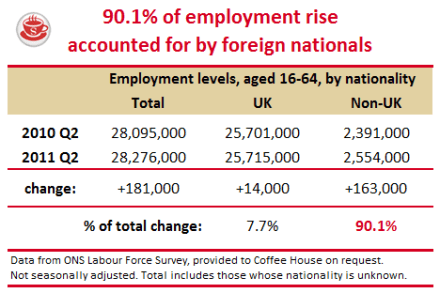
George Osborne was right to boast in the Commons that Britain has the “second highest rate of net job creation in the G7”. Coffee House recently pointed out that all of the increase is accounted for by foreign-born workers. But what if you narrow the definition to foreign nationals? We put in an information request to the Office for National Statistics and the below information came back. It is quite striking. Over the 12-month period to which Osborne refers, 90.1 per cent of the extra employment amongst the working-age population can be accounted for by an increase in foreign nationals working in the UK. Here are the figures. The phenomenon of pensioners returning to work is fascinating, but separate.

British jobs for whom? | 28 August 2011

From our UK edition

“More than 400,000 people have been out of work for more than two years, according to analysis of the latest Government data by think tank IPPR.” So runs its press release today, trailed in the Sunday press and the wires. I hope the IPPR didn’t spend too much of their donors’ money on this research, as the figure is updated quarterly and freely available from the DWP website (click here). Add up only three categories: lone parents, jobseekers allowance and incapacity benefit the figure stands at 2.4 million, certainly “more than 400,000”. Worse, at the peak of the boom (Feb07), this figure was even higher at 2.5 million. And yes, it’s a real problem. As the IPPR goes on to say, unemployment is self-reinforcing.