Unemployment

George Orwell’s lesson for Jamie Oliver

From our UK edition

Jamie Oliver, eh, what a card? Why can't Britain's revolting poor eat better food? If they can afford televisions they can afford mussels and rocket too, don't ya know? Something like that anyway. But instead they loaf in front of the goggle-box stuffing their fat faces with lardy ready-meals and fast food. What is to be done with them? And why can't they be more like the Spanish or the Italians? Never mind that Italian children are more likely to be obese than British children. Never mind, too, that kids in impoverished southern Italy are more likely to be overweight than children in the wealthier north. Instead just fantasise about a future in which poor British families will dine on fresh vegetables and the finest seafood.


Unemployment figures: All good news?

From our UK edition

Unemployment is down, there are fewer people claiming jobseeker's allowance, and more people are in work than ever before. So, the top line on today's employment figures: They're good news. The real picture is more nuanced. Unemployment is down by 4,000 on the previous quarter, a figure that is dwarfed by the margin of error. We might reasonably expect the real number of unemployed to be anywhere within 85,000 above or below the 2.51 million quoted. There have been nine straight months with fewer people claiming jobseeker's allowance, but the unemployment rate is still 7.8% - just where it was in August 2012, and a meagre 0.1 percentage points lower than the 7.9% it stood at when the coalition was formed. And 69,000 extra jobs (taking the total number of people in work to 29.

Zero-hours contracts have their place in the labour market

From our UK edition

One million people on zero hours contracts, scream the media - quoting figures released today by the Chartered Institute of Personnel and Development. This is at odds with recent ONS figures that put the number on these contracts closer to 200,000. Zero-hours contracts have been around for many years in the retail and hospitality industries, where demand fluctuates from month to month and even day to day. Their use has spread recently to other sectors including healthcare (with up to 100,000 such contracts, including last year as many as 800 consultants), education and public services. In response to the media storm, the Department for Business, Innovation and Skills is conducting a review. Why has the use of these contracts grown?

Economy continues greying as unemployment falls

From our UK edition

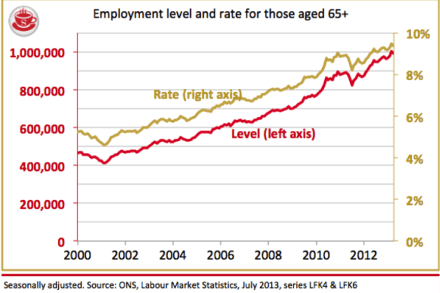
As ever there's good and bad news in today's jobs numbers. Unemployment fell by 57,000, but the number of people in employment only rose by 16,000. The figures also show that the greying of the British economy continues. In May there were 8,000 fewer 16-64 year olds in work, and 25,000 more 65-pluses in work. Since the peak of employment in 2008 there are more than 300,000 more pensioners working. There's one more thing that may turn out to be a big positive: Britons put in over 950 million hours in the last three months, that’s 0.4 per cent more than the previous quarter. According to the NIESR, GDP grew by 0.6% over the same period. That means that the productivity of labour - which has slumped during the recession - may be increasing again.

David Cameron sings the good jobs news, but can Labour deal with green shoots?

From our UK edition

There was plenty for David Cameron to sing about at today's PMQs when it came to the ONS' latest labour market figures, and sing he did. He said: 'First, it is worth announcing to the House what today's unemployment figures show. They show that employment - the number of people in work in this country - is going up, that unemployment is going down, and that - I know the Labour party does not want to hear good news, but I think it is important that we hear it. The claimant count - the number of people claiming unemployment benefit - has fallen for the seventh month in a row. It is interesting that over the past year, while we have lost 100,000 jobs in the public sector, we have gained five times that amount in private sector employment.

Unemployment rises… or does it?

From our UK edition

Today's job statistics are, as usual, mixed — and even a touch confusing. Last month, the headline was that the unemployment had risen to 2.56 million. This month, we're told that it's risen again — to 2.52 million. How can both be right? Because the point of comparison is not the previous month, but the previous quarter. Still, the fall in employment and rise in unemployment is really last month's news, not this month's. As ever, it's worth remembering the margin of error of all these estimates, which dwarfs the quarterly changes — so we don't actually know whether they rose, fell or stayed the same. But there are some trends that we can identify.

Has the jobs recovery stalled?

From our UK edition

The number of people in work in December to February was 29.698 million — lower than last month's 29.732 million and representing a very slight 2,000 quarter-on-quarter fall — according to today's figures from the Office for National Statistics. Of course, 2,000 is just a 0.008 per cent drop, and since the margin of error for that change is ±139,000, the quarter could yet turn out to have been one of reasonable jobs growth. But in today's figures, the lack of employment growth, while the economically active population continued to expand, meant that the unemployment level rose by 70,000 — its biggest quarter-on-quarter rise since September to November 2011. The unemployment rate, which had fallen from 8.4 per cent in late-2011 to 7.

Margaret Thatcher in six graphs

From our UK edition

With the debate swirling about Margaret Thatcher's legacy and her government's record, it's worth taking a look at what the cold, hard economic data has to say about her time in office. Of course, growth rates and unemployment figures can't tell us everything about a period, but they can at least provide a bit of substance to mix with the well-worn rhetoric. 1. Average growth. Under Thatcher, GDP rose by 29.4 per cent — an average of 0.6 per cent growth per quarter. (That's the same as the average growth rate from 1955 to 2013.)   2. Manufacturing jobs lost, but more service jobs created. A net of 1.6 million jobs were created under Thatcher. The manufacturing industry lost 1.9 million, while the services sector grew by 3.6 million.   3.

Why aren’t more people unemployed?

From our UK edition

An unfamiliar noise floats over the town; an insistent, one-note metallic drone. Tracked to its source, it turns out to come from a sawmill in a hidden wooded valley a quarter of a mile from my house. Abandoned for the past year, the mill has suddenly come back to life. It is emitting great plumes of steam as well as a multi-decibel industrial racket. And men are working there — I can see only two or three, but still they constitute another little piece of the great employment puzzle. An uptick in demand for sawn timber matches reports of increased levels of activity in the construction and housebuilding sector.

Good news on employment, but don’t expect it to keep coming

From our UK edition

Today's jobs figures are pretty unambiguously good news. The number of people in work rose by 154,000 in the last three months of 2012 to a new record high of 29.73 million — surpassing pre-recession peak by 158,000. And unlike other recent rounds of employment growth, this wasn't driven by a rise in part-time workers (their number actually fell by 43,000). But there are still a couple of reasons cause to greet this good news with caution. Rising employment at a time of economic stagnation has come at the expense of earnings. Adjusted for CPI inflation, average weekly earnings have fallen by 7 per cent in the last five years, back to 2004 levels. And the Office for Budget Responsibility doesn't expect them to start rising again until late-2014.

The government’s work experience scheme isn’t headed for the plug hole

From our UK edition

Depending on which paper you read this morning, the government's work experience scheme is either heading for the plug hole or going from strength to strength. The Guardian has an editorial praising Cait Reilly, the geology graduate who fought the workfare scheme she found herself on, The Telegraph says workfare can 'still do the job for Britain', and The Sun carries a bullish piece by Iain Duncan Smith on why the scheme is not 'slave labour'. The problem is that everyone has managed to interpret yesterday's Court of Appeal judgement as favouring their own view of the scheme. Reilly emerged yesterday with her lawyer to claim victory, but the Work and Pensions department seemed relatively unperturbed, too.

Tory battle of the letters intensifies

From our UK edition

It's the 200th anniversary of Jane Austen's Pride and Prejudice this week, so perhaps it's the passionate letter from Darcy to Elizabeth that's inspired such an enthusiastic burst of letter-writing from Conservative MPs complaining about stories in the press today. Earlier, we had Jake Berry complaining to the BBC, and now there are more. Sadly, the latest missives I've got hold of from Harriett Baldwin don't contain declarations of love, or any insults for the recipient's mother: instead, Baldwin is angry about an article by Ed Miliband in today's Sun. Plugging his party's policy for every big firm receiving a government contract to train young people, the Labour leader writes: 'Among the major European countries, we are in the relegation zone when it comes to youth unemployment.

Labour revisits old welfare ghosts with its jobs guarantee

From our UK edition

Dig out the bunting, fly the red flags in celebration, for finally we have a policy from the Labour party. Ed Miliband promised that 2013 would be the year he'd set out some 'concrete steps' on key policy areas, and to that end he's announced a jobs guarantee for the long-term unemployed. Coffee House readers will already be familiar with this scheme, as Shadow Work and Pensions Secretary Liam Byrne discussed it in his interview on this site in December.

The Dalkey Archive Press responds

From our UK edition

Following my last post about the Dalkey Archive Press advert for unpaid interns I received an email from publisher John O'Brien. I think it sheds some interesting light on the issue so here it is in full: 'What started out as an announcement of two hires and then hoped-for interns who would become hires (putting aside my "characteristics" sections, if you can), all internships are on hold and will quite likely not resume. We are deluged with requests (paid or unpaid) for internships, and usually take on more than we can properly handle because people are rather desperate to get the experience, without which they cannot get the first door opened for them for a job.

Will 2013 bring an end to unpaid internships?

From our UK edition

It’s a bit early for predictions for 2013. But my feeling is that it could be the year of the unpaid intern, or rather, the year of the paid intern if the campaign to pay people a fair day’s pay for a fair day’s work continues to gather pace. Hazel Blears did well to secure cross-party support for a 10-minute-rule bill to outlaw the advertising of unpaid internships. It does seem odd that employers are obliged to pay the national minimum wage but can advertise that they are breaking the law. Campaigners Intern Aware has been pushing this particular cause for some time and should be congratulated for its work on the bill. The fact that HMRC is doing so little to enforce such breaches suggests it is perhaps not up to the job.

Private sector growth pushes employment to new record high

From our UK edition

The number of people in work in the UK hit 29.6 million in August-October – the most ever — according to today's figures from the Office for National Statistics. So despite GDP still languishing 3 per cent below pre-recession levels, employment has fully recovered, with half a million jobs created in the last year: The rise in employment has been thanks to the private sector more than making up for the job cuts in the public sector.

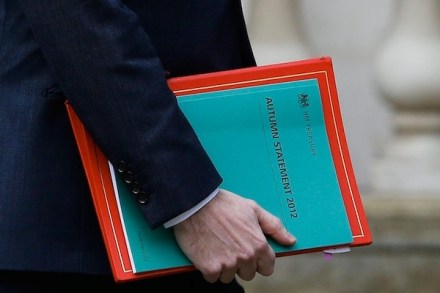
The Autumn Statement in 7 graphs

From our UK edition

1. Growth evaporating. The Office for Budget Responsibility once again downgraded its growth forecasts for 2012-13 and, for the first time, also did so for 2014-16. Despite that, the OBR is still slightly more optimistic than the average independent forecaster: 2. A seven year slump. On the OBR forecasts, it will now take until the end of 2014 to get back to where we were before the crash. In the 1930s, it took 'just' four years to recover: 3. Slower deficit reduction. The weaker economic outlook means the government will be borrowing more than expected. When George Osborne delivered his first Budget in 2010, the OBR predicted he'd get the deficit down to £20 billion in 2015-16. It now says it'll be £82 billion.

Tata Steel’s job cuts, a tale of 2 press releases

From our UK edition

Today brings bad news that Tata Steel is to cut 900 jobs in the UK (at plants in South Wales, North Yorkshire, Teesside and the West Midlands). This is catastrophic news for a government that has announced its intention to rebalance the economy away from financial and professional services in the south-east (and therefore get an hearing electoral hearing in Britain’s former industrial heartlands); but that is only one aspect of the politics at play here. Tata's statement says: ‘Today's proposals are part of a strategy to transform ourselves into an all-weather steel producer, capable of succeeding in difficult economic conditions. These restructuring proposals will help make our business more successful and sustainable.

Employment has recovered from the recession, but wages haven’t

From our UK edition

Today's employment figures don't contain much new to shout about. The number of people in work — although it rose by 100,000 on the previous quarter — is actually down very slightly from last month's record high (but still above the pre-recession peak, just). Unemployment fell by 49,000 from Q2 to Q3, although that's well within the Labour Force Survey's margin of error (so we can't be certain that it fell at all). The best news in today's figures — from the government's point of view — is probably that the headline unemployment rate is now 7.8 per cent, very slightly below the 7.9 per cent rate when the coalition took office (though again, it's worth remembering that the margin of error on that figure is +/– 0.3 percentage points).

Jobs figures show a move in the right direction

From our UK edition

Recently, we've been used to the economic figures being either bad news or mixed news. So today's employment stats come as a welcome surprise: it's almost all good news. They show that total employment rose by 212,000 from March-May to June-August, and now stands at 29.59 million — a record high, 18,000 above the pre-recession peak of April 2008. Since the election, a net of 616,000 jobs have been created. And unemployment is down too — by 50,000 on the previous three months, defying expectations. That means the unemployment rate has dropped to 7.9 per cent, the first time it's been below 8 per cent in over a year.