Ukraine

The end of the Orbán era

Over the headline “Peace Mission,” a recent cover from the conservative Hungarian periodical Mandiner shows an awkwardly photoshopped Viktor Orbán mediating between a bemused-looking Vladimir Putin and a grim Volodymyr Zelensky. Behind Orbán, a map of the world connects Kyiv, Moscow, Beijing, Washington and Budapest. One of these capitals, as they say, is not like the others. Even before Ukraine’s Kursk offensive, the chances of Orbán’s July trips to Kyiv and Moscow producing a peace settlement were slim. The Mandiner cover, however, is a revealing window into the mindset of Orbán’s conservative fans. The idea of a Hungarian prime minister mediating between squabbling great powers is both attractive and plausible to many of Orbán’s fervent supporters.

Orbán

Inside the debate over Ukraine joining NATO

NATO’s summit in Washington, DC will be full of pomp and circumstance. The gathering, from July 9-11, is intended in part to celebrate the Alliance’s seventy-fifth anniversary, a symbolic and emotional event for the leaders in attendance. You can expect the red carpet to cover the entire city. Dozens of speeches will be given about how NATO is the oldest and most successful military alliance in history and why the bloc remains a crucial check on Russian expansionism. Some will even claim matter-of-factly that NATO enlargement over the last twenty-five years — NATO has doubled its membership during that period of time — was sound policy and had nothing to do with Russia’s decision-making calculus on Ukraine.

nato

Antony Blinken embodies decades of failure

There is no sign marking the entrance to Barman Dictat. The bar under 44 Khreshchatyk Street in Kyiv boasts the largest mezcal collection in Eastern Europe. On a typical night you can find it by noting the crowd of people wafting cigarette smoke into the evening air. Inside, you’ll find shelves of more than 400 glowing bottles perched above a steel bar stretching more than thirty feet. You’ll find bespoke cocktails — Kraken, Smoky Voice and Tickle Balls. And, on one particular May evening, you’ll find the seventy-first secretary of state of the United States of America at center stage. Clad in black and wielding a scarlet electric guitar, Antony Blinken seemed less enthused about the moment than his staff had perhaps anticipated.

Blinken
war

What is war good for in the twenty-first century?

What exactly is war good for in the twenty-first century? The US should have asked itself this before embarking on decades of aimless occupation in Iraq and Afghanistan. Israel and Russia — very different countries, morally and otherwise — should be asking themselves today. The wars in Ukraine and Gaza both began with changes in an uncomfortable but previously stable status quo. Sometimes Westerners who try to imagine a peace deal for Ukraine invoke Finland’s strategic neutrality during the Cold War. But Ukraine was Finlandized for nearly twenty years after the fall of the Soviet Union, precariously balanced between Russia and the West but fully committed to neither. No one was entirely happy with that — yet there was peace from 1991 until 2014.

‘Trumpists and Communists’ on Ukrainian NGO list fight back

A US government-affiliated Ukrainian NGO, texty.org.ua, published a list last week of all the Americans “impeding aid to Ukraine.” There are 388 individuals and seventy-six organizations on the list, including members of the conservative media Alex Jones, Tucker Carlson, members of Congress and a few Spectator writers. The piece is titled “Rollercoaster: From Trumpists to Communists. The forces in the US impeding aid to Ukraine and how they do it.” “The title of this article oversells the product: it is a substantively thin piece, largely an excuse to smear a large group of Americans who have been skeptical of aid to Ukraine in one form or another,” Senator J.D. Vance and Representative Matt Gaetz wrote in a letter to secretary of state Antony Blinken on Tuesday.

ukraine ngo

Joe Biden’s TIME interview: the good the bad and the ugly

President Joe Biden sat down for an interview with TIME magazine in the White House last week. The questions centered around foreign affairs, with interviewers Massimo Calabresi and Sam Jacobs asking about D-Day, Ukraine, Israel and Hamas, nuclear power, China, inflation, tariffs and immigration. Back in March Americans generally agreed that the economy and foreign affairs were weak points in Biden’s administration. The TIME interview is unlikely to change anyone’s mind. Cockburn identified a few overarching themes: Biden accused TIME of misreporting and leaving his accomplishments unreported. The first accusation: “The Russian military has been decimated. You don’t write about that. It’s been freaking decimated.” Another theme: senility.

joe biden time magazine

Lessons from the foreign aid votes

The past week has presented a fascinating object lesson in the continued tension over the direction of foreign policy and national security in the MAGA era, on what matters and what doesn’t, and who matters and who doesn’t, when it comes to finding a true forward-looking Trump-Reagan fusion. I wrote about this in the context of reviewing the new book by Matt Kroenig and Dan Negrea, who wrote a Ukraine-focused piece for Foreign Policy last week. But that’s just writing, not voting — and this week brought votes that include more useful indicators of what’s going on.

foreign aid

David Cameron meets Trump at Mar-a-Lago

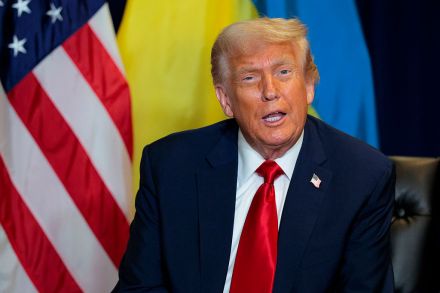
Lord Cameron, the UK foreign secretary, is stopping off at Mar-a-Lago tonight before once again making the rounds in Washington, DC to tub-thump for Ukraine aid. Cameron, who served as Britain's prime minister from 2010 to 2016, is meeting with Republican presidential candidate Donald Trump, who has been skeptical about Ukraine’s prospects of beating back the Russian invaders. A spokesperson for the UK Foreign Office downplayed the significance of Cameron meeting Trump as "standard practice." “The foreign secretary is on his way to Washington DC, where he will hold discussions with US secretary of state Blinken, other Biden administration figures and members of Congress," the spokesperson said.

david cameron

Trump strikes a deal on abortion

Former president Donald Trump announced on Monday that he believes abortion policy should be left to the states to decide and reaffirmed support for exceptions for rape and incest, declining to endorse much-discussed national limits on the procedure.The statement, which was shared on Truth Social, is set to disappoint pro-life organizations throughout the country. Many feared the Trump campaign would continue to move further away from traditional pro-life positions, including refusing to back policies such as a fifteen-week ban. Susan B.

Lessons from costly wars past

Money is often a substitute for strategy in US foreign policy. We spent $2 trillion in Afghanistan, only to lose the country the minute our troops began to pull out. How much will it realistically cost, then, to beat Russia in Ukraine? Will the next $100 or $200 billion do the trick? This is not a question that supporters of war-spending ask themselves. As in Afghanistan, spending is a way to defer thinking about actually winning — or facing the serious possibility of losing. Our aid buys delay, not results. Ironically, while the specter of World War Two is invoked every time there’s a conflict, our experience then teaches the same lesson as recent attempts to purchase victory.

wars
foreign policy

Where is the clarity in modern center-right foreign policy?

When Ohio senator J.D. Vance arrived at the Munich Security Conference in February, he had a clear message meant for the world: the Republican Party was no longer the party of Ronald Reagan. Standing outside the Hotel Bayerischer Hof, he informed reporters that he did not believe American support for combat against authoritarian regimes should extend to Ukraine — and that he would continue to oppose efforts to “increase the supply of weapons in Ukraine because we’ve already expended so many of our munitions and resources” to achieve a victory that he does not foresee. Vance’s bootstrap story is well-known — he’s a Marine veteran turned Yale Law grad turned venture capitalist made prominent by his bestselling Appalachia memoir Hillbilly Elegy.

Resisting the escalation in Ukraine

The drums of war are reverberating across Eastern Europe. Every geopolitical decision made by global powers carries immense weight. Amid the fear of growing conflict, one figure has emerged, wielding a sharp tongue and a pointed finger, challenging hesitant American lawmakers to bolster Ukraine’s defense against Russian aggression. Polish foreign minister Radek Sikorski has embarked on a media offensive, chastising Republicans for their reluctance to green-light the Biden administration’s proposed $60 billion military aid package for Ukraine. Despite his purported noble objectives, Sikorski’s appeal deserves closer examination.

ukraine

Pope Francis’s Ukraine war faux-pas

If you didn’t know any better, you might think that Pope Francis was no longer welcome in Ukraine. His recent interview with a Swiss broadcaster, excerpts of which were released over the weekend, has caused a whirlwind of disappointment and anger in Ukrainian policy circles as well as with some of Ukraine’s staunchest supporters in the West. The subject of derision: whether Ukraine should do a little less fighting and a lot more talking. Asked to comment about the debate between those who seek a negotiated end to Russia’s two-year-long war in Ukraine and those who oppose such a stance, Pope Francis chose the side of dialogue.

pope francis

Victoria Nuland was the Kremlin’s princess of darkness

It was not a Super Tuesday for either Senator Kyrsten Sinema or State Department official Victoria J. Nuland. Each announced that they were stepping down from their positions. Sinema is declining to run once more in Arizona for the Senate. Nuland is exiting her post as the number three official at State, where she was widely seen as the champion of a hawkish approach to foreign policy. Sinema delivered a mawkish message that essentially blamed the American people for failing to recognize, let alone value, her valorous attempt to restore American power and prosperity. Nuland, by contrast, had to be satisfied with a statement from secretary of state Antony J. Blinken: “She always speaks her mind.

victoria nuland
air force catfished

Air Force employee catfished into sharing military secrets

In what may be the most obvious catfishing scam of all time, a contractor for the Air Force was caught sharing military secrets with an individual posing as a Ukrainian woman on a foreign dating app.   David Franklin Slater, a retired Army lieutenant colonel who was serving as a US Air Force civilian employee at the time of the catfishing, was arrested Saturday on three charges of conspiracy and disclosing national defense information.  Slater held a top-secret security clearance from August 2021 until April 2022 which gave him access to briefings about the Russo-Ukraine War.

How foreign policy will impact the 2024 election

Donald Trump’s long march through the Republican primaries leaves little doubt about the inevitability of a Biden-Trump rematch in November — court cases and old age notwithstanding, of course. Unlike previous contests, foreign policy looks set to be at top of mind for many voters. Which, if you’re a Biden supporter, isn’t great news. In a recent AP poll, four in ten American adults named foreign policy as issues the government should work on in 2024. The president’s decisions abroad broadcast weakness, lack of direction and myopia, traits that have come to define his first term. The deadly and chaotic withdrawal from Afghanistan was only a sign of things to come, as more conflicts and crises sprang up around the world.

policy
trump

What will the new Trump foreign policy look like?

A month after the election shock of 2016, CBS’s John Dickerson sat down with the ninety-three-year-old Henry Kissinger to get his assessment of the incoming president. “Donald Trump is a phenomenon that foreign countries haven’t seen,” Kissinger pronounced, noting that many nations would have to weigh “their perception that [Barack Obama] basically withdrew America from international politics, so that they had to make their own assessment of their necessities,” along with “a new president who is asking a lot of unfamiliar questions.” Given “the combination of the partial vacuum and the new questions, one could imagine that something remarkable and new emerges out of it,” Kissinger added. “I’m not saying it will. I’m saying it’s an extraordinary opportunity.

biden ward

Who’s really behind the Biden administration’s foreign policy?

If you’re one of the many people worried that US foreign policy is in the hands of a visibly declining eighty-one year-old president, Alexander Ward’s account of the Biden administration’s first two years in office may — or may not — make you feel better, for he leaves readers with little doubt as to who is actually the executive branch’s most influential decision-maker: forty-seven year-old national security advisor Jake Sullivan. Ward might deny any such authorial intent, but time and again he shows his hand, as when he invokes “Sullivan’s first two years at the helm alongside Biden.

Trump says he will let NATO down. How will Kamala Harris respond?

When Donald Trump declared that Russia could do “whatever the hell it wants” to NATO countries, he was espousing his own lifelong credo. Trump has done whatever he pleases for most of his life. It was generous of him to extend the same carte blanche to the Kremlin, which is presumably pleased with his offer but has yet to comment on it publicly.  Once upon a time, conservatives used to raise an eyebrow over the notion over doing whatever the hell you want. They were in a more censorious mode, arguing that this amounted to moral relativism. Now it seems that anything goes.  The old certitudes are gone.

donald trump nato

Vladimir Putin’s night at the Tucker Carlson circus

Tucker Carlson is a master contortionist. As conservative strategist David Reaboi reminded us this week, one of the most egregious examples of Carlson’s tendency for reality deformation came in the form of an interview with Kanye West, the troubled rapper who sat for an interview on Carlson’s erstwhile Fox News show a couple of years ago. It was the middle of West’s antisemitic meltdown, but because West was embracing Donald Trump, Carlson presented him as a sensible, even brilliant thinker. “Is West crazy?” Carlson asked at the top of the interview, before concluding at the end: “Not crazy. Worth listening to, even if you disagree with him.

tucker carlson