Ukraine

Biden is the war president Ukraine needs

Joe Biden is upping the ante in Ukraine. Even as Vladimir Putin directs a fresh barrage of missiles, Biden is apparently planning a trip to Europe next month to deliver a major address on the anniversary of the Russian invasion and announce a substantial military aid package for Kyiv. Good for him. A speech in Poland or Lithuania — both leaders in the struggle against Russian aggression — will strengthen NATO and demonstrate that a year into the conflict, unity, not dissension, prevails when it comes to confronting Putin’s revanchist ambitions. At every step, Biden has checked Putin, who assumed he could invade and occupy Ukraine in a thrice.

What the US can do about Germany’s hardball on Ukraine

Once again, German Chancellor Olaf Scholz has crushed the hopes of NATO allies and, most of all, the millions of Ukrainians suffering under Russia’s assault. Originally, he refused to send tanks to Ukraine for fear that Russia would escalate the war. More recently, Scholz has said he'd only consider sending tanks if it was part of a coalition, not just Germany acting alone. Last week, the United Kingdom announced it would be sending Challenger 2 main battle tanks (MBT) to Ukraine, making it the first nation to supply modern, Western MBTs to Kyiv. Poland, Finland, and Denmark have also indicated that they would be willing to send their own Leopard 2 tanks. Those are German-origin weapons, so they first require a nod of approval from Berlin in order to export.

Germany’s broken promise to rebuild its military

Germany has a new defense minister. The funny thing is that nobody really knows who he is, what he stands for, and whether he’s capable of doing his job. Boris Pistorius will take over the ministry from Christine Lambrecht, whose one-year tenure was about as embarrassing and gaffe-prone as the Bundeswehr itself. There are too many blemishes on her record to examine in a single post — we would be here all day. But one of the more notable misfires was her tone-deaf New Year’s Eve video, where she reminded viewers that a war was going on in Europe as a fireworks display went off behind her. For many in the German defense establishment, Lambrecht’s departure can be summed up in two words: good riddance. Not much is known about her replacement.

How Republican chaos could threaten aid to Ukraine

As the House GOP continues to make a fool out of itself trying to elect a speaker, those watching might be wondering how all of this will impact the war in Ukraine. The group of around twenty Republican lawmakers who have opposed Kevin McCarthy in the (as of this writing) eight votes taken so far for the speakership include some of the most hardline anti-Ukraine-aid Republicans, like Lauren Boebert and Matt Gaetz. A group this small in the House should be nothing more than an annoyance, but the changes they are demanding — and even those McCarthy has conceded to — give them far more power. The most threatening among them is a provision to return to the system whereby one member of the House can launch a motion to vacate the chair, forcing an up or down vote on the speaker.

Putin mentions the war

So much for "don’t mention the war!" Russian president Vladimir Putin has called the conflict in Ukraine a war for the first time on Thursday. Cockburn is quite flummoxed — this is the same Putin who has made an industry out of locking people up who refused to call the war a “special military operation”. On December 22, while addressing the situation in Ukraine, Putin said, “Our goal is not to spin the flywheel of military conflict, but, on the contrary, to end this war.” The irony alone of this statement is too much to handle. The man who invaded his neighbor and disregarded the laws of war is now saying he does not want to “spin the flywheel of military conflict”?

nuclear tactical putin war

Zelensky spoke to the American soul

When Volodymyr Zelensky entered the chamber to address Congress, the applause and cheers took on a particularly emotional character. It was not the stilted, forced applause that the president receives at the State of the Union; it was an affectionate show of admiration for a man who has come to embody the twenty-first century struggle for freedom. Though delivered to Congress, the opening words of the Ukrainian president’s speech revealed his true audience: “Dear Americans... all those who value freedom and justice.” It was a speech for all of us. He pulled the dusty tarp off of America’s deepest identity as the shining light of liberty in a world of tyranny.

volodymyr zelensky

Could Joe Biden’s Ukraine support define his presidency?

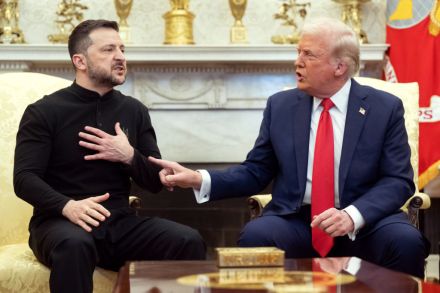
With his whirlwind visit to Washington, Volodymyr Zelensky cemented his bromance with Joe Biden. Even as MAGA Republicans have been sniping at Ukraine — Donald Trump, Jr. derided Zelensky on Wednesday as an “ungrateful welfare queen” — Biden declared that he will support Ukraine “as long as it takes.” Welcoming his Ukrainian counterpart to the White House, he went out of his way to depict support for Ukraine as bipartisan and unflinching. Like Herman Melville in his novel White-Jacket, Biden believes that “we bear the ark of the liberties of the world.” The Russian invasion and Ukrainian defiance are the making of Joe Biden’s presidency. Biden may well go down in history as the man who finally drove the stake through the heart of the Russian empire.

Biden and Zelensky
putin

Biden needs to stop ceding the initiative to Putin

Washington will provide Patriot missiles to Ukraine, bolstering Kyiv's air defenses in the new year. This is welcome news — but it should have happened a long time ago. One word best characterizes the Biden administration’s response to the war in Ukraine: reactive. The president’s lack of proactive measures both gives Putin an edge and prevents Ukraine from achieving a swift victory. US weapons began arriving in Ukraine in December 2021 from a $60 million package approved in August, with another package worth $200 million being approved in December and arriving in January. Both lacked the firepower needed to deter Moscow. The administration knew by October 2021 that Putin might invade — and that Russia had been building up forces around Ukraine since the spring.

Edward Luttwak, the uncontained strategist

“Christ, Edward! No!” Edward Luttwak has just lunged at me with a knife in the study of the house he shares with his wife in a suburb of obdurate anonymity near Washington, DC. He is giving an unsolicited demonstration of how to most effectively stab someone. “Let your hand go limp, then feint a punch with your non-knife hand,” he says with gusto, his left fist fluttering around my face, “then stab into the diaphragm upwards. The air will go out of them like a balloon and they’ll drop to the floor. They may live another twenty years, but they’ll certainly be out of action for the next twenty minutes.” The demonstration has come after a brief typology of knives for my benefit — also unsolicited.

Luttwak
travelers

‘Country collectors’ go to war over Ukraine

While most travelers compile bucket lists of dream destinations, some revel in the pursuit of everywhere. Self-styled “extreme travelers” are seduced by hard-to-reach islands like Norway’s Bouvet, South Africa’s Prince Edward Islands and hundreds of other geographic oddities, in the same way children are tantalized by Disney World. In this subculture, visits to forbidden destinations like Guantánamo Bay, the Gaza Strip and India’s Andaman Islands, where the missionary John Allen Chau was murdered by spear-brandishing natives in 2018, confer status. And so do visits to pariah states and conflict zones, at least until Russia invaded Ukraine. The close-knit, extreme-travel community, who you might think would be an anything-goes bunch, is divided over the war.

The US must punish Iran for aiding Russia

Russia’s brutal war in Ukraine has been disastrous for Vladimir Putin, but it has been a boon for the Islamic Republic of Iran. Western nations are increasingly concerned about Tehran’s profitable cooperation with Moscow, as Iran leverages Russian desperation to fuel its own ambitions. So far, Iran has sent hundreds of drones to Russia along with training personnel, and may soon send ballistic missiles. Tehran has continued its malign activities in the Middle East as well, attempting to steal American drones and blind American ships, attacking and endangering American forces and personnel, and supporting destabilizing groups such as the Houthis in Yemen. Iran has also ruthlessly repressed widespread protests at home.

Don’t condemn Ukraine for its ‘illiberal’ measures against Russia

The war in Ukraine is being fought on two fronts: the battlefield and the information space. From the beginning of Russia’s interference in Ukraine in 2014, the information war has been a key factor in the Kremlin’s strategy for victory. Because of this, Ukraine has taken a series of wartime measures to stabilize and protect itself, from political restrictions to media regulations. Some in the West have used these measures to paint Kyiv as undemocratic, but such rhetoric rings hollow. What these criticisms miss is the fact that Ukraine, unlike other Western democracies, has been in a state of war for eight years.

Ukraine is ready to keep fighting

Lviv, Ukraine I write by candlelight from a centuries-old coffeehouse on a snowy day, even though the electricity is working. Lviv is a history-loving city that likes to live by candlelight, so they are not panicking about sporadic power losses. But today, when my apartment here had no heat, it was clearer than ever to me: Russia is seeking to break the Ukrainian people this winter. Why? Because the Kremlin knows that in Ukraine: the people and not the government are in charge. I wish those people in the West, especially in America, who talk about freedom realized the radical nature of Ukrainian democracy. Influential Americans in media and politics often talk about how “the Kyiv regime” needs to negotiate in order to bring about peace.

lviv

It’s time for Pope Francis to speak out against China

There is a lot to dig into amid Pope Francis’s recent interview with America magazine, but the most interesting tidbits might be his commentary on foreign affairs. Whereas the traditional head of state represents the interests of a nation, the Holy Father’s most important duty is the shepherding of the Catholic faithful. His message thus carries much weight, not because of the raw power at his disposal, but because it is backed by the moral authority of the Catholic Church. The pope has been in some hot water recently over both the war in Ukraine and the Vatican’s relations with China. Though he has long condemned the violence in Ukraine, he has not been as clear in condemning Russia and Putin specifically.

The Europeans are complaining, again

All is not well in the transatlantic relationship. This might come as a surprise given that the United States and Europe have been remarkably unified on Europe’s most urgent security crisis in the post-Cold War era. Despite Russian President Vladimir Putin’s attempt to inject division into the pro-Ukraine coalition by throttling gas supplies to Europe, the West is sticking to its guns, maintaining sanctions on Moscow until either the war ends or Russian troops are forced to withdraw. This consensus, however, has masked disputes between Washington and its European allies that are becoming more difficult to manage.

The West should follow Eastern Europe’s lead on foreign policy

Few countries know Russia’s brutal imperialism better than Poland and the Baltic states. These nations are among a handful in the West to have responded to Putin’s invasion of Ukraine with the decisiveness and clarity of vision that the security environment demands. This is why the United States, as it faces a dual threat of China and Russia, should look to Eastern Europe for inspiration. Poland has undergone the most dramatic transformation of the bunch, increasing its defense budget and boosting the size of its military, in addition to supplying Ukraine with a vast array of materiel. Warsaw has pledged to raise defense spending to 3 percent of gross domestic product (GDP) within a year, up from 2.2 percent, which will be nearly on par with the United States.

NATO acquits itself well in the Poland missile crisis

Mid-afternoon Tuesday, a missile struck the town of Przewodow in eastern Poland close to the Ukrainian border, killing two. The incident immediately set off alarm bells around NATO and the world, as Poland, a member of the military alliance, could invoke Article 5 of the North Atlantic Treaty, bringing all 30 members to its defense. The Polish government is considering invoking Article 4 of the treaty, which allows any member state to call a meeting of all members to discern if "territorial integrity, political independence or security… is threatened." NATO was due to meet on Wednesday anyway, but the tragedy in Poland has superseded the gathering’s planned lineup.

Winter is no time for weakness in Ukraine

With the recapture of the key southern port city of Kherson, Ukraine has achieved yet another success in its nearly nine-month war with Russia. But as winter approaches and conditions worsen, both sides will face new challenges, and the West’s support will be tested. As the Institute for the Study of War indicated in a recent assessment of the conflict, it is unlikely that combat activity will drop significantly in the coming months. As the early winter rains roll over Ukraine, the region’s infamous mud will prove to be an impediment to maneuver warfare. That period will then give way to the freezing temperatures that characterize the Eastern European winter. Those temperatures will put an end to the mud, allowing forces to more effectively continue operations.

Don’t expect the midterms to change our foreign policy

President Joe Biden and his Democratic allies were expecting a romp on Tuesday. So were many of the career prognosticators surveying the election landscape. Instead, many of the close Senate races, including in all-important Georgia and Nevada, haven’t been called. Those of us who have been staring at the returns for hours on end still don’t know the full extent of the results. But what can be said with reasonable certainty is that however the balance of power stacks up, foreign policy is likely to be the same as it ever was. The status quo is an all-powerful force inside the Beltway, where conventional wisdom rules the roost and any tilt away from the mainstream is usually corrected before an honest discussion can be had on the merits. Part of this is institutional.

Republican support for Ukraine is fading

There is much that is uncertain about Tuesday’s elections, but it seems all but certain that the GOP will take the House. They may well do the same in the Senate. What the new majority will stand for, however, is far from clear, particularly on foreign policy — and it is foreign policy that will likely prove to be the most impactful area of the 118th Congress. With Biden in the White House, there is not much on the policy front that a GOP legislature can do beyond budgeting, but as the war in Ukraine drags on, the power to set budgets will be crucial. When the Congress is sworn in on January 3, Ukraine will be in the dead of winter, and — if Russia’s strategy remains the same — home to millions without access to heat and water.