Ukraine war

Inside the Killhouse: where Ukraine’s revolutionary military robots are developed

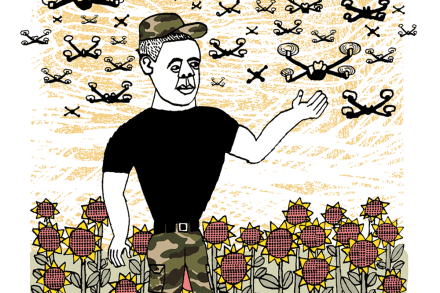
The Ukrainian unmanned ground vehicle rolled up to a small bunker hidden in a thicket in Kharkiv oblast then stopped. Another remote-controlled vehicle had just detonated its 66lbs of explosives at the Russian bunker’s entrance, which was still smoldering. And before that a kamikaze drone had dived inside and exploded. The operator was about to detonate his explosives when two Russian soldiers pushed a sign through the bunker’s shattered roof saying they were surrendering. They were directed to Ukrainian lines by a drone and taken into custody as POWs. So ended the world’s first fully robotic assault on an enemy position. The remotely operated vehicle in this attack is called a Targan (“cockroach” in Ukrainian) and looks like a miniature flatbed without the cab.

killhouse

How the Ukraine war could end in revolt

Ukraine and Russia are exhausted. Neither side is close to defeat and yet discontent is growing on both sides. In Russia, open criticism of the regime is spreading. Social media influencers have, bizarrely, led the charge. In Ukraine, fury is directed at press gangs who hunt down young men and force them, often violently, into the army. Today, the chances of some kind of political crisis in either Kyiv or Moscow seem more likely than a great breakthrough on the battlefield.  In Russia, there was a rare example of the Kremlin responding to criticism earlier this month when influencer Viktoria Bonya posted an Instagram video addressing Vladimir Putin. “The people are afraid of you, artists are afraid, governors are afraid,” she said. “There is a big wall between you and the people.

Ukraine

How Silicon Valley is calling the shots on the battlefields of Ukraine

Sometime in the late morning of February 4, somebody at SpaceX headquarters pressed a computer key. A command line was beamed to Starlink’s 9,600 satellites in low Earth orbit. Their onboard processors, circling 550 kilometers above the Earth, instantly obeyed the command and fractionally changed their operational settings. Back down on the frozen ground, in the trenches, bunkers and ruined cities of Russian-occupied Ukraine, hundreds of Starlink terminals lost internet connectivity. As another freezing night set in, the Russian army’s drones and tactical comms went dark. “We are left without communication!” complained a frontline Russian military officer in a video posted on the Telegram channel “Voenkory Russian Spring.

The war in Ukraine is reaching its endgame

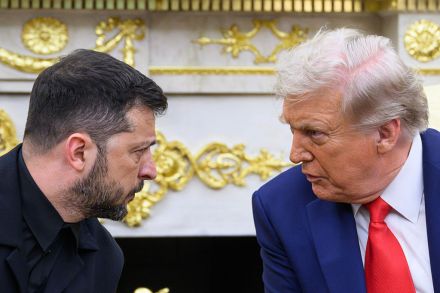
Painfully and chaotically, the outline of the peace deal that will eventually end Russia’s invasion of Ukraine is emerging as the US leans on Kyiv to abandon key red lines. It may still be months before the guns finally fall silent. But one by one various roadblocks to an eventual agreement are falling away. Crucially, this week Volodymyr Zelensky conceded that his country needed new presidential and parliamentary elections. Moreover, for the first time, he floated the possibility that a Ukrainian military withdrawal from Donbas could be put to a national referendum.  "The Ukrainian people must answer the territorial question," Zelensky told reporters on Thursday. "I say clearly: yes, I support elections.

Bureaucrat Main Character Syndrome is killing Ukraine — and America

Kyiv Last week, Texas congressman Pat Fallon asked why Ronald Rowe, the acting director of the US Secret Service, appeared in a 9/11 memorial photo op rather than focusing on his duty to protect Presidents Biden and Trump — just two months after an assassination attempt left Trump grazed by a bullet. Instead of addressing the concern, Rowe, an unelected bureaucrat, lashed out: “Do not invoke 9/11 for political purposes!” Citing his presence at Ground Zero on 9/11, Rowe seemed insulted by the congressman’s challenge to his judgment. But Rowe’s job wasn’t to be part of the story — it was to protect those who actually are the key players, current and former presidents.

What Ukraine really needs from Europe

If bear hugs were army divisions and brave words cash euros, Volodymyr Zelensky would have ended his tour of European capitals this week the best-armed and best-funded leader in the world. "We stand with Ukraine," vowed British Prime Minister Sir Keir Starmer after hosting a summit for Zelensky and top European allies at Downing Street on Monday. "We support you in the conflict and support you in the negotiations to make sure that this is a just and lasting settlement." Germany’s Chancellor Friedrich Merz declared that "nobody should doubt our support for Ukraine" and added that "the destiny of this country is the destiny of Europe." France’s President Emmanuel Macron promised that Europe has "a lot of cards in our hands.

Will the Russia peace deal backfire on Trump?

Kyiv The rumor reverberating around Kyiv is that the FBI has been leaning on Ukrainian anti-corruption police to investigate Zelensky’s inner circle in order to force him to swallow the bitter US peace deal. Trump, as they say, has put the screws, or the feds, on Zelensky. The National Anti-Corruption Bureau – which is unravelling a $100 million war-profiteering scandal that has implicated many of Zelensky’s closest political allies – has denied the accusation point blank, and there’s not a single shred of evidence that it is true.

ukraine

A prayer in Ukraine

By the summer of 2024, Kyivans could joke that there was no way the Russian army could take their city now — they’d never get through the downtown traffic. The simple normality of urban congestion, crawling through grand boulevards in the shadows of buildings that, with fresh coats of paint, would suggest a Wes Anderson vision of Mitteleuropa, could lull a visitor into thinking he could be in any capital on the old Orient Express route. So, too, would the world-class Fenix restaurant, run by a celebrity chef and festooned with Chihuly-inspired decor. It was between the salmon tartare eclair and the rabbit ravioli that I heard for the first time, face-to-face, what it’s like to be persecuted for worshipping God in the wrong way.

Putin thinks time is on his side

Very well then – war. That is the bottom line of Vladimir Putin’s response to Donald Trump’s latest attempts at mediating an end to Russia’s invasion of Ukraine. In August, Putin rejected the peace deal that Trump lined up in Alaska. Now, the Kremlin has scuttled the White House’s plan for a summit in Budapest by insisting that Russia’s demands for Ukrainian demilitarization and “de-nazification” remain in force. Clearly, the Russian President still believes that he can win the war on the battlefield – and terrorize Ukraine’s civilians. What is Putin’s plan?

putin

No, Trump has not changed course on Ukraine

President Trump has once again played the global foreign-policy commentariat for fools. They have taken a startling statement from Trump’s Truth social-media account on Tuesday as a sign of a new policy – or at least a new attitude – toward the Russia-Ukraine war. Yet what Trump actually wrote says nothing of the sort.  If Trump really were newly committing himself to Ukraine, why would say, as he’s so often said before, “I wish both countries well”? One country has invaded the other; wishing one of them well means wishing defeat on the other. Wishing them both well indicates indifference.

Trump Ukraine

The Alaska summit went much as expected

The summit between Presidents Donald Trump and Vladimir Putin ended predictably, without a ceasefire deal or, it seems, assent on much else. Trump said “Many points were agreed to, and there are just a very few that are left,” but failed to offer any details. Even if true, the leftovers are critical, and the gulf between the two governments on the war remains huge. Critically, Putin cares more about security than image or economics, and understandably believes that he would lose leverage by agreeing to halt military operations before winning the concessions he demands from Ukraine. Nevertheless, the summit improved, however slightly, the prospects for negotiating an end to the war.

Trump Putin

Tariffs and the psychodrama of Trump diplomacy

A bleached white conference room, somewhere near Jeddah in Saudi Arabia. On one side sits Volodymyr Zelensky, the Ukrainian leader, in his soldier-boy outfit. On the other, Russian President Vladimir Putin in dark suit and tie. And in the middle, a beaming President Donald J. Trump. "People said this could never happen," he says, as Zelensky and Putin stare awkwardly at the floor. "But it’s a beautiful thing." A White House memo lands in inboxes across the world: "THE PEACEMAKER-IN-CHIEF..." Pure fantasy, perhaps, but Trump does have an almost cosmic ability to get what he wants – and he really wants to end the war in Ukraine. Last night, having spent weeks telling the world how "disappointed" he was with Putin, Trump abruptly announced "great progress" in US-Russia dialogue.

trump Steve Witkoff and Vladimir Putin shake hands (Getty)

The secret life of Agent Melania

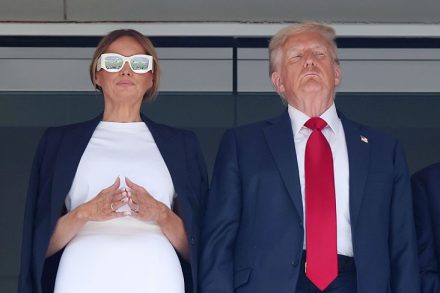
The activities of First Lady Melania Trump have been the subject of much discussion in Cockburn’s circles during her husband’s second term. Where is she? What is she up to? For the most powerful spouse in the world, she keeps an extraordinarily low profile. But now a new theory has emerged: she’s been spying for Ukraine. Over the weekend, an X user named “Kate from Kharkiv” posted a photo of Melania wearing a blue blazer bearing the Ukrainian trident insignia. Melania is also wearing one of her signature wide-brimmed hats, which shield her eyes from enemy view. “Agent Melania Trumpenko,” the caption read. https://twitter.

Melania and Donald Trump at FIFA Club World Cup (Getty)

Play Putin at his own game by ‘nightmaring’ his world order

There’s a delicious Russian verb that derives from the criminal underworld: “koshmarit,” literally “to nightmare someone.” It usually denotes how authorities give criminals, or anyone they dislike, so much relentless hassle from so many different angles they bend them to their will. Vladimir Putin, always keen to bring mafia language into politics, was the first Russian statesman to make use of it in public – he once instructed his authorities to stop “nightmaring” the business community. I keep returning to that word when I think of how Putin’s own foreign policy could be restrained to make real the Reaganite slogan that helped Donald Trump win the election: “peace through strength.

nightmaring

Ukraine war, three years on

From our UK edition

13 min listen

Today marks three years since the start of Russia's full-scale invasion of Ukraine. From early fears of a swift Russian victory to the Kharkiv offensive and the slow war of attrition that has played out since, each stage of this war has been hard to predict. None more so than this stage, with the USA drastically changing tack and tearing up the transatlantic alliance by pursuing back-channel peace talks with Putin. Europe has been left scrambling. Where do we go from here? And with an isolationist USA, the breakdown of the European consensus on Ukraine and the UK's armed forces being hollowed out, who is left to defend Europe? James Heale speaks to Katy Balls and Keir Giles, a senior consulting fellow at Chatham House. Produced by Oscar Edmondson.

europe

Europe learns the facts of MAGA life

Panic, even hysteria, has swept Europe. Its leaders realize that in their case Trump should be taken literally as well as seriously, and he seems prepared to trade the transatlantic alliance for détente with Russia. Eight decades of good times for the continent might be coming to a dramatic end. Trump demonstrated contempt for Europe during his first term; however, his top aides moderated his antagonism, carrying on policy as normal. While out of office he evidently decided never again. Today he is firmly driving American foreign policy. As ever, Trump’s tactics are often dubious, even counterproductive. However, only shock treatment is likely to cause Europe to take its own defense seriously.

What does Putin want from America?

If I had a penny for every time I have been told that Russian president Vladimir Putin only wants respect. Or that he is only interested in eastern Ukraine. Or that if Kyiv is only denied NATO membership, then he will call off the tanks. Well, in the last seven days President Donald Trump has given Putin all this and more. And, though it is still early days, so far the war is showing no sign of slowing. And what has the man who wrote The Art of the Deal asked for in exchange for all this diplomatic largesse? Absolutely nothing. In fact, the only substantive demand Trump has made so far is of the Ukrainians. Last week Washington sent Treasury secretary Scott Bessent to Kyiv with an extraordinary demand.

Putin

The endgame: Biden’s quest for a foreign policy legacy

President Joe Biden only has a few more months before he steps out of the White House, hands over the keys to his successor and spends his remaining days soaking in the Delaware sun. But before he enjoys retirement, the lifelong public servant has a big piece of unfinished business: scoring a major foreign policy win that will secure his place in the history books. Unfortunately, dreaming about being a statesman is one thing; being one is quite another. The two conflicts that would give the president that coveted status — the wars in Gaza and Ukraine — aren’t presently amenable to diplomatic resolution. And while Biden and his advisors may be committed to doing the impossible, all the commitment in the world won’t do much if the combatants are intent on slugging it out.

Biden

Joan Collins, Owen Matthews, Sara Wheeler, Igor Toronyi-Lalic and Tanya Gold

From our UK edition

30 min listen

On this week’s Spectator Out Loud: Joan Collins reads an extract from her diary (1:15); Owen Matthews argues that Russia and China’s relationship is just a marriage of convenience (3:19); reviewing The White Ladder: Triumph and Tragedy at the Dawn of Mountaineering by Daniel Light, Sara Wheeler examines the epic history of the sport (13:52); Igor Toronyi-Lalic looks at the life, cinema, and many drinks, of Marguerite Duras (21:35); and Tanya Gold provides her notes on tasting menus (26:07).  Presented and produced by Patrick Gibbons.

John Mearsheimer on Ukraine, Israel-Gaza and the US election

From our UK edition

44 min listen

Professor John Mearsheimer joins Freddy Gray to discuss the wars in Ukraine and in Gaza, and the influence of both on the US election. The Israel-Gaza conflict has led to internal divisions within the democratic party, how will Kamala Harris deal with this? And as the Russia-Ukraine conflict shows no signs of ebbing, what does he see as the west’s role in the war?  Produced by Natasha Feroze and Patrick Gibbons.