Uk politics

Another goat goes

From our UK edition

News is breaking that the Health Minister Lord Darzi is leaving the government. By my count, that means Lord West is the ony one of Gordon's goats still in post.

The slowdown in government

From our UK edition

It's no secret around Westminster that civil servants are giving up on the Labour government and are wait-wait-waiting for the Tories to shuffle into power.  But few articles have captured that process so well as Rachel Sylvester's column in the Times today, which contains this striking passage about the suspended animation along Whitehall: "It is said that the Civil Service has the engine of a lawn mower and the brakes of a Rolls-Royce. And slowly but surely the government machine is coming to a halt. Contracts are delayed, decisions deferred, reviews welcomed. When Alan Johnson, the Home Secretary, announced a U-turn on ID cards recently, he was only catching up with his civil servants.

The tide turns on public spending

From our UK edition

If further proof were needed that the public’s attitude to public spending has changed it comes in the latest Guardian / ICM poll. It finds that 64 percent of voters think that spending should be being reduced now as opposed to 28 percent who want it increased: the electorate is on the other side of Brown’s favourite dividing line. Even among Labour and Liberal Democrat supporters, a majority favour cuts. Amongst those who favour cuts, the Tories have a significant advantage. 46 percent of those who support cuts think Labour would cut too little with 21 percent saying it would cut too much. With the Tories, 30 percent worry they would cut too much and 22 percent that they would not cut enough.

Public in favour of ringfencing defence spending

From our UK edition

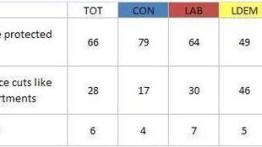
A timely poll from PoliticsHome which finds that two-thirds of the public think defence should be protected from any spending cuts.  Here's their graphic with full results: The question, of course, is whether this kind of public pressure forces any of the main parties to actually shield defence from cuts.  With the debt burden as it is, its difficult to see them doing so while also sticking to their current commitments in other areas. UPDATE: Ok, just to provide a bit of context in the wake of some thought-provoking comments from CoffeeHousers below.

Coulson in the clear?

From our UK edition

It's worth following Andrew Sparrow's typically excellent live blog of the Commons culture committee's first public hearing into the recent NotW "phone-hacking" claims.  So far, the biggest revelation has come courtesy of Nick Davies - the Guardian journalist behind the story last week - and it's one which will please the Tories: "Davies says he has the names of 27 journalists from the NoW and four from the Sun who used a private investigator to get information. Some of the requests were legal, like electoral register searches. But many were not. Davies says he does not want to name the names. "I'm a reporter, not a police officer." But there are a number of senior editorial executives on the list. One was Greg Miskiw, the assistant editor, news, at NoW.

Behind the swine flu panic

From our UK edition

I am instinctively sceptical about health scare stories, so have been watching the Swine Flu story with much suspicion. We are seldom reminded that it's less serious than normal flu. Hysterically, Andy Burnham claims there could be up to 100,000 infections a day in Britain next month - the latest worldwide tally is 121,000. We are told how many die from swine flu, but not how many have also died from normal flu so we can put it in context (the DoH, remarkably, can't tell me).   Proper diagnosis is not being done by our doctors. Virtually anyone with a summer cold is being told to stay at home for seven days - result! - and prescribed Tamiflu just in case.  I went hunting for the normal flu figures, but found something else instead: that this is a London flu.

Defending his own premiership

From our UK edition

The Times's story of how Bob Ainsworth came to be Defence Secretary is equal parts extraordinary and disheartening.  Here are the key passages: "Mr Ainsworth’s predecessor, John Hutton, had indicated to Mr Brown in mid-May that he was thinking of leaving the Government. Mr Hutton, recently remarried, had a compelling family reason for wanting to step down. But Mr Brown, preoccupied with the elections and the possibility of a leadership challenge, appears to have spent little time thinking about the vacancy. It wasn’t until around noon the day after the polls that he began to focus on who should oversee Britain’s military and its engagement in Afghanistan.

A burden for future governments

From our UK edition

If you haven't already, it's well worth reading Robert Peston's analysis of the first annual report from UKFI, the government's banking wing.  There are plenty of fascinating titbits in there, but this passage on how long it will take the government to sell its shares in Lloyds and RBS rather jumped out at me: "As the annual report makes clear, flogging perhaps £100bn of stock in Lloyds and RBS - which is what the holdings may easily be worth in a couple of year - can't be done overnight. That's just too big a mouthful for investors to swallow quickly. How can I be certain?

What did Mitchell mean?

From our UK edition

Andrew Mitchell is doing the media rounds to discuss the Tories' new policy paper on international development, and he seemed to let slip with a major claim on defence spending to the BBC earlier.  Here's how the indispensable PoliticsHome reports it: "Mr Mitchell said that it was not a question of choosing between the budgets for defence and international development, adding that the two departments would work much more closely under a Conservative government. 'I don't think that defence will face cuts, but it's not a question of either or, you have to do both," he said. 'The development effort in Afghanistan which hasn't always gone well and so to upgrade we need to have much closer coordination than we've had in the past,' he added.

Continuing the immigration debate

From our UK edition

My post on immigration the other week was picked up by BBC World Service, who invited me to discuss it with Lord Maurice Peston (podcast here). I regard it as one of the most important yet least discussed issues in Britain right now, and my original also raised some typically robust comments and critiques from CoffeeHousers. My point is that Britain has a dangerously dysfunctional labour market, one so flawed that when the economy expands it sucks in foreign workers rather than tackling our unemployment. I also revealed that all net job creation in the private sector can be accounted for by immigration. Anyway, allow me to respond to some of the points raised: 1. THE BORIS FACTOR.

Who watches the watchmen?

From our UK edition

In the US, a storm is brewing over Dick Cheney’s alleged role in concealing an intelligence programme from Congress. Whatever the details of the alleged offence, it raises an interesting question: should oversight of the intelligence community intrinsically be different from other kinds of parliamentary oversight? Over in the States, Legislators were content to delegate the management of intelligence agencies to the executive until a series of abuses was revealed in the early 1970s, and the House and Senate Committees on Intelligence were set up in 1977. In Britain, however, Parliament has only had scant role in overseeing the intelligence community.

The UK “surge” debate

From our UK edition

The support for Britain's involvement in Afghanistan is, for the first time, showing major signs of fraying. Nick Clegg broke ranks with the other party leaders last week, and this weekend the total number of British deaths went beyond the number of soldiers killed in Iraq. Understandably, the Sunday papers are filled with stories about the lack of troops and kit. The Observer reports that an emergency review is taking place in the MoD to see if more soldiers need to be sent out. So what to make of it all? First of all, it is clear that there were too few troops and civilians deployed to start off. I have given my take on what went wrong initially in Helmand to the Foreign Affairs Committee, as have some of the protagonists like Ed Butler.

What Labour women think of Gordon

From our UK edition

For those of you who missed it, Radio Four has just broadcast a piece about what the women who worked with think Gordon Brown think of him. Not a lot, it seems. Here are some of the quotes: Jane Kennedy "Well I think that the Labour Party is expecting us to do better. The Parliamentary Labour Party were told in the first meeting after the election in June we were promised that there was going to be a change.  We haven't seen that change yet, we haven't even really seen the kind of clarity and willingness to listen to what the voters are telling us about policy.

A framework for shelving tax cuts

From our UK edition

So, the News of the World claims that the Tories are planning to shelve some of their tax-cutting proposals - including the inheritance tax cut and tax breaks for married couples - to help combat the fiscal crisis.  Guido suspects that the news came direct from the Blackberry of Andy Coulson, but the Tories have told Tim Montgomerie to "treat the story with a ton of salt". Either way, I do - like Tim - have some sympathy for the idea that commitments will have to be sidelined to overcome Brown's debt mountain.  The longer those terrible deficits remain, the more future generations will be burdened by the Dear Leader's fiscal sabotage, and the more likely that potential investors will turn away from the UK.

So who’s really “playing politics” over troop numbers?

From our UK edition

Just when you thought Brown's government couldn't sink any lower, you go and read the Sunday Times's lead story today and the comments it contains from "senior Labour figures", including a minister.  Here are the first few paragraphs: "Senior Labour figures accused the head of the army last night of playing politics as he said that there were too few troops and helicopters in the Afghan war zone. One minister expressed fury that General Sir Richard Dannatt, the chief of the general staff, had attended a private dinner with Tory MPs and suggested an extra 2,000 troops were needed in Helmand province. The general’s remarks put him at odds with the official government line, that the 9,000 British troops already in Afghanistan are sufficient to cope with the offensive.

Good lord

From our UK edition

Earlier this week, Lord Malloch Brown announced he's resigning his brief as Africa Minister in the Foreign Office. I'm sure this will cause some rejoicing, including among my Coffee House colleagues. It was, after all, the Spectator that went to town on the former UN staffer's grace-and-favour appartment in Admiralty Arch and the other niceties offered to him by the Prime Minister a few years ago. However, I have always found Malloch Brown professional, courteous, and insightful. He may have struggled to find his proper role immediately upon appointment - foolishly describing himself as a Richelieu-type character to David Milliband's king - and sometimes allowed his sense of self-worth get the better of him, but he was miles ahead of any other Foreign Office minister.

Smith’s claims call Brown’s political judgement into question

From our UK edition

Ok, let's get the hard, grim facts out of the way first: Jacqui Smith was an ineffective Home Secretary whose expense claims were dubious, to say the least, and who rightly lost her job in government.  But - having said that - it's hard not to feel slightly sorry for her as she discusses the embarrassment caused by her husband's porn rentals in an interview with the Guardian today.  The whole piece is a remarkably candid exchange: she also discusses how she "did wrong" with her expenses, and how she'd "definitely" be voted out "if the general election was tomorrow".  But this passage struck me more than any other:      "[Smith] insists she wasn't forced out - that Brown asked her to stay when she first said she wanted out.

National security priorities: your say

From our UK edition

Watch out: it's security review season. The Brown government is about to issue a second version of its National Security Strategy. You can expect Pauline Neville-Jones to put out a revised version of the paper she did for the Tories a while ago. The Obama administration is set to launch a new "Quadrennial Diplomacy and Development Review," to be headed up by Deputy Secretary of State Jacob "Jack" Lew and Policy Planning chief Anne-Marie Slaughter. While NATO has just begun work on its Strategic Concept, and Russia recently updated its National Security Strategy. Oh, and the EU disseminated a new Security Strategy under the French EU Presidency, which also saw the French government issue its Livre Blanc, a national security-type document.

Brown’s legacy of inequality, poverty and joblessness

From our UK edition

We all know Labour has failed to run an efficient economy or public services, but what’s little discussed is its failure to achieve even its own goals. Had Brown bankrupted the country but, say, made the poorest much better off, then Labour members might not be facing such an existential crisis. As it stands they won three victories, trebled health spending, redistributed some £1.5 trillion – and will end up with a society even more ‘unequal’ than it ever was under Thatcher. I look at this in my column today, and thought I’d share a few of the points with CoffeeHousers. First, equality. This (rather than making the poor better off) is the great leftist goal – and it can be nominally achieved by hurting the rich.