Uk politics

Expect more “fine print” on spending soon

From our UK edition

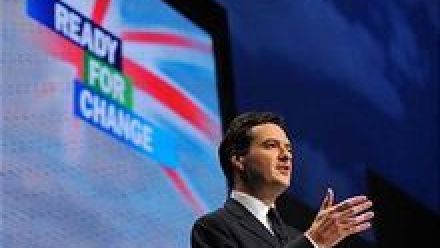
Sifting through this morning's papers, you'd say that it's mission accomplished for George Osborne's speech yesterday. The realigned Sun demonstrates how much it has got behind the Tories, by giving the Shadow Chancellor an absolutely glowing report ("the Shadow Chancellor came of age"). He also receives good-to-medium notices in the Times, the FT and the Independent, while the Guardian is more mixed, but hardly damning. In the Mail, Quentin Letts writes that "Yesterday the Boy became Boss George". And so on and so on. You can see where they're all coming from.  As I wrote yesterday, there's much that was impressive in Osborne's speech. But there were also some weaknesses on the policy side of things.
Cameron needs to tackle the expenses scandal head on

From our UK edition

The current consensus issue in British politics is not to discuss the expenses scandal. The so-called ‘New politics’ was a brief footnote in both Brown’s and Clegg’s conference speeches, but public anger remains palpable. Daniel Finkelstein points out that the Tories stand to lose the most from sidelining the issue: continuity undoes their claim that they stand for wholesale change. That is unquestionably true. Whilst the leadership prepare us for the age of austerity, visions of duck houses, moats and servants’ wings pervade the public consciousness, even though those responsible have been disciplined.

Aside from saving Gordon Brown, twice, what’s Peter Mandelson ever done for us?

From our UK edition

For such a Big Beast, Ken Clarke’s speech this afternoon was very pedestrian. Admittedly, the subject matter, cutting red tape for small businesses, was unlikely to inspire a carnival of Churchillian wit and verve. However, Clarke did provide activists with a whiff of red of meat: he trashed Mandelson’s come back. "Yes, I agree with him - responsibly and in the national interest - agree with him on the future of Royal Mail.  We agreed with him when he took his Bill through the House of Lords.  And what happened?  That weak and dithering Prime Minister – Gordon Brown - has stopped him bringing his Bill into the House of Commons.

Cameron & Osborne getting into a muddle over 50p tax

From our UK edition

When Fraser interviewed David Cameron last week, the Tory leader suggested that the 50p tax rate would be easy to drop, if necessary.  If it doesn't raise any money, then - voilà! - it's gone.  In fact, here are the Tory leader's words: "If you're right that it raises no revenue, even in the short term then clearly it would be painless and advantageous to get rid of it at an early stage." But George Osborne's policy package today contains this little nugget, taken from the press notes: "The new 50p tax rate and associated changes to the taxation of higher earners should be kept in place for at least as long as the public sector pay freeze, in order to ensure that the richest in our society pay their fair share of the burden of tackling Labour's debt crisis.

Dannatt may be overstating his case, but the government is being disingenuous

From our UK edition

General Sir Richard Dannatt issues a vociferous condemnation of the government’s commitment to British efforts in Afghanistan in the print edition of today’s Sun. Dannatt asserts that Gordon Brown vetoed increasing the British deployment by 2,000 troops, against the advice of military chiefs. He told the paper: “The military advice has been for an uplift since the beginning of 2009. If the military says we need more troops and we can supply them, then frankly they should take that advice and deploy up to the level we recommend. “If it means finding more resources and putting more energy in, let’s do it. If you’re going to conduct an operation, you’re doing it for one reason – to succeed.

Gotcha!

From our UK edition

When David Cameron turned up to The Spectator’s party last night, I thought it only decent to ply him with a glass of fizz. After all, a magazine whose motto is “champagne for the brain” can hardly begrudge champagne for the guests. And what’s the harm, I thought – there were no photographers at the party. Right? Wrong. The picture is now on the front page of the Evening Standard – with yours truly beside Cameron having just plonked it in his hand a few seconds earlier. I promise, it wasn’t a set-up: we thought we’d cleared the place of photographers.

How are the Tories responding to Labour’s pay freeze?

From our UK edition

So what do the Tories make of Alistair Darling's limelight-grabbing decision to freeze public sector pay? The ones I've spoken to seem perfectly relaxed with it. A little bit annoyed perhaps: wouldn't you be, if your opponents appeared to cynically delay an announcement that they could have made during their own party conference last week?  But they're confident that the public will see through the stunt, and that it will actually reflect badly on Brown & Co.  On top of that, the Tories are sure that Labour will make little headway in a news agenda that will be dominated by Tory announcements for the next few days. It's hard to disagree with them.

Will the civil service block Tory Euroscepticism?

From our UK edition

Of all the countless leaflets, pamphlets and circulars being handed out in Manchester, one of the most interesting is a glossy collection of essays entitled Cameron's Britain.  It has been put together by the folk at Portland PR - who recently hosted that "war game" which James reported back on - and has entries on everything from the NHS to tackling global poverty. As it doesn't seem to be online, I figured it's worth quoting from one of the most insightful essays of the bunch: that by Steve Morris, a former Downing St adviser, on the Whitehall machinery that the next government will have to get to grips with.  Norris makes some important points - e.g.

Further, stronger, faster

From our UK edition

Later today, George Osborne will elaborate on the Conservatives’ plan to raise the state pension age to 66. The rise will be enacted by 2016 at the earliest and will save an estimated £13bn per year. The Tories will review how they can accelerate the original planned pension age rise, dated for 2026, that would link the state pension with earnings. There’s much to elaborate upon, notably how the rise will affect female retirement age and exactly how much money would be saved overall. But essentially, this move should be welcomed. It is realistic and proves that there’s substance to the Conservatives’ cuts agenda beyond ‘trimming bureaucracy’ and burning quangos.

Lansley keeps the spending taps on

From our UK edition

Struggles with the conference internet connection prevented me from posting on it at the time, but it's still worth flagging up Andrew Lansley's big speech on the NHS today. Why so? Well, because it exemplifies how the Tory message on health undermines their general rhetoric on public spending. At the heart of the speech was a pledge that I'm sure many CoffeeHousers would cheer: to slash the money spent on NHS bureacrats by a third, from £4.5 billion to £3 billion. Good stuff, you might think. That's what governments should be doing in there difficult times. And you'd be right. But the rest of Lansley's speech was at odds with this basic position. There were, of course, the familiar reminders that the Tories would increase health spending year-on-year.

Tory welfare plan is welcome but does not go far enough

From our UK edition

The Tories new welfare plan is, it seems, their old welfare plan – with a more ambitious timeline. It’s to be welcomed, but this is not the step change that you’d expect. In Jan08 Chris Grayling broke new ground when he proposed diagnosing all 2.7m on incapacity benefit for what work they could do (as opposed to the ‘ill’ or ‘sick’ binary distinction). Today, they express an ambition to get this done in three years. Set aside questions as to whetehr you can find enough doctors to do 2,500 “capabilty asssessments” every day – all this means is going a little faster on the original Freud proposal. There is a welcome move towards benefit simplification, but I have to agree with the conclusions of James Purnell on Open Left.

We have a tax cut

From our UK edition

George Osborne has just announced a tax cut. Any new business started in the first two years of a Tory government will pay no employers’ national insurance contributions on the first ten people it hires. This means these first ten employees will cost new businesses 12 percent less. This is a move that makes sense in both economic and political terms. Economically reducing the tax on jobs is a good move, getting more people into work will eventually result in more money coming into the Exchequer. Politically it is smart as it gives the Tories something they can point to on the doorstep to show they really are serious about boosting job creation.

The Tories in the stocks

From our UK edition

Here’s something new for party conference season: real people. About 200 of them. Firemen. Unemployed. And, yes, workers. They are brought to you courtesy of Victoria Derbyshire’s Five Live show, where I am sitting at the back listening to this mass focus group session. It has become (for me, anyway) an unmissable feature of the party conference season – a welcome injection of real life into the all-too-myopic conferences. Cabinet and Shadow Cabinet members turn up knowing that this session will be about all the normal, disinterested person will hear about the conference. Now and again, she asks them to clap or boo depending if they agree or disagree. It’s fast-moving, and very much to the point.   One point has jumped out at me immediately.

Book Club October book of the month

From our UK edition

Following a lively discussion and a member’s poll, the Spectator Book Club’s October book of the month is Bilton, by Andrew Martin. By all accounts it is an extremely funny satire of politics and the media in the late 90s, and it comes highly recommended by a number of Book Club members. You can buy a copy at a 10% discount, courtesy of Blackwells, if you register with the Spectator Book Club.

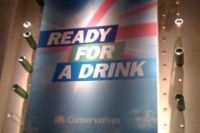
Labour isn’t working. Have a drink

From our UK edition

Thanks to Guido for snapping this arresting political slogan. The Conservatives will now sweep the country; of that I have now doubt. But as ever, there is a complication. In what is clearly an indication of the Tories’ target audience and political intent, lashings of Scotch and Newcastle Brown Ale are readily available, but Eric Pickles has banned Champagne. Is this the precursor of a hardening Eurosceptic line…?

The need to go further and faster on Welfare reform

From our UK edition

I’m on my way to the home city of the best football club in the world (and one of the worst) shortly.  In the meantime, it’s worth flagging up this morning’s reports on Tory welfare policy, which we’ll be hearing more about later today.  Basically, the Tories are going to re-emphasise that they’d put incapacity benefit claimants through medical tests, to check their ability to work, and that the more effective private-sector wing of the welfare service would be massively expanded.  While this is, in essence, an extension of existing government welfare policy, it’s certainly to be welcomed.

The Tories look evasive on Europe, but now is not the time to clarify

From our UK edition

The phrase “we will not let matters rest” sounds slightly menacing, but it’s completely opaque. Is it time for the Tories to define what they mean by it? The leading article in the Times argues that perhaps it is. ‘Now that the Irish have ratified the Lisbon treaty at the second attempt, the Conservative Party needs to listen to Robert Peel. In 1834 Peel issued a manifesto in Tamworth in which he said the Conservative Party should now accept the Great Reform Act which it had vigorously opposed. Now that David Cameron finds himself struggling to clarify the circumstances in which he will offer the nation a referendum on the Lisbon treaty, he could do worse than echo Peel’s sentiment.

Straight talk on Lisbon?

From our UK edition

I have just been on a phone-in with Five Live, and heard Greg Clark getting into a fix over Europe. “Are you going to do some straight talking with us tonight?” asked Steven Nolan. Yes, he replied. What will the Tories say if Lisbon is ratified, then? Wriggle wriggle wriggle. “We don’t deal in hypotheticals” Clark said – the worst possible answer in my view. Any question starting in the word “if” is a hypothetical, and politicians answer them all the time. To claim otherwise insults the intelligence of listeners. But what other option did Clark have? I can’t understand why the Cameroons don’t say that there is no point in a post-ratification referendum. Who would they be upsetting?