Uk politics

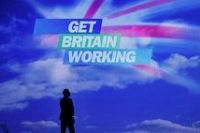
Labour isn’t working. Have a drink

Thanks to Guido for snapping this arresting political slogan. The Conservatives will now sweep the country; of that I have now doubt. But as ever, there is a complication. In what is clearly an indication of the Tories’ target audience and political intent, lashings of Scotch and Newcastle Brown Ale are readily available, but Eric Pickles has banned Champagne. Is this the precursor of a hardening Eurosceptic line…?

The Tories look evasive on Europe, but now is not the time to clarify

The phrase “we will not let matters rest” sounds slightly menacing, but it’s completely opaque. Is it time for the Tories to define what they mean by it? The leading article in the Times argues that perhaps it is. ‘Now that the Irish have ratified the Lisbon treaty at the second attempt, the Conservative Party needs to listen to Robert Peel. In 1834 Peel issued a manifesto in Tamworth in which he said the Conservative Party should now accept the Great Reform Act which it had vigorously opposed. Now that David Cameron finds himself struggling to clarify the circumstances in which he will offer the nation a referendum on the Lisbon treaty, he could do worse than echo Peel’s sentiment.

Straight talk on Lisbon?

I have just been on a phone-in with Five Live, and heard Greg Clark getting into a fix over Europe. “Are you going to do some straight talking with us tonight?” asked Steven Nolan. Yes, he replied. What will the Tories say if Lisbon is ratified, then? Wriggle wriggle wriggle. “We don’t deal in hypotheticals” Clark said – the worst possible answer in my view. Any question starting in the word “if” is a hypothetical, and politicians answer them all the time. To claim otherwise insults the intelligence of listeners. But what other option did Clark have? I can’t understand why the Cameroons don’t say that there is no point in a post-ratification referendum. Who would they be upsetting?

A festival for the political class

When you get on a train on a Sunday and find First Class is more full than the cheap seats, it can only mean one thing: a political party conference is starting. The Tories starts tomorrow – but still, folk travel up today. Why a Monday start? And why Manchester? The seaside resorts were chosen when party conferences were rallies of the grassroot members, and venues were chosen for their supply of cheap (usually B&B) accommodation. Now, most people who attend are the new breed of political professionals who are not paying their own hotel bills. Lobbyists, quangocrats, NGO advisers, journalists, the whole lot. And they come to meet each other, not really watch what’s going on.

Who won’t make it into Cameron’s Cabinet?

There are 29 members of the Commons and the Lords speaking from the podium at conference. Four shadow cabinet members are not — Lord Strathcylde, Lady Anelay, Patrick McLoughlin and Mark Francois. We shouldn’t read too much into who is not speaking. The Leader of the Lords and the Chief Whips in the Lords and the Commons are not regular conference turns and there is an obvious reason why the Tories don’t walk to talk about Europe. What might be more significant is that one person who is on the front bench but not in the Shadow Cabinet has got a slot, Maria Miller — suggesting that the party hierarchy rate her communication skills. But the 29 speakers beg the question of who won’t make it into Cabinet.

We await the beef

The Tories have been briefing heavily that this would be a policy heavy conference. Indeed, I’m told that every shadow Cabinet member will have at least one substantive announcement to make. But there is relatively little that is genuinely new in the Sunday newspapers. One explanation for this is that the Tories accept that Lisbon is going to crowd out any other story. One senior source told me on Friday that CCHQ thought that nothing other than Europe would have cut through until Sunday afternoon. So far, the Tory containment operation on Europe appears to be just about holding. There is, though, grumbling about Boris’s comments in the Sunday Times which are seem as being distinctly unhelpful and threaten to reignite the stories about tension between him and the leadership.

Cameron’s radicalism is best for Britain

The Observer’s leading article asks the question: will David Cameron’s modernism serve Britain’s interests? The article’s conclusion is a firm ‘no’; its key is that the ‘Conservatives' apparent relish in tackling the budget deficit is not entirely economic in motivation. It expresses a broader ideological commitment to a smaller state.’ A smaller state is better for Britain. The consistent growth of the state over more than a decade has demolished Britain’s financial strength. In changed economic circumstances, its continued growth is unsustainable. July is a month that should produce a revenue surplus, as tax receipts outweigh borrowing. This year saw a £8.1bn deficit.

The European issue gets the Tory conference underway

The Conservative conference is just hours old, but already Cameron faces a battle to hold the line over Europe and the Lisbon treaty.  He produced his standard response on the Andrew Marr show: that he wanted a referendum if the Czechs refuse to ratify the treaty. And he added: “I don’t want say anything or do anything that would undermine what was being decided and debated in other countries”. Meanwhile, rent-a-quote Europhiles and Eurosceptic Tories exchange blows in Manchester. Leon Brittan described a possible referendum on the Lisbon Treaty as “ludicrous” and Dan Hannan has just told Sky News: “This is not the Conservative party of the past. This is a 1990s story.

Signs of the changing political landscape

So how radical is David Cameron? I  was on a Radio Four panel yesterday for “Beyond Westminster” (now online) where, for once, I was not the only token right-winger. It was presented by Iain Martin and had Bruce Anderson, who wrote this week’s cover piece about Cameron, and Jackie Ashley. I was begging Iain to introduce her as being from “the left-wing Guardian” to repeat the intro that the BBC so often gives the “right-wing” Spectator (“Warning: the views you are about to hear are not from the consensus”). Iain asked me if I thought Cameron had the courage and the character needed to transform Britain. I concluded with words of endorsement that had TGF UKIP choking (on another thread). In spades, I said.

Time to start banging on about Europe

It’s not yet official, but everyone is couning on a big “yes” from Ireland – to the tune of about 64% says The Guardian. I say in my News of the World column tomorrow that this is far from a disaster for the Conservatives. It works well for them, in fact: it isn't nerds who want a UK referendum but any fair-minded person who has just witnessed the way Brussels bullies, bribes and cajoles to get its way. Tony Blair was the one who reneged on his promise of a rederendum – something which, in my opinion, should be a criminal act (but, as Stuart Wheeler tested, is not technically breach of contract). And who is to be EU President? Blair himself. It will be dawning on Cameron, fairly soon, why Europe is important.

The politics of hope are dead. Cameron has everything to gain by being realistic

Publicly at least, Labour MPs are jubilant that Gordon Brown has agreed to appear, in principle, in a televised election debate. They give the responses to the creed first spun by Blair: that Brown is an arch-realist and heavyweight who will undo the vacuous Tories in debate. Certainly, Mr Brown is blessed with talents. As proud wives like to do, Brown’s listed his the other day – intelligence, hard work, dutifulness, diligence and patriotism. All laudable attributes, but even from environs of the cosy Labour conference, Mrs Brown did not dare suggest that her husband was in any way a realist. Brown’s, and Labour’s, messy divorce from political reality was finalised this week when they launched a limp counter-attack based solely on crass anti-Tory slurs.

Brown agrees in principle to TV election debate

Despite trying to turn Adam Boulton to stone on Tuesday night, Gordon Brown has agreed in principle to appearing on the Sky election debate. It's long been suspected that he would agree to participate, today merely confirms the rumour. If the debate goes ahead, it would represent a huge change in British electoral procedure. Mr Brown deserves credit for contributing to that change. Why he did not choose to announce this positive move, illustrating that he's prepared to take the fight to Cameron and Clegg, in his conference speech defies belief and speaks volumes about his political courage and instincts.

A glimpse of Home Secretary Grayling?

Chris Grayling’s reputation as a one-dimensional attack-dog was accentuated by his ill-judged comparison of Britain with Baltimore. The argument laid against Grayling is that he shouts about the government but provides no more than a whisper about policy. However, Grayling shows deep and nuanced consideration of policy when interviewed by Martin Bright in the Jewish Chronicle. Grayling’s subject is extremism and failing multi-culturalism. I apologise for its length, but here is the key section: ‘“I think the government has to make it absolutely clear that anyone in our country who espouses violence is not going to be able to do business with the government of the day and in many circumstances will be putting themselves in danger of prosecution.

How to form a government

The change from being in opposition to being in government is almost impossible to gauge. How does a new prime Minister assume control of government? Peter Riddell gives David Cameron 10 tips that would ease the process. To emphasise the scale of Cameron’s impending problem, the only tip he can enact now is to ensure a smooth transfer from Shadow Cabinet to Cabinet. Riddell writes: ‘Do nothing that would make governing harder. When appointing Shadow spokesmen, think whether you want them to do the same job in office. In 1979 and 1997, two fifths of the new Cabinets had not held the same posts in opposition.

Council tax freeze is a cracking wheeze for Labour

Paul Waugh has the scoop that all eight Labour councils in London will freeze council tax from next April. The councils worked with Communities Secretary John Denham, who emphasised that 2010-2011’s increase in the central grant means that tax rises are unacceptable. As Waugh puts it, the “low-tax era seems finally to have begun”. This is very early to announce rate levels and represents a pre-election skirmish, suggesting that Labour will campaign on the issue of maintaining low council taxes nationwide. Labour face annihilation in the capital, so freezing unpopular rises whilst not embracing equally unpopular cuts is politically smart.

The SFO can go hang, BAE should not be prosecuted for doing business

All eminent barristers have their specialism, Lord Goldsmith’s is changing his mind. Scholarly integrity is to blame – he likes to give both sides of the argument. His two thrillingly different Iraq war advices are, of course, his crowning achievement; but he’s playing devil’s advocate again today. He writes in the Guardian: ‘I applaud Richard Alderman, director of the Serious Fraud Office for his vigour in pursuing corruption cases in Africa and eastern Europe against BAE. Reports are that he had put an ultimatum to BAE to reach a plea agreement or suffer the full weight of prosecutions. He is right to do so.’ Now, the general sentiment expressed is somewhat at variance with his position on the BAE/al-Yamamah scandal in.

Memo to Brown: compromise can be a good thing sometimes

Iain Martin writes a typically insightful post on Labour's conference capitulation.  His central point is that Brown & Co. are following a misguided "no compromise" strategy: "These difficulties with the media are part of a wider problem with the so-called 'fight-back' strategy being used by Gordon Brown. It is based on an analysis which is highly unlikely to convince any voter to change his or her mind. In short, it runs like this: 'We have looked at the many opinion polls which tell us the vast majority of you think we’re untrustworthy and have messed up monumentally. But we think you’re wrong. We’re actually brilliant, and we’re going to keep telling you so, in a very aggressive fashion.' Who is going to be wooed by that?