Uk politics

An untrumpeted change

From our UK edition

John Rentoul rightly flags up the story in this morning’s FT that about 100,000 NHS patients have gone private and had the state pick up the tab, the private hospitals have had to agree to do the work at the NHS price. For those of us who would like to see the NHS move towards a model where the state pays for healthcare but it is provided by a whole panoply of providers, this is an encouraging step. This kind of consumer-focused reform is hard to reverse. The story, as John notes, hasn’t got as much coverage as it should. John blames this on the press’s lack of interest in policy stories. But it is also the case that the Brown government, which is currently slowing down if not reversing Blair’s NHS reforms, hasn’t chosen to trumpet this story.
The quangocracy laid bare

From our UK edition

At last the full facts about our burgeoning quango state are laid bare. The conclusion of a report published today by the TaxPayers’ Alliance is that it’s "big, bloated and more expensive than ever before." The TPA document provides the most comprehensive and up-to-date listing available of all 1,152 'semi-autonomous public bodies' operating in the UK, along with details of how many staff each employs and how much they spend. More than £90 billion of taxpayers’ money was spent on or channelled through quangos/SAPBs in 2007-8 (up £13 billion on the year before). That’s equivalent to £3,640 for every household in the land.

The Neather clarification

From our UK edition

Plenty of CoffeeHousers are mentioning the Andrew Neather revelations in various comment sections.  If you haven't seen them yourself, the story is that Neather, a former government adviser, wrote a comment piece claiming that New Labour's immigration policy was "intended - even if this wasn't its main purpose - to rub the Right's nose in diversity and render their arguments out of date."  Many reports since have taken this as confirmation that Labour's policy was exclusively politically-motivated.    In which case, it's worth highlighting Neather's latest column for the Evening Standard, in which he claims his comments have been exaggerated and misinterpreted.

The Tories develop their <em>de facto</em> Glass-Steagall Act

From our UK edition

The most striking aspect about George Osborne's speech today is how it concentrates on retail banks - the banks you and I do business with - rather than the big investment banks.  He's expected to announce that retail banks should stop paying "excessive cash bonuses" to their senior staff, but should instead reward them with shares in the company and use the cash they would have dished out to increase the amount of credit in the economy.  This won't apply to investment banks. The separation rather recalls the American Glass-Steaghall Act, which split commercial banks from their riskier investment counterparts.  The thinking behind it was that the investment banks could then get up to all kinds of risky behaviour, without then impacting upon ordinary people's money.

The EU prepares for a Conservative government

From our UK edition

The wheels seem to have come off Tony Blair’s EU presidency campaign and no doubt there is much genuflection and soul-searching in Connaught Square. The Director of the Centre for European Reform, Charles Grant, gives an intriguing explanation at Comment is Free: ‘Yet it may be the Conservatives who spike Blair's chances of getting the job. William Hague, the shadow foreign secretary, has told the other EU governments that the Conservatives would see support for a Blair presidency as a "hostile act". A week ago, Blair was the clear favourite, with the likely support of Britain, France, Germany, Italy and Spain, plus several of the smaller countries. But on my travels around Europe last week, I have found that Hague's comments have made a huge impact.

The Tories now have a monopoly on the language of optimism

From our UK edition

So how big a blow was the news that we're still in recession to Gordon Brown?  Well, compare and contrast his latest podcast on the Downing Street website with David Cameron's article in the Sunday Times.  Brown's effort is necessarily defensive.  Gone is the "we're leading the world" bombast of a few weeks ago, to be replaced with a crude "pledge" to get the economy growing again by 2010: "My pledge to you is to make reform of the financial sector a reality, and to see Britain's economy return to growth by the turn of the year." While Cameron's effort is considerably more agressive, and concentrates on outlining a "pro-growth, pro-enterprise agenda".

Still no room for complacency about the BNP

From our UK edition

It's an odd one is today's ICM poll in the News of the World.  Most of it makes for sobering reading for the political class: it finds that two-thirds of voters think the mainstream parties have no "credible policies" on immigration, and that one-third agree with a core BNP policy on removing state benefits from ethnic minorities.  The Tories will be disappointed to see that only 20 percent of respondents think that their plan to cap immigrant numbers will work. But there are also some findings which support Alex's thesis that we shouldn't be unduly troubled by the levels of support for the BNP.  For instance - and despite all of the above - 26 percent say the Tories have the best policies on immigration, compared to 21 percent for Labour and 13 percent for the Lib Dems.

Get ready to feel worse about our political class

From our UK edition

If you want an idea of how resistant MPs might be to the proposals of the forthcoming Kelly review into expenses, then I'd suggest you wander through to page 13 of today's Sunday Times.  There you'll find a story about how MPs are planning to counter Kelly's expected ban on employing relatives.  Their ideas stretch from employing each others' relatives ("a giant wife swap") to taking legal action. In this particular case, I think there's something attractive about the compromise revealed by James on Wednesday: that MPs be allowed to employ one relative each.  But, even if that compromise is made, it still only defuses one sub-section of Kelly's review.

For want of leadership and a clear aim

From our UK edition

A Channel Four News You Gov poll suggests that an overwhelming 84 percent of the public think that the war in Afghanistan is being lost and that British troops specifically are not winning in Helmand. Just because a large majority think that British troops are losing the fight does not mean that the public are not behind the forces’ efforts, but it is hardly a ringing endorsement and British servicemen deserve support. But, this poll should send a clear message to the cross-party consensus in this country and Nato leadership that the current ill-defined strategy is failing.

The Tories’ support for the war in Afghanistan owes nothing to neo-conservatism

From our UK edition

In his column in the Mail, Peter Oborne writes that Cameron’s stance on Afghanistan represents the same mistake made by IDS in his unstinting support for the Iraq war. Oborne fears that neo-conservatism has gripped the Tory leadership. ‘The ‘Neocons’, despite being discredited by the Iraq war, have furtively regained their position at the heart of the Tory party. Almost without exception, Cameron’s senior team are passionate Atlanticists who seem committed to the policy of ‘reinforcement of failure’ in Afghanistan. Both the Shadow Foreign Secretary William Hague and the Shadow Defence Secretary Liam Fox are ‘Neocons’. As are Cameron’s two most trusted Shadow Cabinet colleagues, Michael Gove and George Osborne.

One in five would consider voting for the BNP

From our UK edition

Here are the stand-out findings from today's YouGov poll, conducted after this week's Question Time, for the Telegraph: "The survey found that 22 per cent of voters would 'seriously consider' voting for the BNP in a future local, general or European election. This included four per cent who said they would 'definitely' consider voting for the party, three per cent who would 'probably' consider it, and 15 per cent who said they were 'possible' BNP voters." This just reinforces my qualms about Thursday night's show.  Yes, Griffin embarrassed himself in front of a hostile audience and panel, but that may not have mattered.  He had already reached out to any potential voters before the cameras were switched on.

Worse than the Major era?

From our UK edition

Here's one for Coffee Housers: is this government sleazier than John Major's?  Asked that question on the BBC News channel's Straight Talk with Andrew Neil this weekend, Martin Bell has no doubts.  "I think this one is worse," he says. But that's not the end of it.  The former independent MP thinks that the parties need to start looking towards their front benches if they're to properly cleanse the taint left from the expenses scandal: "But I do think it is going to require the assisted departure of all frontbenchers of both parties who have claimed unreasonable and disproportionate expenses.  And if you look back over the dramas of the last four or five months, not a single frontbencher has been removed.

There is no need to go out this Saturday

From our UK edition

The Thick of It returns tomorrow night and by all accounts its as cynical, savage, sweary and uniformly contemptuous as ever. The subject matter of this series is, apparently, over promoted female Cabinet ministers – very topical in view of the government reshuffle and the Conservatives’ perverse all-female candidate lists. It goes without saying that the show’s producers have a sense of humour, but to make the fact plain they invited Jacqui Smith, Hazel Blears and Caroline Flint to the premier on Tuesday. I’m told they didn’t like it. Anyway, The Thick of It is the sharpest and most well attuned political satire since Yes Minister; it’s essential viewing.

Liberalism is good, beautiful and true

From our UK edition

Most of the media responses to Griffin have been a bit complacent. He was exposed as a dodgy idiot, the vast majority say. I thought he came across pretty well, considering the wrongness of his views. I was uncomfortably reminded that the message of an extreme reactionary is always surprisingly seductive, tempting. The essential appeal is the promise that life can be radically simpler. This strikes a chord in the vast majority of us. We are burdened by complexity, anxiety, a sense that the contemporary world is alienating, chaotic. A vision of our culture being purged of its cultural complexity and working more effectively and more simply is, alas, beguiling. There's something in our dodgy DNA that responds to the dark logic.

Griffin to complain about “lynch mob” Question Time

From our UK edition

Nick Griffin has just made the following statement: “It was not a genuine Question Time, it was a lynch mob… People wanted to see me and hear me taking about things like the postal strike. Let’s do it again and do it properly this time.” He added that he would lodge a “formal complaint to the BBC over the way it twisted Question Time”. As James wrote last night, the debate was an extended navel gaze into whether it was right that Griffin appeared on the programme. Whilst Griffin unquestionably came off worse by babbling about a rather enigmatic, non-colour specific group called British aborigines, the panel missed the opportunity to demolish the BNP’s policies, by concentrating on illustrating that the BNP is ideologically racist.

So where does this leave Brown?

From our UK edition

Most people expected this morning's official GDP statistics to show that the economy has come out of recession.  But they didn't.  In fact, they had the economy shrinking by 0.4 percent in the third quarter of this year.  So the downturn continues – and it's the longest on record. We've always maintained on Coffee House that coming out of recession won't do much good for Brown.  But, obviously, staying stuck in one has far more dangerous implications for him (not to mention the country).  Obviously, the government won't be able to deploy the green shoots strategy now.  But with other major economies already out of recession, they'll struggle to deploy it in future.  You imagine the Tories will have a field day with this.

Euro Foreign Minister Miliband?

From our UK edition

The Lisbon Treaty decrees that Europe must have a Foreign Minister. It is not clear exactly what the Secretary of State will do, but David Miliband is being widely tipped for the role. According to one diplomat quoted in the Times and the Guardian, Miliband has “good European credentials and a brilliant mind.” The minister made famous (rather unfairly) by banana-wielding and a penchant for Indian donkeys is undoubtedly pro-European: he is in favour of further integration and deeply opposed to Cameron’s euroscpetic Tories and their European allies: so he ticks all of Brussels’ boxes. But would he take the job? The Labour party’s Titantic predicament is now so advanced that the protagonists have given up reorganising the chairs on deck.

Tin pot Griffin fluffs his lines

From our UK edition

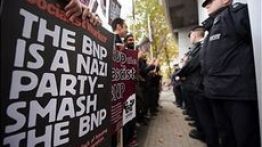
Mobs of howling protestors outside the BBC. Police cordons being smashed by anti-fascists. News clips of upended students being dragged across the foyer of the TV Centre shouting, ‘Shame on you for defending fascism.’ It was chaotic, it was emotive, it was anarchic. But, ultimately, it was a marvellously British occasion. Thanks to the BNP, we were given proof tonight of the rag-bag unity of our society. No one is quite sure how Nazi bogeyman Nick Griffin was smuggled into the Shepherds Bush studios for the recording of Question Time. The best evidence is that he stowed away in a lorry driven by an unsuspecting dupe who failed to check the back of his rig. When Griffin entered everyone was amazed that his suit was unsmeared by bunged eggs.

The laughter will have hurt Griffin

From our UK edition

There's only one question that counts now that Question Time has been shown: did it do Nick Griffin and the BNP any good? It's a tough one to answer. To my eyes, at least, Griffin embarrassed himself in front of the cameras - he was given scant opportunity to gloss over his more unsavoury views; he looked terribly uncomfortable whenever the debate ran away from him; and the other panellists scored most of the major points. But we largely expected that anyway. Griffin was always going to come under heavy questioning, and he was never going to have many friends in the audience. Like Fraser, I fear that much of Griffin's job had been done before he appeared in front of the cameras.