Uk politics

Scorching the earth

From our UK edition

Tim Montgomerie is right; Peter Oborne is at his best in the Mail today – a mix of relevant history and sharp analysis of current affairs. Like Callaghan and Major before him, Gordon Brown faces electoral defeat. Brown’s predicament is deep – consistently loathed by the electorate and the target of unhatched coups and constant intrigue. How does a prime minister defend a hopeless position? Does he govern in the best interests of the country, his party, or himself? Oborne remarks about the magnanimity of Callaghan and Major and notes that Brown has not followed their example. ‘The truth is that Gordon Brown is now governing Britain purely for partisan or even personal advantage rather than in the national interest.

Hain’s hollow rhetoric 

From our UK edition

This week’s interviewee on the BBC’s Straight Talk with Andrew Neil is Peter Hain. One of the topics for discussion is Labour’s disengagement with its core vote and the rise of the BNP. Hain admits that this can be ascribed to Labour’s failings and Westminster’s disengagement with voters. Certainly, Labour’s failure on housing and migration has been a major factor in Griffin’s rise. But there is nothing to suggest that Labour has the political strength to re-engage. Even after the recent furore, there have been no new initiatives on housing or migration, just pitiful contrition in the place of action. Hain’s outright refusal to share a platform with the BNP and engage with its arguments is a case in point.

A careful believer

From our UK edition

Is David Cameron religious? In the course of his interview with the Evening Standard he provides a clear glimpse of his attitude to religion. He sees it as something that should be advocated with the utmost care, if votes are not to be squandered. He is asked if faith in God is important to him. "If you are asking, do I drop to my knees and pray for guidance, no. But do I have faith and is it important, yes. My own faith is there, it's not always the rock that perhaps it should be.” Hmmm. Surely praying for God’s guidance is a basic part of Christian faith, and nothing to be ashamed of. He is trying hard to sound pro-God but not in a Blair-like way.

Quantatitive Easing is an affront to democracy

From our UK edition

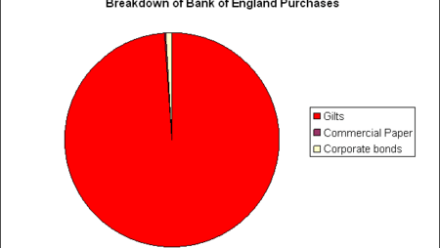
Readers of the Spectator will know George Trefgarne’s work, and today he delivered an important report on the dangers of Quantitative Easing. I urge Coffee Housers to read the speech. It provides an interesting and relevant insight into historical precedents for the policy and how to manage it, and gives a balanced analysis of the current policy’s pros and cons. Trefgarne concurs with Mark Bathgate’s critique. There is little evidence that QE has stimulated money supply, as banks are using the cash to re-balance their lop-sided books. QE is funding the government’s debt habit. The IMF estimates that QE has reduced the benchmark 10-year interest rate on government debt by up to 1%, currently standing at 3.5%.

Positive polls for Cameron’s European policy

From our UK edition

So, has he got away with it? The press reaction to the Tories’ new European policy has been generally positive, or at least understanding that Cameron did the best he could in impossible circumstances. Only the Daily Mail and Melanie Phillips voiced ideological objections. More importantly, Messrs Davis, Redwood, Cash et al have not broken ranks – this reflects the policy’s essential euroscpeticism as much as it does party discipline. Most important of all, the above Politics Home poll suggests that the public back the long-term policy, adapted to new circumstances, and do not think that Cameron has broken a promise.   But, the overwhelming majority want a referendum on renegotiating Britain’s engagement with the EU.

The fierce urgency of education reform

From our UK edition

Michael Gove is giving a speech tonight reaffirming the Tory plans for radical education reform. In it Gove deploys a battery of statistics to show just how comprehensively the current system has failed. The one that stood out most dramatically to me was this one: “Out of 75,000 children eligible for free school meals only 5,000 were even entered for A level. Of that 189, only 75 were boys.  Yet in the same year Eton had 175 boys who got 3As at A level.  One school with almost two and a half times as many boys getting 3As as the entire population of our poorest boys on benefit.” If this doesn’t persuade you of the urgent need for education reform, then I don’t know what will.

Leaked minutes reveal a party short on ideas and low on confidence

From our UK edition

It’s worth flagging up the minutes of a regional Labour Party meeting, dated 2 November, that have been leaked to Iain Dale. The first stand out passage shows the Labour Party’s reliance on Barack Obama as a source of inspiration: ‘Claude[Moraes MEP] has been to Washington DC where Obama administration key players made it clear they don’t want to have to deal with a Eurosceptic Tory Government here as they want to be able to deal with the EU as a whole.’ Iain argues that the claim has no basis in fact. But, as Daniel Korski pointed out recently, it is clear that the US administration would prefer to work with an assertive and united EU, not one embroiled in internal squabbles.

A bit of French stock in play

From our UK edition

Describing foreign dignitaries as ‘castrated’ and ‘autistic’ is terribly Gallic. As a rule, British politicians tend not to invoke ‘sensitive conditions’ to aid their critiques and the force of their rhetoric. I can’t imagine Chris Bryant, for instance, describing David Cameron’s euroscepticism as ‘autistic’ – he’d probably even baulk at describing it as ‘political halitosis’, preferring wink-wink, nudge-nudge gags about “cast-iron guarantees”. It is because this expansive sensationalism is so alien to our political culture that Pierre Lellouche’s comments sound so provocative and make Mr Cameron’s ambitions look unrealisable, with Europe seemingly united against him.

Labour and the KGB

From our UK edition

How close were Labour and the Soviets during the cold war? At the time, many newspapers were on the hunt for links - but allegations were hard to prove. Today, the Spectator tells the story from the horse's mouth - Anatoly Chernyaev, the Kremlin's link man with Labour in the 70s and 80s. Unbeknown to his visitors - Michael Foot (who welcomed Brezhnev as 'comrade') and even Charles Clarke (who comes out of this quite well) Chernyaev was keeping a diary. It shows how various Labour visitors begged for help - after all, Labour and the Soviets had a common enemy: the Conservatives. They said so in terms. Edward Short, as Harold Wilson's deputy, said: "if you, the Communist party of the Soviet Union, want a Labour government in Britain then help us". It goes on like this.

Fifth columnists

From our UK edition

The Afghan police were supposed to be layabout drug addicts and petty crooks, but that the force has been infiltrated by murderous, cowardly fifth columnists has concentrated Westminster minds. Current strategy in Afghanistan is failing. Paddy Ashdown’s is one of the most distinct voices on Afghanistan; and although he resembles a crazed Cockleshell hero when in full flow, he provides much needed clarity. In an op-ed in this morning’s Times, he writes: ‘It is at the political, not the military, level that we are failing. And if we did not have enough problems already, we now have a Government in Kabul whose legitimacy has been fatally damaged and for whom respect has reached a new low.

There is only one question that frightens Brussels

From our UK edition

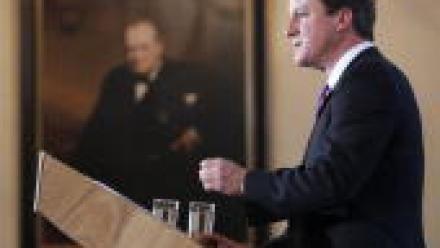
So David Cameron will let it rest there after all.  And in fairness to him, he can do nothing else. Thanks to the Blair/Brown stitch up, Britain has no options left. It never did. Cameron knows that and today’s speech was just a longwinded way of saying it. He is right not to promise what he calls a “made-up referendum”, that would accomplish nothing other then vent rage. But nor should he kid us all that he is going to renegotiate some powers back from Brussels. That would need the unanimous approval of all other member states, and it would never be granted. If Britain were to repatriate powers, then who would ask next? Where would it stop? The post-Lisbon EU is more powerful, bullying (as we saw with Ireland and Czechs) and it will refuse any request Cameron makes.

How much longer must we wait?

From our UK edition

Cameron had little choice today. At PMQs he played it sober and he played it statesmanlike. The Afghan issue, which is close to becoming a crisis, dominated the session. Both main party leaders were standing shoulder to shoulder, and Cameron used five of his six questions asking the same thing. ‘Are we both right in thinking we’re both right?’ Yes, said the PM, we’re right. Afghanistan’s salvation lies in the usual mantras. More ‘training up’ of security services, more help for the economy, greater attempts to root out corruption etc. It must all be ‘better targeted’ and ‘more focused’. The question of a ‘single, strong co-ordinating figure’ is being discussed in Washington. Nothing has been decided.

Failing to address the banking crisis is hampering recovery

From our UK edition

As another £30 billion of taxpayers’ money is handed over to banks, the role of banking sector in the continuing UK recession cannot be understated. 1990s Japan taught the world that developed economies with zombie banking systems don’t grow.  Crippled by bad debts, lending margins on solvent borrowers increase, credit availability declines and ongoing bailouts are needed. This hampers growth in the rest of the economy. The more indebted the private sector, the greater the damage a bust banking system inflicts. The above chart shows how margins on UK mortgages – the gap between borrowing from the Bank of England and what is then leant to mortgage holders – have soared since September last year.

The bills just keep coming in

From our UK edition

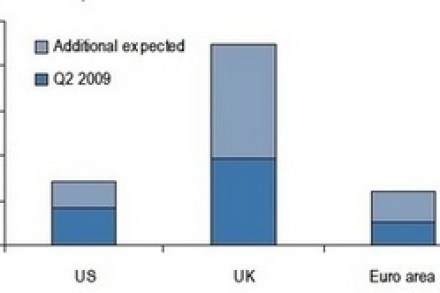
Two years after Northern Rock became the first bank failure of this crisis, another £30 billion of taxpayers’ money needs to be thrown at the banking system. Behind all the noise about improving competition and the European Commission lies one core fact: the UK banks have lost an astonishing sum of money. The above chart shows bank losses as a percentage share of GDP, and illustrates the scale of the crisis that has overwhelmed the banking system and the taxpayer. The IMF estimates that losses could be as high as 25% of UK GDP.   UK banks went on an orgy of lending around the world, becoming the biggest source of credit growth in many countries. RBS trebled its total lending in just three years, expanding its balance sheet to almost 1.5 times the size of the UK economy.

Vaclav Klaus signs the Lisbon Treaty

From our UK edition

According to the BBC's Laura Kuenssberg, Czech President Vaclav Klaus has signed the Lisbon Treaty. As James wrote this morning, Cameron has not broken any promise concerning a referendum because there was no such pledge except under circumstances that have passed; but Cameron must now detail how he intends to repatriate powers and obtain an opt-out from the Social Chapter. What is peculiar is how this has become a story about the Tories breaking pledges. It should be nothing of the sort. That 'honour' lies squarely with Brown and Blair. Labour's mock-outraged line that Cameron has '"reneged on his cast-iron guarantee" defies belief; it's incredible, brazen and unmistakably wrong.

Next step for banks provides further vindication of Osborne

From our UK edition

Alistair Darling has unveiled the initial phase of his plan to get the majority state owned banks back into private ownership. RBS and Lloyds will dispose of more than 918 retail branches across the country over the next four years and will receive up to £40bn of taxpayer funds to strengthen their capital bases. In exchange for this injection, both banks have deferred cash bonuses for 2009. Also, Lloyds will not join the government’s asset protection scheme by securing £13.5bn privately through a rights issue. There is an argument that the government should have gone further and demanded the complete separation of retail and investment arms, followed by additional demergers, and John Redwood makes a clear case as ever.

One in five children live in jobless households

From our UK edition

The Guardian reports this morning that, “One in five – two million – British children now live in households where neither parent has a job.” This is an incredibly worrying statistic. The evidence suggests that worklessness is corrosive and soul-destroying. A child growing up in a workless household will, for obvious reasons, tend to have limited ambitions and opportunity. Obviously, as the economy recovers this number should go down — the recent rise indicates that many of these parents have been laid off in recent months. But even before the credit crunch really kicked in, there were more than 1.8 million children living in workless households.