Uk politics

The unravelling continues apace

From our UK edition

Has Brown got away with his horror Budget?  Reading the Populus poll in this morning's Times, you might be tempted to say he has.  Sure, there's some bad news in there for the government: trust in Dave 'n' George's ability to manage the economy has hit an all-time high, and only 12 percent of respondents think that the measures outlined in the PBR will be sufficient to deal with our country's fiscal woes.  But Labour types will also seize on those numbers which show quite high levels of support for the individual proposals annouced on Wednesday.  78 percent back the bonus tax.  61 percent back the capping of public sector pay increases.  And – surprisingly, to my mind – 51 percent back the national insurance increase.

Gordon Brown’s one and only legacy

From our UK edition

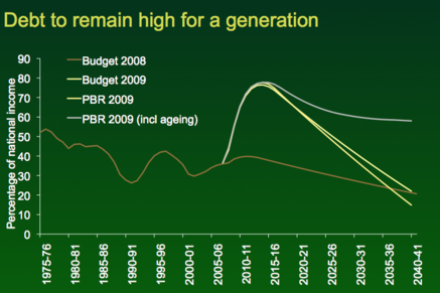
I will sign off tonight with this sickening graph from the earlier IFS presentation – showing the extent to which Gordon Brown’s economic incompetence has transformed the public finances for a generation. Servicing this debt will absorb money that would otherwise be spent creating jobs, lifting people out of poverty, advancing education, promoting prosperity. The leading article in the magazine this week finishes with these words, which came to mind when I saw the above graph: “It will be no surprise if UK public debt has been downgraded by the election; if so, a gilt buyers’ strike will become more than a theoretical possibility. The new government will face a Sisyphian financial task, so formidable as to make almost every other issue of the day look trivial.

Those hidden cuts in full

From our UK edition

The truth about the Pre-Budget Report was revealed today by the Institute for Fiscal Studies: the new National Insurance tax will hit everyone on £14k or over, not £20k - and there are implied 19 per cent cuts of some £40 billion in the “non-protected” areas. The event was sold out, because it now has the reputation as the only place you learn the truth about Budgets passed by this government. Yet again, Gemma Tetlow from the IFS has unearthed the cuts which the Chancellor felt he had to conceal from the public (and – unwittingly, I hope - lied about this morning on the radio).

At least Gordo and Sarko are still friends…

From our UK edition

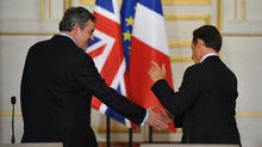
If you're looking for some sort of light relief after yesterday's horror-PBR, then can I recommend the joint article by Gordon Brown and Nicolas Sarkozy in today's Wall Street Journal.  Yep, the two men have put their recent spat behind them, and have cemented their relationship by huddling over a typewriter and bashing out just under 900 words on global financial regulation.  The Entente Cordiale never looked so strong.    Beyond the display of unity, it seems the article's purpose is to convince the City that the EU's French finance commissioner won't blunt our competitive edge.

The cuts unveiled

From our UK edition

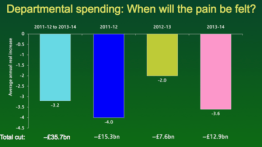
Well, as expected, the IFS have put the lie to Darling's claim that the budgets of non-ringfenced departments would be "pretty much flat".  Here's how Nick Robinson reports it: "The Institute for Fiscal Studies says that government plans imply £36bn of cuts in departmental spending ie over 19% from 2011-2014 in order to protect schools, hospitals and increase overseas aid. They say the police pledge is meaningless. They also say that defence, higher education, transport and housing are most likely to be hit.   The cost of paying back the debt over the next eight years is equivalent to £2,400 per family in taxes or cuts over that period." UPDATE: The relevant IFS presentation has now been uploaded on their website – you can read it here.

The markets’ verdict on the PBR

From our UK edition

The press didn’t like Darling’s budget – and neither do the markets. What Darling didn’t say yesterday is that the Treasury is looking to borrow £243 billion from the City by the end of the financial year – this info was slipped out by the debt management office (link here). Brother, can you spare a quarter of a trillion quid? The markets are not sure they can. Gilts are being hammered today - biggest single day sell off for some time - 13bps so far this morning on 10yr gilts. They now stand at 63bps above German bunds, the widest since the crisis started. On another measure, Credit Default Swaps, the UK is being hit hard again. It now costs $85,000 to insure $10 million of UK debt against default – against just $24,000 for German debt.

The Darling deception

From our UK edition

Alistair Darling normally strikes us as an honest man dropped into an impossible situation. But whether he misspoke, or whether he set out to mislead, he told a lie on the Today Programme this morning which needs to be highlighted. So what was it?  That non-ringfenced departmental budgets would remain "pretty much flat" rather than receiving significant, if not sufficient, cuts.  As Fraser demonstrated yesterday, there were spending cuts hidden in the Budget   and we'll see the full extent of those as soon as the IFS processes the numbers later today.  Last time around, after April's Budget, they calculated cuts of 7 percent across three years.  Thanks to a few more ringfenced budgets here and there, those cuts could even be deeper this time around.

Last orders in the last chance saloon?

From our UK edition

It's the set of headlines which Labour must have dreaded after their recent progress in the polls.  The Times: "The axeman dithereth ... but the taxman cometh".  The Guardian: "Darling soaks the rich ... and the rest of us too".  The Mail: "The Buck Passer's Budget".  And so on and so on.  It doesn't look too good inside the papers either.  The FT rails against a  "lack of clarity on public spending plans", while the Independent says that "rarely has a pre-Budget report promised so much and delivered so little".  The Sun's opposition may not be too surprising, but it's there in bucketfuls: "Britain is staring into the abyss. After yesterday's performance that abyss has got deeper.

Has Labour u-turned on protecting defence spending?

From our UK edition

Back in July, Lord Mandelson added defence to health and education as an area of spending that Labour would protect from cuts. But looking at page 97 of the Green Book, defence is conspicuously absent from the list of areas of public spending that are protected in 2011-2012 and 2012-2013. The only areas mentioned are NHS spending, schools, sure start, policing and overseas aid. As some of these are only receiving funding increases in line with inflation, it seems reasonable to assume that everything else - including defence - is likely to be cut in real terms.    (There is a commitment to spend up to £2.5 billion from the reserve on the mission in Afghanistan in 2009-10. But this will not add to the baseline of the MOD budget.

An unhealthy dependence

From our UK edition

Few columnists are read more carefully in Conservative circles than Danny Finkelstein. He is extremely well connected in the Cameron circle and enjoys something of a mind-meld with George Osborne. Danny’s column today is the argument for sticking to the modernising message. It does, though, contain one significant criticism of the party, its dependence on David Cameron.   This Cameron dependence has been a problem for a while. But the leadership itself must take most of the blame for this. They have used Cameron for almost every announcement that they view as important and that has sent a message to the media that if it doesn’t come from Cameron the party doesn’t view it as important.

The end of spending

From our UK edition

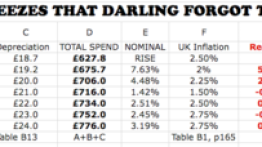
So Alistair Darling today repeated the same trick he used in April’s Budget – referring only to rising “current spending”, so as to hide the full extent of Labour’s spending cuts. Current spending is only one component of total spending, and when you add in some of the other components – as we have done in the table below – the cuts become clearer. The table shows that next year is the last year of any real rise in spending. From 2011, spending either falls or flattens out. But the cuts will be even deeper than the table reveals.  This “total spending” figure is all we could work out from the appendices in today’s Pre-Budget Report – but, alas, it doesn’t account for debt repayments or unemployment benefits.

What to do if you can’t tax or borrow out of trouble

From our UK edition

Today one Finance Minister in the British Isles cut spending, cut borrowing by 1 per cent of GDP compared to his last Budget and cut the national debt by 5 per cent.  It wasn’t Alistair Darling. Brian Lenihan cut Irish public spending by 7 per cent (equivalent to a £40 billion cut in the UK).  He cut the public sector headcount, pay, pensions for new entrants and unemployment and child benefits. Alistair Darling postponed the inevitable reckoning on the finances until the pre-election Budget, the post-election Budget or a currency or debt crisis if that comes first.  Brian Lenihan gave us the flavour of what that reckoning will be and how it will be argued.

The public’s right to know

From our UK edition

The Treasury have just banned transcripts of the all-important briefing they give to journalists after the budget. Coffee House broke the mould after the April budget by producing the first-ever transcript – releasing to the public the spin which journalists are given in the precious few hours they have to write up the Budget. This shows how journalists were wrongly told that there were no spending cuts, when there were in fact cuts of 7 percent over three years. Here is an example of their misleading briefing last year Q: Why are you cutting spending by more? A: By more? (quizzical look on his face) Q: Well not reducing the rate of growth by more than you are.  It is not that big a reduction given the scale of the problems you are facing.

A whole batch of Brownies

From our UK edition

There are some pretty cheeky claims in today’s Pre-Budget Report. One is that “Cyclically-adjusted borrowing is lower than at Budget across the medium-term forecast.” (page 171). That makes it sound like it’s all under got a bit better since the Budget. But in fact the “cyclically adjusted” improvement is entirely because of a redefinition of the cycle - not because of any actual reduction in the deficit.  For example, the PBR forecasts the deficit for 2013/4 as 5.5 percent of GDP - exactly the same as that in the 2009 Budget.   Another claim is that “The annual pace of consolidation set out in this Pre-Budget report is faster than the pace of deficit reduction forecast by the IMF for all other G7 economies” (page 33).

Don’t worry about the tax on jobs

From our UK edition

I’m not that worked up about the National Insurance increase. Sure, a tax on jobs is the best way to choke a recovery – but this is only due to come in April 2011 by which time Darling will be collecting the royalties on his memoirs. It only matters if the Tories support it, which (I hope) they won’t. It is a wee gesture, to help calm the bond markets. The only fiscally significant mive in this budget is the £550m they intend to raise from inheritance tax. The giveaways are all planned from April next year – ie, they are little exercises in forcing the Tory hand. Extension of free school meals (£140m) the benefits uprating (£700m) - all things Brown would like a Tory government to do. And he may succeed.

In his comfort zone

From our UK edition

Today we saw just how tricky the game can be for opposition leaders. The government sets the parliamentary agenda and holds the keys to the war-chest. Cameron’s attempts to upset the PM looked diffuse and repetitive. On Afghanistan he offered support. On Kelly he flannelled about some footling detail of parliamentary timing. And on ministerial pay he drew attention to his gravest difficulty, namely that the pre-budget report was coming up next. Brown never looked in difficulty and he cruised easily towards his Six O’Clock sound-bite. ‘The opposition leader has lost the art of communication but not alas the gift of speech.’ A poor day for Dave. Nick Clegg did much better. Gosh he’s an angry beggar isn’t he?

In a world of their own

From our UK edition

As I suspected, Darling has cooked the figures by laughably unrealistic growth forecasts. He is predicting a sustained economic sprint that will mysteriously come to Britain the April after next. Table B1 of the PBR shows that he expects 3.25% growth every year for a whole four years: from April 2011 to April 2015. How does this square with what the real world thinks? I blogged earlier what HM Treasury’s independent forecasts have to say. Robert Chote from the IFS has just been on TV saying the good news is that the structural deficit isn’t as big as it used to be. Little wonder, when you can concoct growth forecasts like this.  Here is a graph, laying it out. The subtext to this Budget is “securing the recovery”. It should be “once upon a time..

How much more will Darling have to borrow?

From our UK edition

The figure of £178 billion in the Budget – for 2009/10 – is by no means the full story. For that we have to turn to the Debt Management Office, which is in charge of flogging the IOU notes. It just now confirmed that it will need £223.3 billion by the end of this financial year - £5 billion more than expected. And a staggering amount, which I suspect the government simply could not raise if it did not have the Bank of England printing presses working overtime. Why the gulf between the two? Because of the bank crisis. This financial year a further £42 billion has needed to by pumped into the banks in various forms – not just Lloyds and RBS, but the smaller bank failures like Northern Rock and Dunfermline Building Society.