Uk politics

Osborne’s speech contained not a whiff of radicalism

From our UK edition

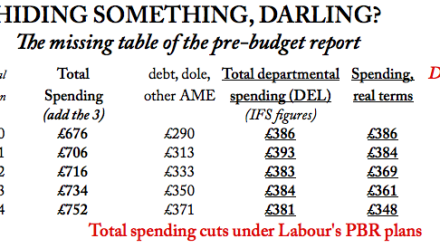
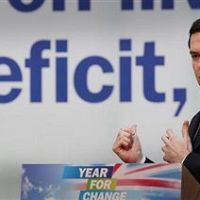
I’m afraid I did not detect a “new economic model” in George Osborne’s speech. He has said he will “eliminate “a large part” of the deficit (ie, the amount that debt goes up by) over the next parliament. In questions, he kept repeating this phrase: “a large part” - and which is woolier than Labour’s plan to halve it. When asked about this he said that he would do more than half it – but gave no indication by how much. It could be a lot, or a negligible amount. We still don’t know. Osborne said he will stick to what was, in my view, the root error of the recession: the 2 percent CPI target. Inflation was fine in the boom years – it was asset price inflation that pointed to the debt bubble.

The Tories must be bold and exploit every tiny opening toward victory

From our UK edition

Voltaire praised the English for their boldness: “how I like the people who say what they think”. The slow and steady contraction of the polls continues, and Rachel Sylvester is convinced that the Tories must embrace risk and revoke ‘health-and-safety politics’. She writes: ‘Increasingly, his pronouncements seem designed to grab a headline rather than challenge the status quo — it’s bash-a-burglar, prison ships and PC-gone-mad, instead of hug-a-hoody, husky sleighs and general wellbeing. He drips out minor policy announcements on broadband and planning laws, while failing to confront a more important issue and force his biggest donor, Lord Ashcroft, to say whether he pays tax in this country.

The Tories are muddying their clear, blue water

From our UK edition

Front page of the Independent: "Vote of no confidence in Tory economic policies".  As headlines go, it's one of the worst the Tories have had for a while - even if, as Anthony Wells and Mike Smithson point out, it's kinda misleading.  Truth is, the Indy's ComRes poll finds that 82 percent of people want "Mr Cameron to be clearer about what he would do on the economy".  And 24 percent think the Tories would have ended the recession sooner, against 69 percent who don't.  They're hardly positive findings for CCHQ, but, by themselves, they don't quite add up that that two-line scarehead.

Will Brown’s election chances be Chilcot’s premier victim?

From our UK edition

Giving evidence to the Chilcot inquiry, Tony Blair said: “I never refused a request for money to pay for arms and equipment during my time as Prime Minister.” The panel did not take the bait, but they will have to following Lord Walker’s evidence today: "There was indeed a list of stuff that we were having to make decisions about and I think we drew a line somewhere halfway down the page and said, 'if you go any further than that you will probably have to look for a new set of chiefs'." The disclosure has the iron-cast hand of Brown upon it. The PM’s decision to give evidence may prove a ruinous act of hubris. Voters and commentators may not comprehend the subtleties of deficits, but all can see when a politician has neglected serving British troops.

The widening public-private divide

From our UK edition

The growth of the public sector isn't exactly new news, but the figures attached to it are always pretty eyecatching.  These courtesy of Allister Heath in City AM: "MORE evidence of a growing public-private divide: 57 per cent of extra UK jobs created during 1997-2007 were either officially on the government's payrolls or 'para-state', technically private but dependent on government funding. And that was before the private sector jobs bloodbath since 2008. Manchester University's Centre for Research on Socio-Cultural Change calculates that of the 2.24m net new jobs created in 1997-2007, 1.

Cameron has shifted the spending debate to Labour’s home ground – but the Tories still have an aggregate lead

From our UK edition

So, is David Cameron's shift in emphasis on spending cuts a u-turn, a clarification, or something else?  Well, when it comes to existing Tory policy, it doesn't actually change much.  We were always rather taking it on trust that Cameron & Co. would cut spending by much more than Labour this year.  The cuts they've announced so far aren't really that much deeper – and most folk in Tory circles were waiting for George Osborne's potential Emergency Budget to see whether that would change.  So, when Cameron says that his party wouldn't introduce "swingeing cuts" this year, the position is still remarkably similar: we still need more details to judge the true extent – not the publicised extent – of any Tory cuts.

Clarification or u-turn?

From our UK edition

Smarting from the savaging he received in Mo, Peter Mandelson characterised David Cameron’s "no swingeing cuts” comment as a u-turn, and compared Cameron and Osborne to Laurel and Hardy. This is a bit rich considering the government’s obvious confusion over the timing and extent of cuts, and that the immortal line “That’s another fine mess you’ve gotten us into” should be the Tories’ campaign slogan. Cameron’s comments are a clarification, not a u-turn. As Jim Pickard notes, Tory policy has to respond to last week’s withered growth figures.

The single best reason to vote Tory

From our UK edition

There can be fewer more powerful untapped resources in Britain than the desire of parents to place their children in a good school. Every Sunday, pews of school-sponsoring churches are filled with atheist mothers and their kids. You read stories of parents giving up their kids to live with their aunt and uncle just to get a better school.   The single best reason to vote Tory is that they will set up a new system to harness this power, and allow anyone to set up a state school (by themselves or, more likely, in collaboration with the many companies offering to run new schools).  The Times today says that 350 requests have been made through the New Schools Network - an organisation dedicated to explaining the system. You can bet this is just the start.

Leaked MoD report says, well, nothing really

From our UK edition

What is the difference between a sieve and the Ministry of Defence? If you think of good punch-line send it in; in the meantime, suffice it to say that department seems to be leaking any and every sensitive document in its possession. Ministry of Defence staff have apparently leaked secret information onto social-networking sites sixteen times in 18 months. Over the week-end, it happened again: Sky News obtained a paper, which will form the basis of the forthcoming Strategic Defence Review. I have not seen the paper, but judging from the Sky reports there is not much to get excited about. Everyone accepts that the nature of warfare is changing, that traditional battle-lines are being re-drawn and that a new form of warrior will be required for future conflicts.

Because of Blair, Britain will now be shaped by the world

From our UK edition

It's striking how Tony Blair, the most successful election winner in Labour party history, is now so despised in the country that gave him three landslides. This matters politically, because he has - I fear - poisoned the cause of liberal interventionism. I look at this in my News of the World column today. Blair's Chicago speech of 1999 laid out what I regarded as a bold and coherent foreign policy case. It was time to stop letting genocides happen because they take place within the borders of sovereign states protected by the UN Security Council. I agreed with him when he said that, if the Rwandan genocide happened again, we would have a moral duty to act there. But if it happens again, what are the chances of Britain joining a multi-national coalition? Pretty close to zero.

Could Jacques Chirac add to the Chilcot inquiry?

From our UK edition

The Iraq inquiry is making the political weather, much more than Gordon Brown expected. By the time of the general election, every key diplomat, soldier and politician involved in the war will have given evidence. But there are people that have played pivotal roles who should be given the chance to put their views across - not about the war as such but about Britain's diplomatic and war record. I'm thinking of senior US officials, from President Bush down the hiearchy but also then-French President  Jacques Chirac, former UN chief Kofi Annan and so on. I'm not suggesting Sir John Chilcot broaden his inquiry to nor that 'W' would come to give evidence.

It’s war!

From our UK edition

Politicians have to shout to be heard over the lurid tale of John Terry's bordello, but Ed Miliband’s fervour for climate change is sufficiently shrill. He has declared “war” on “sceptics”, who have been rather jaunty of late. As Fraser noted yesterday, the press’ climate change narrative is shifting – scepticism, in its proper sense, is replacing blind subscription. In this context, Miliband’s comments are extraordinary. His intellectual complacency is irritating, his sanctimony nauseating and his hypocrisy palpable. “It's right that there's rigour applied to all the reports about climate change, but I think it would be wrong that when a mistake is made it's somehow used to undermine the overwhelming picture that's there.

I bear a charmed life, which must not yield to one of woman born

From our UK edition

If Tony Blair were to go to the newsagents to day to see how his performance is being reported on the front pages,  he'd be in for a pleasant surprise. He does not feature - certainly not in the biggest sellers. The extra-curricular activities of John Terry make the the lead story on the Mail, the Sun, the Daily Telegraph and the Daily Mirror. Blair himself is relegated to the inside pages on most.  Of all today's press coverage, The Times is probably the most damaging. "Tony Blair was branded a murderer and a liar last night,". But even Blair-hating papers like the Daily Mail find it hard to compete with the John Terry story, which journalists have known about for days but been unable to report (I gather that there are more explosive revelations to come).

Talking to the Taliban | 29 January 2010

From our UK edition

After the London conference, it is clear that “talking to the Taliban” will become part of the strategy in Afghanistan. But the conference left a number of important questions about what this means in practice unanswered. Talking to the Taliban is not a new idea. Even though he expelled a British and Irish diplomat for holding secret talks with Taliban in December 2007, President Karzai has become an advocate for such negotiations over the last two years. In the Spring of 2009, Saudi Arabia hosted tentative negotiations between Karzai’s representatives and former Taliban, with links to the current movement. But the idea now has a head of steam behind it.

Gordon’s off the hook, for the moment

From our UK edition

Oooh, there’s just been a wonderful exchange at the Chilcot Inquiry. Baroness Prashar was asking some kindergarten questions about military planning. She barely mentioned Geoff Hoon’s evidence that the MoD was chronically under-funded and short of equipment before, during and after the conflict, and merely concentrated on 'visible military planning', or the lack of it to be precise.   Blair is much more assured after lunch than he was immediately before, and gave one of those of those “Trust me, I’m Tony” spiels about the armed forces’ readiness.

Further trouble in Northern Ireland

From our UK edition

Michael Crick reports that Owen Paterson is seeking an urgent conference with Sir Reg Empey (the UUP leader) after revelations that the UUP held secret talks about a possible electoral pact with the DUP. If the story stands up, the UUP/Tory pro-Union and anti-sectarian alliance is dead. Crick writes: ‘Some in Belfast think that the Conservative-UUP pact is now effectively dead, and that Conservative leader David Cameron will be forced to announce its demise within the next few days.’ It may be that the UUP and DUP merely discussed breaking the deadlock at Stormont.

Blair on the rack

From our UK edition

Not so good for John Rentoul: it’s WMD time and Blair’s body language spoke volumes. His movements were almost involuntary. The glasses were on and off, the brow furrowed, the head wagged and jagged in the manner of an amphetamine junky going cold turkey, and the hands were more intrusive than Andrew Marr’s. In round one, Blair was as languid as Dirk Bogarde; he was more like Daniel Day-Lewis second time round. That said, the line holds. As Iain Martin notes, it is extraordinary that Blair “didn’t focus a great deal” on the intelligence he received.

Blair, the Special Relationship and the Clash of Civilisations

From our UK edition

So far so good for John Rentoul: Blair’s walking it, but there have been intriguing moments. The suggestion that Blair’s foreign policy was motivated solely by vanity is false. The former Prime Minister’s thinking is extremely coherent. That is not to say that he is right nor to deny his obvious vanity, or to overlook that this may simply be Blair in matinee idol mode. But he subscribes to an ideology. He stated, once again, that he saw 9/11 as an attack on “us”, not just America. The language is redolent of Samuel P. Huntingdon’s Clash of Civilisations. Blair perceives a band of religious fanatics and a crucible of oppresive rogue states which desire the West’s destruction.