Uk politics

Parris versus Nelson

From our UK edition

Here’s a question: to be a good angel or a bad angel? We know what Fraser thinks; Matthew Parris differs. Writing in the Times today, he asserts that he would give David Cameron the same advice he offered Margaret Thatcher in 1979: agree a gloriously unspecific manifesto. The details of hard-edged manifestos are ambushed well before polling day; discretion is the better part of valour. In the immediate circumstances of the Tory wobble both arguments are commendable. The Tories have unwound when trying to supply detail to flesh out their broadly radical ideas. Recognising marriage in the tax system has been their foremost blunder.

Another very good Friday

From our UK edition

Yesterday, Gordon Brown was less Macavity, more the Cheshire cat. Now both he and Blair have helped to bring a modicum of peace to Northern Ireland, and Brown was a ubiquitous, beaming presence on the TV throughout the day - jaunty not jowly. Naturally, Brown’s confidence fell victim to the absurdity that lurks behind him like some familiar. Sky Sports News asked him if he thought John Terry should retain the England captaincy. Brown pondered the question - the arguments for and against and the possibility of his bringing peace to Cobham - before conceding that the decision was entirely Capello’s. It was priceless. To suggest that this latest Hillsborough accord is a final panacea is to tempt fortune.

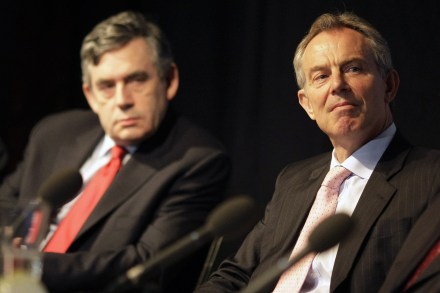
Brown and Blair, together again

From our UK edition

Strange that there's really only one major political point arising from Gordon Brown's interview in the Standard today.  But, then again, maybe that is the point.  Like the PM's interview with the News of the World a few weeks ago, the emphasis is far more on the personal than anything else: his relationship with Sarah Brown, the death of his daughter Jennifer, his upbringing, and so on.  We even learn why his handwriting is so bad ("due to the way he was taught to write at school," apparently).  And with a TV appearance alongside Piers Morgan in the schedules, it does seem that Brown is keen to present a more human front. As for that political point, it's Brown's confirmation that Tony Blair will play a "major role" in Labour's election campaign.

The Tories need to push the fiscal case for public service reform

From our UK edition

Andrew Haldenby's article in the Telegraph this morning got me thinking: when was the last time the Tories really pushed the fiscal case for public service reform; that the government can indeed deliver better services while spending less money? By my count, you'd have to go back around six months to George Osborne's speech on progressive politics at Demos. There, the shadow chancellor said this kind of thing: "Indeed, I would argue that our commitment to fiscal responsibility in the face of mounting national debt is not at odds with progressive politics, but fundamentally aligned to it - as politicians on the left from Bill Clinton to former Canadian Prime Minister Jean Chretien once understood.

Four Parliamentarians to be charged over expenses

From our UK edition

It's just been announced which Parliamentarians will face criminal charges over their expense claims. They are: David Chaytor Jim Devine Elliot Morley Lord Hanningfield So, three Labour MPs and one Tory Lord.  Expect plenty more public anger – the Legg report has no way near drawn a line under this issue.

Post-election Entene Cordiale?

From our UK edition

If there is a strategic thought lurking inside the Tories' grab bag of foreign policy ideas, it seems to be closer cooperation with France, particularly on defence matters. Should William Hague become Foreign Secretary after the election, he might end up working with a new French counterpart, as rumours persist about Bernard Kouchner's imminent departure (knowing this, he apparently even floated his own name for the Kabul UN job). A new Parisian counterpart for Hague - for example, the current French Agriculture Minister, Bruno Le Marie - could make a new Entente Cordiale easier. But, even then, would the French be up for closer links with the UK? Angela Merkel and Nicolas Sarkozy have just unveiled a new 10-year plan, including 80 projects designed to improve Franco-German cooperation.

Practice – not pay – may be the key to public sector workforce savings

From our UK edition

Great article from my former boss, Andrew Haldenby of Reform, in today's Telegraph.  He makes the general case that spending less on public services needn't mean worse public service – far from it, in fact – and is scathing about the political class's inability to soak up this lesson.  But it's this passage which jumped out at me: "Another path to reform is to get more out of the workforce. Simple changes have tremendous results. If public-sector workers took the same amount of sick leave as those in the private sector, that would save 3 per cent of their wage bill, which adds up to £6 billion per year. If they worked the same number of hours per week as in the private sector, that would save a further 10 per cent, or £20 billion per year.

In response to CoffeeHousers

From our UK edition

CoffeeHousers have left some characteristically forthright and thoughtful comments on the blog about my Keith Joseph lecture, and I thought I’d answer them in a post.   Tiberius says that I don’t mention voters very much – I talk only about ideas. The voters have been taught Labour ideas: isn’t this something the Tories have to deal with? First, I firmly believe that the public are open to persuasion, open to new ideas having seen the collapse of Labour’s ideas. But, in my lecture (full text here), I do mention voters quite a lot. As Keith Joseph put it, it is folly to seek the ‘middle ground’ between political parties, and Conservatives should seek the ‘common ground’ which they share with the punters.

The Old Lady is becoming more pessimistic

From our UK edition

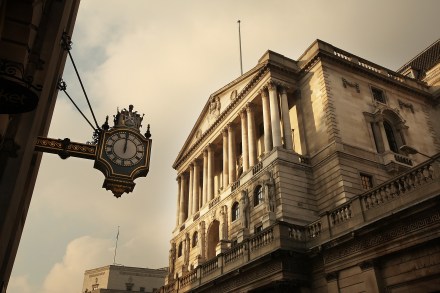
Faisal Islam, Channel 4’s economic correspondent,  is one of the journalists who best understands what the Bank of England’s institutional view is. So it is interesting to see him writing this today: “I’m convinced that at Threadneedle Street, they were shocked by the limpness of Britain’s exit from recession. They have been running their big computer model in the past weeks. When it reveals new economic forecasts next Wednesday, we are likely to see a marked downgrade to Britain’s economic prospects.” Politically this could have an impact as Labour’s, to put it charitably, extremely optimistic growth forecasts are what allow it to claim that it will cut the deficit in half in four years.

Why winning isn’t enough – and a response to The Fink

From our UK edition

I delivered the Keith Joseph lecture last night, entitled Winning Is Not Enough. My point: that the Tories have adopted so many Labour policies out of tactical considerations that they are in danger of getting to office only to find they have signed up to continuing Gordon Brown’s agenda. The problem is not so much Gordon Brown himself, but his misunderstanding of government and politics: it’s his ideas that are so dangerous. If those ideas survive with a blue rosette, they are no less dangerous. And if a Tory government adopts these ideas then that’s not change. It’s more of the same.

Legg latest

From our UK edition

The Legg report is about 240 pages, if you can manage it.  But the message you can take from it is short enough: there's going to be plenty more public anger with our political class.  Guido's post here should tell you why.  But, suffice to say, there are MPs paying back up to £42,458.  There are dodgy claims for flagpole accoutrements, luxury furniture and expensive gardeners.  And even the report itself cost more than the money than it's going to recoup. Although I don't think the parties should be trying to make political capital out of each other's misdemeanours – beyond, of course, proposing ways to fix the mess – there's little doubting that this is especially bad news for Gordon Brown.

It’s Legg time

From our UK edition

Consider the expenses wound well-and-truly reopened – not that it ever really closed in the first place.  Sir Thomas Legg's report into the matter will today identify around 350 MPs who have to return a total of about £1 million in dubious claims.  What's more, in his introduction to the document, Legg is set to attack MPs in general for "knowingly" encouraging and exploiting a "culture of deference" in the Parliamentary fees office.  The papers are calling it "devastating". But what will it all come to?  The worry is that Legg's report won't draw a line under the whole stinking affair – but will instead kickstart a new round of grumbling, backbiting and reprisal on the part of MPs.

The chip on Brown’s shoulder

From our UK edition

So the former roadblock is now a born-again reformer – and, like most born-again types, he wants everyone to know about it.  Writing in today's Guardian, Gordon Brown sells his proposal for a referendum on the alternative vote system as "a rallying call for a new progressive politics."  And, from there, he gallops through written constitutions, Lords reform and digital democracy.  Watch him go.   Amid it all, though, I couldn't help noticing that the PM repeats a key mistake from last year: "I am inviting the leaders of all parties to engage positively in these debates and back our constitutional reform and governance bill.

Brown meets his Waterloo

From our UK edition

Lord Guthrie had it right with his well-directed expletive: Gordon Brown just doesn’t get defence. His record, both as Chancellor and PM, leave him vulnerable to criticism on the subject; but today, Brown has been confronted by a khaki-clad nightmare. After suffering his first reverse at PMQs for months, beaten decisively by a beautifully executed Tory plan, former permanent secretary at the MoD, Sir Kevin Tebbit, informed the Chilcot Inquiry that Brown ‘guillotined’ the defence budget with annual reductions of £1bn. Geoff Hoon’s testimony disclosed the full effects of Brown’s single act of stringency. The timing could not be better for the Tories, who have been intent on self-destruction of late.

Cameron blitzkriegs back into the game

From our UK edition

Dave bounced back today. After a couple of lost months he showed up at PMQs and gave a thoroughly convincing display. Shrewd tactics, sound principles, headline-friendly quotes and some decent gags. The Chilcot Inquiry is proving a handy prosecution witness in the case against Brown. Cameron quoted a fistful of top generals who believe the former chancellor was a serial under-funder of the military. Brown’s response was a classic example of bluster and confusion. Good arguments arrive singly. Bad arguments enter in rowdy swarms. He gave five different replies to the main charge: the 2002 defence review had been the best in 20 years; fourteen billion pounds has been spent on Iraq: the rising defence budget would rise even further; the Tory manifesto in 2005 promised a £1.

The scary graph

From our UK edition

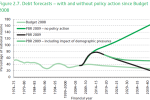
If you're worried about the national debt burden, then what follows is one of the scariest graphs from the IFS's Green Budget.  It extrapolates from the government's current plans and assumptions to work out when debt may get below 40 percent of GDP again.  The answer, as you can see, is sometime in the early 2030s - and later if you account for demographic pressures: Of course, this isn't a perfect model.  For instance, things will certainly change before the 2030s - governments will come in which adopt stronger or weaker fiscal tightening policies; we may have another recession or strong spurts of growth; and so on.  But, even from the vantage point of 2010, it's clear that Brown's debt binge will haunt us for decades to come. P.S.

A first time for everything…

From our UK edition

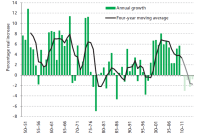
A noteworthy observation from the IFS's Rowena Crawford, here at the Green Budget launch: "We've never had three consecutive years of public service spending cuts, let alone the five years we've got forecast ahead." She also pointed out that, if Labour extended its pledges to ringfence certain areas of spending until 2015, the cuts for "unprotected"  departments could start pushing 24 percent. That would be around 23 percent if current Tory plans are extended over the same time period. UPDATE: Here's the graph which relates to the "five year" observation above, from page 195 of the Green Budget.