Uk politics

Cameron kicks off the transparency agenda

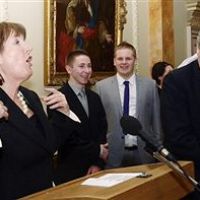
Here I am, in a cavernous "space" in East London, for a conference on the Post-Bureaucratic Age - or  "See-Through Government," as Guido more evocatively put it. David Cameron has kicked things off with a speech on the issue, and there'll be talks and panels throughout the day. It's like Glastonbury for policy wonks. So how was Cameron? Well, he's normally at his snappiest and most persuasive when he talks about all this tech stuff - and today was no exception. All the usual lines about "handing power to the people," and eroding "the dull, stultifying presence of state control," made an encouraging appearance. And he outlined what this would mean in practice, with new policies on town planning, for instance.

How should the Tories respond to the Rawnsley allegations?

As James predicted last night, the ‘Bully boy Brown’ story is now at full steam and will speed on as phone-ins discuss bullying in the workplace. The National Bullying Helpline’s intervention, ethically dubious in view of the charity’s supposed confidentiality, has negated Labour’s damage limitation strategy. Both Peter Mandelson’s line that Brown is a passionate and demanding man and the PR campaign to soften Brown’s image have been blown clear out of the water. Brown has made significant progress recently: David Cameron’s personal ratings have halved since September. That brief resurgence will be reversed as this story rolls. The Sun’s hot-headed frontpage says it all.   Now is the time for a Conservative counter-attack.

Background politics

The Conservatives are at pains to emphasise that 'it's not where you're from but where you're going that's important.' A trite but pertinent phrase: background is neither a pre-requisite nor an impediment to a political career, nor should it be. Upbringing is important when it informs values. Many of the Shadow Cabinet have travelled together from the chapel pews of Eton to the Tory front bench; consequently, the Tories are wary of linking politics to background and experience. On the whole that is sensible, the exception is Michael Gove's personal history, which is central to his Swedish market based education reforms.

Time for Cameron’s Lazarus act

Two seriously worrying polls for the Conservatives today. One is a Sunday Times/YouGov poll, showing a Labour recovery reducing the Tory lead to six points  well into hung parliament territory and the lowest since December 2008. The other is a PoliticsHome poll in the News of the World, according to which: Cameron’s approval rate has been steadily falling, and Brown’s similtaneously rising – the difference between them has halved, in recent months, from 90 points to 45 points. If the election is a 39-33 split, then the Tories end up with just ten more seats than Labour and are dependent on coalition with the LibDems.

Brown faces the Rawnsley revelations, while the Tories face the polls

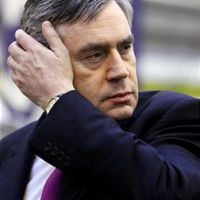
The question tonight is: which piece of bad news will make the biggest impact?  The bad news for the Tories, or the bad news for Labour? Let's take the second one first.  I'm referring, of course, to the first installment in Andrew Rawnsley's revelations about Gordon Brown.  ConHome have already published some snippets – click here – and they give you plenty of juice for your buck.  Not only are there the expected allegations about Brown hitting his staff (much of which seems to have been covered in the Mail on Sunday a couple of weeks ago), but Rawsley also reveals that the Cabinet Secretary, Gus O'Donnell, investigated and reprimanded the PM for his behaviour.

Cameron for Middle England

David Cameron is a man for all seasons. The Bullingdon Club man told the men’s mag, Shortlist, how he takes a glug of Guinness, steps up to the oche, shoots 180 and then retires to watch the seemingly interminable Lark Rise to Candleford. He also likes pottering around his garden dispensing Miracle Grow with liberal conservative largesse. So it's only fitting that the Leader of the Opposition will appear on housewives’ favourite, gardener and erotic novelist Alan Titchmarsh’s daytime TV show. This is a PR masterstroke. Brown has benefitted from his interviews with Piers Morgan and Tesco magazine, not in the polls but in terms of perceptions.

No surprises – and much Tory-bashing – in Brown’s Big Speech

Move along, now – there's nothing to see here.  Or rather, reading Gordon Brown's Big Speech, there's nothing that you hadn't already seen in the papers, or that you wouldn't have expected to see anyway.  The four election themes got a mention.  Labour's record in government was pushed and promoted to the point of absurdity.  Words like "new", "fair" and "change" were flung around like so much confetti.  And no election date was given.  No alarms, no surprises. More than anything, Brown set about attacking the Tories on every conceivable level.  He caricatured Cameron & Co. as a party of privilege and wealth, who are more concerned about fox-hunting than reform, and who are still peddling the "same old Conservative economics of the 1980s".

Welcome to The Future Fair

So now we know.  Labour's election slogan is A future fair for all.  And – as various folk, including Alex, have pointed out – it's kinda screwy.  As in, "we're all going to The Future Fair" kinda screwy.  So don't expect it to catch on.  Unless, of course, there really are bright lights, big wheels and rollercoasters on offer. The slogan kickstarts a feverish weekend of activity.  Brown is going to set out the main themes of Labour's campaign.  The Tories might try to sabotage it all.  And we may, possibly, perhaps, find out what the election date is.  Stay tuned, so to speak. P.S. I wouldn't be too surprised to see that slogan tweaked slightly – A fairer future for all, perhaps.

Brown goes shopping for votes

There’s an interview with Gordon Brown today in the Mirror about his relationship with his mother. As you might expect given the subject, it is hardly an interrogation. Indeed, it manages to make Piers Morgan’s questions to him resemble the final part of the Frost Nixon interview. But what caught my eye was this note at the end, “This article appears in Tesco magazine, published by Cedar Communications Ltd. The magazine is available in store from March 1.” Tesco magazine isn’t small beer. Its circulation is more than five and a half million and data shows that more women read it than any other magazine. To Brown, the attraction of this kind of interview is that it is a no lose situation for him.

Labour’s spin machine needs a service

Has Alastair Campbell lost his touch? In his heyday, Labour’s spin was mesmeric, with the godlike Campbell blowing smoke and manipulating mirrors. Now their tactics are as obvious as Britney Spears. Having prepared the ground with Piers Morgan last weekend, Brown will attempt to divert attention from the dreadful state of the economy; his government’s collusion in torture; the steady increase of casualties in Afghanistan; the Labour party having a slanging match before the Chilcot Inquiry; Argentine posturing; James Purnell’s awkwardly timed resignation; and indeed the spectacle of Brown himself doing a Derek and Clive skit in the nude, which, if you want to make eating Sunday breakfast impossible, will be splashed across the Observer.

Not a leg to stand on

Oh dear. The Evening Standard reports that Harriet Harman trod on Sir Thomas Legg’s toes and forbad him to publish claims that the fees office had turned down. Harman queried the ‘appropriateness’ of extending the enquiry beyond wrongly approved claims. English is a wonderful language and ‘appropriate’ has a number of nuances. The fees office rubber-stamped pornos, so what on earth did it turn down? Membership of Madame Jo Jo's? A mail order bride as part of the second home allowance? In fact on reflection I don’t want know. Now on the face of it this disclosure is yet more bad news for Britain’s beleaguered political class: it looks shifty and runs contrary to the new fashion for transparency. But those are superficial concerns.

Purnell leaves parliament but not politics

The news that James Purnell is to stand down is a shock. It is clear that Purnell was disenchanted with Brown’s continued leadership and with the direction in which the Labour party was heading. Purnell was marginalised in parliament and his much vaunted alliance with John Cruddas came to nothing. Plainly, he believes that he can exert more influence outside the parliamentary Labour party than within it. The Tories stole the limelight this week with their commitment to public sector co-operatives; Purnell’s response fell flat, caught in the contradictory statist language that even the most uber-Blairites cannot escape.

Sunny side up?

Earlier this week I asked what Obama's experience could teach a Cameron government. At the same time, there has been a well-argued debate in The Times about whether the Tories should go negative or not. There is one point where the two issues converge - and that is in how a newly-elected government should deal with the country's economic legacy. Once in power, a Tory government will be tempted to be optimistic, to point to the sunny uplands. General Colin Powell said "positive thinking is a force multiplier" and the Cameron team come across as natural adherents to this viewpoint. There is also the fact that the modern Tory agenda - of decentralisation and trust in people - is at heart a positive philosophy of government, not a mistrustful statist one.

The numbers spoil Labour’s narrative

Labour have certainly come out of the traps snarling and gnashing this morning.  For one, they're making the most of two letters in the FT, signed by 60 economists, which ostensibly support their position on the public finances.  And then there's Gordon Brown's speech to European leaders, in which he implores them to tackle the "hatred" of "the right".  Naturally, by "the right", he means "David Cameron". It's those letters which really grab the attention, though.  Not really because of what they say, or who has signed them, but because they're suggestive of how the debate over the public finances is going to go.  Yep, the Tories get 20 economists to write a letter in support of their deficit-reduction plans, so Labour respond with 60 economists of their own.

Cameron and the power of the bully pulpit

I must be one of the very few people who would genuinely like to see David Cameron give another speech on chocolate oranges. There was much mockery of it but it contained a very important point: there are some things that a business can do that have negative externalities to which the appropriate response is not taxation or regulation but social disapprobation. So, it was good to see Cameron promising both to use the power of his office to call out companies that sell age inappropriate products and to make it easier for people to protest against such behaviour. There are other areas where I expect social pressure could be effective. It would be fantastic if Cameron would say that only people who are domiciled and resident in this country for tax purposes are eligible for honours.

First class chaps

Bravo Sir Nicholas Winterton! It’s pernicious that no one will pay for me to travel First Class. As two separate scions of the same upper crust, it is mine and Sir Nicholas’ birthright. The country is going to the dogs with all this plebeian impertinence. It’s like turning up at the airport and being asked if you’ve packed your own bags, which forces you to admit that the dastardly Social Chapter means you can no longer afford a batman to do it for you. Myself, I commute to and from Sussex on the milk train and the sleeper, rubbing shoulders with hoi polloi – no children thank God, but a bolus of grubby lawyers and clammy insurance brokers nonetheless.

Introducing Dave

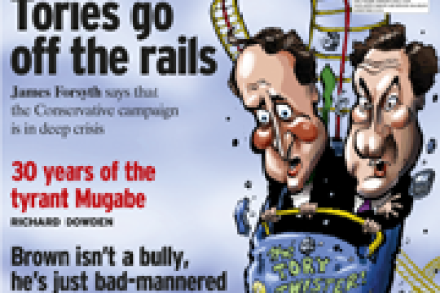
Readers of the magazine will be familiar with Michael Heath's series of 'Flash Gordon' cartoons, based on the life and sulks of our glorious Prime Minister.  Well, now it's got a successor – 'Dave' – which, naturally enough, focuses on the Tory leader and would-be PM, Mr Cameron.  Here's the first of them, from this week's issue, for the benefit CoffeeHousers.

Can it get much worse than this?

£4.3bn in the red, that is the gruesome fact of the government’s January accounts. Never before has the government borrowed money in January, usually a month of surplus as self-assessed income and corporation tax receipts line government coffers. Analysts forecast a surplus of £2.8bn, denoting just how bad the situation is. This is an exact copy of last July’s accounts, lending weight to the analysis that Britain’s recovery is slow and very precarious, an analysis confirmed by the weakest mortgage lending figures for ten years. Obviously tax revenues have collapsed.