Uk politics

Darling’s nothing budget puts the ball in the Tories’ court

From our UK edition

This year’s Budget was never going to win the election for Labour but it could have lost it. If the markets had reacted really badly to it, warnings about how Britain is in danger of going Greek would have suddenly gained traction. But Darling avoided that fate with a Budget that did little. Listening to it, it was clear that those inside Labour who argued that the strategic imperatives for this Budget had to be appearing credible and not risking an adverse market reaction had prevailed. The mood music was very different from the PBR, with its emphasis on investment versus cuts.

Fiscal drag

From our UK edition

It is good to see the Tories calling fiscal drag what it is, a tax rise by another name. Fiscal drag is a result of holding income tax thresholds steady while both prices and earnings are increasing. This means that more people have to pay more of their income in tax. Gordon Brown indulging in this ploy so often as Chancellor was one of the main reasons that the number of people paying the 40p rate pretty much doubled between 1997 and 2008. One other good thing about the Tory line on fiscal drag today, is that it will put pressure on them to raise personal allowances and income tax thresholds in line with inflation every year. If they don’t, they will be—by their own definition—raising taxes.

In defence of Alistair Darling

From our UK edition

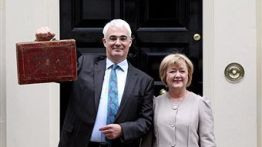
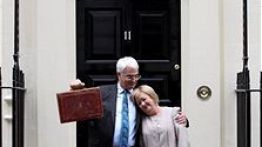
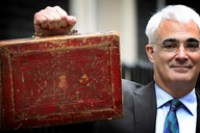
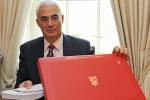
It's unusual for Chancellors to stand with their wives on the steps of the Treasury on budget day, and to see the Darlings together this morning gives an indication of what they have been through. Brown doubtless thought him an automaton when he appointed him to the job - but I was wrong to say that he would be "no more a Chancellor than Captain Scarlett was an actor". He has defied Brown, bringing moderation and much-needed dullness to the worst fiscal crisis in Britain's peacetime history. In James's political column last week he suggested that Darling calls his autobiography "the forces of hell" - that he would defy Brown like that takes some guts. It felt strange to praise Darling in the editorial of tomorrow's magazine, given that he has presided over this fiscal collapse.

Darling, what about the deficit?

From our UK edition

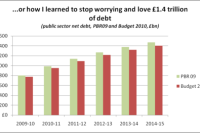
Alistair Darling was terribly proud of the Government's record in his Budget speech today.  But he again dodged the question of how he'll get the deficit under control.  Ruth Lea has called this his "do little" Budget. With the country still facing hundreds of billions in borrowing, the few billion being saved are virtually neglible.  There are huge downside risks for those borrowing forecasts as we get onto the more contentious growth projections from 2011-12 onwards, which are way above City expectations.  And everything will get much worse if borrowing costs rise - Mike Denham has explored the frightening possibilities in a blog for the TPA. We had a proud boast that Britain has "the fastest deficit reduction plan of any G7 country", a massive Brownie.

Another dangerous Quango in the offing

From our UK edition

This government’s love of quangos reached new heights in today’s Budget when Darling announced the creation of a ‘credit adjudicator service’. This will allow companies who feel they have been unfairly denied credit by their bank to appeal the decision to the credit adjudicator service which will have the legal power to order the bank to lend the money.    The Treasury is quick to stress that businesses will have to have claims referred to the credit adjudicator service by their regional business body. But this quango, which will cost five million pounds a year to run, strikes me as a quite absurd attempt to second guess commercial lending decisions. It is also unaccountable.

A reassuringly dull budget

From our UK edition

This was a surprisingly subdued Budget, and for that Alistair Darling is to be commended. He must have resisted all manner of pressure from Brown to put in pre-election pyrotechnics. But the budget was what it should be: a punctuation mark on the sentence of the national economy. That sentence says "our finances are going to hell," and the Budget's high point is that we are doing so fractionally slower than we were expecting to last November. Personally, I forgive Darling all the partisan stuff in his speech - this is a pre-election Budget after all. There is no act of wanton vandalism, like the 50p tax. Stamp duty on properties over 1m is rising from 4 percent to 5 percent, but does anyone seriously think this would not have happened under the Tories?

Darling’s phoney Budget doesn’t change anything

From our UK edition

Was that a Budget sufficient to the fiscal nightmare that we face?  Well, I think we all could have answered that question before Alistair Darling stood up at the dispatch box, but now we can at least be sure: no, it wasn't.  The government's overall spending plans remain roughly the same as they were in the PBR, there aren't many tax increases to raise much money for the Treasury, and we're meant to be all excited that borrowing is £11bn lower this year than previously forecast – at £167bn.  It's a shame that Darling increased alcohol duty, or we'd all be be out celebrating that particular success, I'm sure. If you're feeling charitable to the government, you could say that if might have been worse.

Not the main event

From our UK edition

Cameron was scarcely trying at PMQs today. Show up, look a bit cross, slip in a joke or two, then sit down and wait for the Budget. That was his plan. When the PM offered his congratulations on BabyCam, the opposition leader quoted a text he’d received – ‘How do you find time for these things?’ Making this wisecrack seemed more important to him than attacking the PM. His tactics were odd, out of touch, retrospective. He asked about Brown’s attempts to conceal the evidence that, as chancellor, he flogged the nation’s gold too cheaply and blew vast sums in potential profits. Brown’s bungling over the bullion billions should be a promising issue.

Spotting the Budget deceptions

From our UK edition

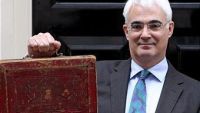
There are, lest you need reminding, two levels of deception on Budget Day.  First, there's the Chancellor's Budget statement, which is pretty obviously spun to put the best light on things.  I refer you to when Brown triumphantly announced a 2p cut in the basic rate of income tax in his final Budget statement, while somehow forgetting to mention that the 10p rate has been abolished.  And then there's a Budget document itself, in which much of the most revealing content is tucked away in appendices and footnotes.  Even straightforward spending figures are hard to come by in the Red Book. In which case, we'll be doing our best to catch out Darling in our live-blog of his statement from 1230.

Germany to the EU: no more integration

From our UK edition

A Conservative Party article of faith has been the belief that other Europeans are innately more pro-EU than the British. In the past, this has undoubtedly been the case. Poll after poll has shown that Britons see the EU differently than most other Europeans. But as I have argued before, times are changing on the continent. In an article in the Frankfurter Allgemeine Zeitung (not a Europhile newspaper by any stretch), Germany's new politics is explained.

All quiet on the Westminster front

From our UK edition

If there's one thing distinguishing this morning, then it's just how placid everything feels.  The clouds are moving sluggishly across the sky; there's little excitement about the measures expected in the Budget; and there are no stories about rifts between the Prime Minister and the Chancellor.  Indeed, Downing St insiders tell the FT that relations between Gordon Brown and Alistair Darling have been "pretty good" in the run up to the Budget, because both are "broadly agreed on the strategy of halving the deficit in four years while backing growth initiatives." Many are taking this as a sign that Darling and Peter Mandelson have won out in their efforts to coax Brown away from the crude "investment vs cuts" thinking of yesteryear.

Closing the gap between state and independent education

From our UK edition

I do hope that Oxford will finally be free from government claims of snobbery soon. We learn today that the proportion of state school pupils it admits has fallen from 55.4 percent to 53.9 percent - but, as the university says, this is in line with the (appallingly low) proportion of state school pupils achieving three As. The problem lies with the schools, not the universities, and it helps no one to pretend otherwise. Here's one figure that you won't read in the ongoing "Oxford snobbery" story: in 1969, only 38 per cent of Oxford's places went to privately-educated children. Why? Because the private schools in those days were not places of educational excellence, but of social preference. The decline of state education, relative to private, is the problem here.

The Tories want you to help unpick the Budget

From our UK edition

One of the best things about this Brave New Web World is how it helps you to draw upon the talents, knowledge and expertise of people around the world. We certainly had that in mind when we asked CoffeeHousers to help us track down the tricks and deceptions in last year's Budget – and now the Conservatives are thinking along similar lines. Earlier today, David Cameron said that the Tories would "crowd-source" their Budget response tomorrow. Jeremy Hunt has since provided more details here. This kind of thing ties in neatly with the Tories' powerful transparency agenda.

Two things to bear in mind tomorrow

From our UK edition

If, as expected, Alistair Darling reduces his borrowing forecasts tomorrow, it's worth keeping two particular points in mind: 1) This government has always tended to underestimate its borrowing levels.  Ok, so you might argue that the government couldn't have foreseen that public sector net borrowing would rise to £178 billion in 2009/10 when it predicted £38 billion in Budget 2008.  A recession has bitten, banks have collapsed, since then – that kind of thing.  But Brown & Co. certainly have a track record when it comes to underestimating borrowing totals.  In Budget 1999, they thought that borrowing would be at £3 billion in 2002-03 – it turned out to be £23 billion.

Alistair Darling needs to tell us that frontline services will be affected by cuts

From our UK edition

The credibility of the Chancellor’s Budget tomorrow depends on the policy changes that he announces for the public sector.  It won’t be enough for him just to announce a series of public spending totals that decline gracefully in the years to come.  Within some broad limits, anyone can do that.  What counts is whether he backs it up with practical ideas to target the big government costs, which lie in two places - benefits and the public sector workforce. In retrospect, the general election has fallen at the wrong time for the UK public finances.  Since early last year, the prospect of an early election has allowed the Government to put off the date of publication of its full plan to address the deficit.

Cameron denounces Labour’s “lies”

From our UK edition

David Cameron’s press conference this morning was ticking along rather uneventfully until James Landale asked Cameron a question that set the Tory leader off on one about, what he called, "Labour’s complete and utter lies." Cameron had started off by talking about how pleased he was that we going to be a father again, letting slip that he and Samantha had been trying for another baby for a while, and with some remarks on the lobbying scandal and the Budget. There had been questions on Ashcroft and cuts but nothing had really got going. Then, James asked Cameron about a Lib Dem plan to scrap the winter fuel allowance for pensioners under 65. At this point, Cameron’s whole demeanour changed.