Uk politics

Goldsmith’s declaration of independence

From our UK edition

Make what you will of his political agenda, but I think this is quite a refreshing admission from Zac Goldsmith today: "There are various things I have said in this campaign with absolute certainty. I said there will be no Heathrow expansion under our Government, there will be no charges for parking in Richmond Park and Kingston Hospital will be safe. If any of those promises are broken I will trigger a by-election and allow people to penalise my party." It's bound to rile some of his Tory colleagues, of course – particularly this close to the election.  But one of the upshots of Parliament's recent spate of scandals is that they – and we – will have to come to accept more independent, and independent-minded, MPs.
Memo to Cameron: don’t be angry

From our UK edition

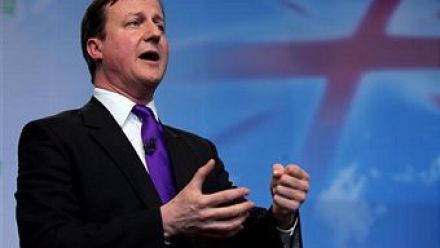
There will be no shortage advice for David Cameron as he prepares for tonight’s TV debate. Wear this tie, smile a lot, be direct but not controversial and so on. The newspapers have been full of tips and lessons from the US debates. The Tory leader is also said to have hired Squier, Knapp, Dunn Communications, a DC-based political consultancy, specifically for help with the TV debates. Allow me to add my piece of (unsolicited but free) advice: don’t be Mr Angry. People want to like you; they want to feel that you can be trusted. They know they don’t like Labour. They know that the country needs change. But they are not yet sure you represent a benign form of change.

Brown’s signature parade

From our UK edition

Only 58? Labour's last letter attacking Tory spending cuts this year had 60 economists' signatures attached to it. Their latest, released today, has only 58. Number 10's signature-marshalling skills are clearly on the wane. I sincerely hope that the Tories don't marshal some economists of their own. The last time that happened, back in February, we witnessed the low point of the fiscal debate – with both sides using a bunch of academics as a substitute for a proper conversation with the public. And, lest we forget, Guido's handy graph reminds us just what those economists were and are quibbling over anyway. This is a phoney war, so it's little surprise that Brown has resorted to it once again. Thankfully, signs are that Tories won't pay heed to the bait.

First poll since all the manifesto launches has the Tories ahead by 9 

From our UK edition

The figures from YouGov's daily tracker have just been released, and they have the Tories on 41 percent (up 2), Labour on 32 (up 1), and the Lib Dems on 18 (down 2) – so a lead of 9 points for Cameron & Co.  It's worth noting, as well, that the Tory manifesto comes out on top in supplementary questions about which has the best policies, which is most honest and which is the best for the country.  But, to my eye, the most striking result is that relatively low level of support for the Lib Dems.  I imagine that they'd certainly hope for better as they continue peddling their anti-"Labservative" message.

Brown demolishes himself with untimely ‘admission’

From our UK edition

Sorry is the hardest word and Gordon Brown stil hasn’t said it. But, everyday brings surprises. His ‘admission’ about his errors is the first time I’ve ever agreed with his economic analysis. In short, even Brown knows he’s not what he’s cracked up to be. Making such an admission at this stage of the election cycle is extraordinary. The intention may have been to make Brown look human. In which case, he’s succeeded, but to his detriment. Brown looks Biblically fallible. Labour’s campaign rests on one deduction. Gordon Brown built an era of prosperity; then Gordon Brown saved the country from a recession that originated in America; therefore Gordon Brown is the man to lead the country back to prosperity.

How Charlie Whelan killed New Labour

From our UK edition

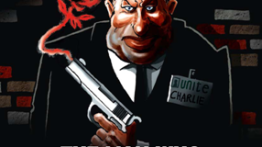
Last summer, The Spectator received a letter from Charlie Whelan's solicitors complaining about this post - where we mention their client's spot of bother with his colleagues at Unite. Carter-Ruck were instructed on one of the no-win-no-fee deals: it cost Whelan nothing to sue, but could cost us £thousands to defend. So the lawyer's letter is, by itself, an effective form of intimidation. A magazine with a small budget obviously faces huge pressure to do what he wanted: apologise, pay up and (suspiciously) undertake not to pursue the story any further. Under the circumstances, The Spectator could do only one thing. Our full investigation into Charlie Whelan is the cover story of tomorrow's magazine (see image, left).

Follow the money | 14 April 2010

From our UK edition

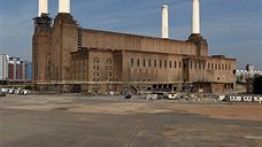
Looking at the papers this morning and watching the news last night, you realise what a benefit in the image stakes the Tory cash advantage gives them. The Tories can afford to hire out better venues than the other two parties. So while Labour launched their manifesto in hospital and the Lib Dems theirs at Bloomberg, the Tories used Battersea Power Station which provided them with much better visuals. We saw the same dynamic on the day the election was called: Labour’s event was in Downing Street, the Lib Dem one in an office and the Tory one on the terrace of County Hall looking over to Parliament The Mirror’s front page today accuses Cameron of using his photo-ops to benefit the firms that are backing his position on National Insurance.

The future might be yellow

From our UK edition

The Liberal Democrats are doing well. Very well. More voters seem actively to want a hung parliament - they neither hate Labour or love the Tories enough to act decisevely either way - and a vote for Nick Clegg seems a safe, fair choice. A few years ago Paddy Ashdown was over the moon to have won far fewer MPs than the party is hoping for at this election. Then came the "Iraq Bounce" with Charles Kennedy's anti-war stance doing the party well. Many assumed that without a clear-cut issue, and having chosen a leader who looked like David Cameron's younger brother, the Lib Dems might struggle. Instead, the party seems to be fighting off Tory inroads.

The Lib Dems have found their issue

From our UK edition

Well, that was quick.  After the Tories' one-hour-and-forty-minutes-long manifesto launch yesterday, and Labour's comparable event the day before, it was quite a relief that the Lib Dems got through theirs in a nerve-soothing 45 minutes.  And that included introductions from Sarah Teather, Danny Alexander and Vince Cable, and a speech from Nick Clegg - all of them short, sharp and snappy.  The only thing which seemed to drag was the Q&A session at the end. But timings aside, it was clear that the Lib Dems have hit on an issue which - they think - separates them from the other parties.  In 2005, it was Iraq.  This time around, deserved or not, it's fiscal responsbility.

Labour’s response to the Tory manifesto

From our UK edition

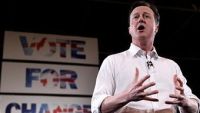
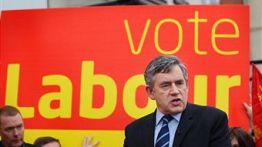
Anyone else think that Labour's latest poster is like a negative of the Tories' "Vote For Me" effort?  White text on a black background, instead of black text on a white background.  A picture of Cameron, instead of Brown.  I mean, the only thing that isn't swapped over is the tone: both go on the attack, rather than presenting a positive vision. Labour's message here is that the Tories' Big Society manifesto washes its hands of the people.  Which echoes the caricatures - "an agenda for abandonment" - that Peter Mandelson wheeled out yesterday, and which you can expect to hear again and again between now and polling day.  The question is whether this attack will connect at a time when people trust politicians - and their capabilities - less than ever.

The Lib Dems’ turn to convince?

From our UK edition

So now it's the Lib Dems' turn to present their prospectus for the country.  And, in some respects, I expect they'll want a fairly uneventful day.  They have, after all, endured the most topsy-turvy campaign of the three main parties so far.  Brown has given us no more, and no less, than what we expected.  The Tories have been riding the crest of a national insurance wave.  But the Lib Dems have bounced around from the highs of Nick Clegg's performance on Newsnight to the lows of their misleading VAT poster, from their continuing Labservative attacks to Ed Balls describing their schools policy as "creditable" on Sky this morning.

Counting the cost of Labour’s national insurance hike

From our UK edition

Insightful work from the FT's Chris Giles, who has dug out a couple of academic articles - including one co-authored, in 2007, by George Osborne's current chief of staff, Rupert Harrison - to work out how many jobs Labour's national insurance rise might cost the economy.  The results?  Well, according to Giles, one says that 23,000 jobs will be lost, and the other comes up with 22,000. Neither of these are figures that Labour will want to crow about.  But, as Giles points out, they are below the "57,000 jobs in small and medium-sized businesses alone" that the Conservatives predict in their manifesto.

Voting blues

From our UK edition

One of the key questions in any election is turnout: whose voters will turn up and whose won’t. People are clearly disappointed in the political class - on a scale from 0 to 10, trust in politicians and parties is hovering around 3 points - but does it mean that they will stay at home, spoil their ballots or opt for fringe parties and single-issue candidates? What about the talk of a hung parliament ? Will it make voters believe that their vote counts - and so bring them to the polling stations -- or make them stay at home, giving up on the idea that any change is possible? In the last three elections turnout was low, relatively speaking: 59 percent of the electorate voted in 2001 and 61 percent went to the polls in 2005.

The return of Chris Grayling

From our UK edition

Adam Boutlon's interview with Chris Grayling this afternoon felt like a pressure valve being released.  Grayling's recent low profile had already become a rolling story, and his absence from the speaking line-up at his party's manifesto launch was bound to fuel more murmuring and speculation – so the Tories clearly decided to wheel him out in front of the cameras to calm things down a bit.  As it happened, Boulton was on combative form – arguing that elected police commissioners would just add "another layer of bureaucracy" to society – but Grayling sounded quite reasonable in response.

The Big Idea Competition

From our UK edition

Whatever your political leanings, it is hard to deny that the Tories won the Big Idea Competition. The Labour Party offered a series of unconnected (if occasionally innovative) initiatives. But they lacked coherence. Their manifesto had what Peter Mandelson called “Blair Plus”, but also what could be referred to as “Prescott Squared”. “What's The Big Idea?” asked Sky’s Niall Paterson. The Tories on the other hand have a Big Idea – decentralisation. Giving power to citizens in a number of different ways. It is a concept that gives shape to the Tory manifesto, providing a ready stock of sound-bites.   But why do we need Big Ideas, as opposed to just Good Ideas?

Around the Web: Conservative manifesto

From our UK edition

You can read Fraser’s verdict here, but this is what the rest of the Web had to say: Janet Daley described it as ‘the perfect pitch’: 'The Conservatives have just given a launch performance for their manifesto which was as close to perfect as any I have seen. It was clear, coherent and genuinely compelling: the message was simple: people power rather than state power.' Ben Brogan welcomes less, not more: 'Today was also about David Cameron. He made a long speech, too long, and so reminded us that when he is scripted he is less effective.