Uk politics

Cameron has a policy agenda to change Britain – he should tell us about it

From our UK edition

Cameron has not, alas, broken free of the never-ending opinion poll bungee jump which is the story of his leadership of the Conservative Party. Cleggmania is a bubble – but the thing about bubbles is that one can never quite tell when they will burst. The Tories, who have lost the most votes due to this bubble, will have their needles out. But in my News of the World column today I suggest they focus on policy because they do have hard ideas that could radically change Britain. Cameron missed a trick by failing to mention his single best policy, Gove's school reform, last week.  On immigration, his plan for reducing it is the most radical promise on the market, and his linking it with welfare shows maturity and sophistication.

Brown’s mindset on full display

From our UK edition

Labour high command will be very satisfied with Brown’s performance on Marr this morning. There was far less of the tetchiness that we usually see from Brown in interviews and by being invited to talk about the ash cloud and the government’s response to it at the beginning, Brown was able to assume some of the aura of his office as Prime Minister. The interview saw the debut of Brown’s latest rewriting of history. Apparently he has always been for bringing in the liberals (exact quote to follow when the BBC release the transcript) and a ‘progressive consensus’. This will come as a shock to anyone who has read Paddy Ashdown’s diaries or talked to those involved in the discussions between the two parties in the mid to late nineties.

Mandelson contra Cameron

From our UK edition

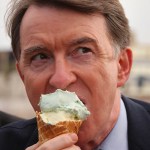
So far as the Tories are concerned, Peter Mandelson is the political equivalent of an itch that you can't scratch: irritating, elusive and impossible to ignore.  And he's at it again today, with an article in the Independent on Sunday chiding the Tories' over their Big Society agenda.   It's not the "agenda of abandoment" attack that Mandelson made a few days ago.  But, rather, a return to the "cross-dressing" territory of last year.  As Mandelson puts it, "[Cameron's] tightly knit group of associates has simply pinched a few ideas from our campaign manual, rather than fundamentally reforming the party to make it fit for office.

The impediment to a Lib-Lab coalition

From our UK edition

Certainly, the Lib Dems’ current joy will prove transient; but for the first time since 1983 this is a three party race. As Pete notes, Labour see Nick Clegg as the surest means to keep the Tories out of office. Even before the debate, the normally cerebral Andrew Adonis was penning passionate articles appealing to Lib Dem support. Since the debate, the love-bombing campaign has become indiscriminate .   Love isn’t all you need. Labour will need nous to make the most of the opportunity Clegg has presented.

Nick Clegg: the Hans-Dietrich Genscher of Britain

From our UK edition

Nick Clegg has always said that if no party can command a majority in parliament, he will support the party voters have been seen to support. It was assumed that if the Tories were the biggest party - but a few members short of an outright majority - he would back them. But if the YouGov poll comes true, on a uniform swing Labour will be the largest party and the Liberal Democrats still the third largest party in parliament but with 90-odd seats. With Labour out front, Clegg's logic would suggest he would back a Labour-led government. But Clegg's poor relationship with Gordon Brown is well known and with such a strong showing for the Lib Dems will he feel less bound by who is the largest party and feel empowered to bargain more freely?

Responding to the Lib Dem surge

From our UK edition

We've had the insta-polls and that eyectaching YouGov poll, and now we get the political reaction to Thursday's TV debate.  Interviewed in the Times, Alan Johnson plays up what Labour and the Lib Dems have "in common," and opens the door on a potential coalition.  While, in the Telegraph, David Cameron sets about Lib Dems policies – attacking, for instance, the "flimsy backing" to their plan for making the first £10,000 of income tax-free These different responses to the Lib Dem surge are stiking, if predictable.  Labour see Clegg as an opportunity: an opportunity to whitewash Brown's mechanical performance in the TV debate, and to keep the Tories out of government.

A gentle fightback

From our UK edition

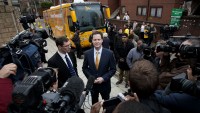
The consensus is that David Cameron made a mess of last night’s TV debate. And whilst he wasn’t bad, he certainly wasn’t good, especially to watch. In a post over at Cappuccino Culture, I make the point that Cameron was the most static and soulless feature of a static and soulless piece of television. Undoubtedly the Tories' greatest presentational asset, his subdued performance is inexplicable. Whilst there is no cause for panic the Tories are rightly trying to regain the initiative. Gary Barlow’s appearance with Cameron at a school this morning didn’t relight Dave’s, or anyone else's, fire.

The case for Nick Clegg

From our UK edition

Ok, this won't be one of my more popular opinions, but here goes ... Nick Clegg is a Good Politician.  And I don't mean that in some Machiavellian sense – although, for all I know, that might be true.  But, rather, that he's got some decent ideas and ideals, and he presents them convincingly.  This is why he deserved his victory in yesterday's TV debate.  It wasn't the novelty factor, as Fraser claimed last night.  It wasn't even really his plague-on-both-your-houses positioning.  No, last night was the culmination of two years in which – politically speaking – Clegg has kneaded and pulled his party into one which can stand, unashamed, on a platform beside the Big Two.

What the polls say about the leaders’ debate

From our UK edition

More concrete information will emerge over the next few days, and it may be sensible to reserve judgement until then. But the polling data we have so far is unanimous: Nick Clegg walked it. Here are some of the polls: YouGov: Who performed best in the TV debates? Clegg: 51 percent Cameron: 29 percent Brown: 19 percent Com Res: Who won the debate? Clegg: 46 percent Cameron: 26 percent Brown 20: percent Populus: Who won the leaders’ debate? Clegg 61: percent Cameron: 22 percent Brown 17: percent Angus Reid: Who came out on top? Clegg: 48 percent Cameron: 20 percent Brown: 18 percent PS: As ever, Anthony Wells's analysis is a must read.

So what’s changed?

From our UK edition

The question is: how much has really changed after last night?  And the answer is hard to pin down.  There are the plastic, surface changes, of course.  Nick Clegg may now be recognised by more that one-third of the nation.  His party will probably come under greater scrutiny from the media and his opponents.  And the leaders' debate is here to stay; a defining feature of this election which will become a standard feature of future contests. But what about deeper change?  Well, I can understand the argument – made punchily by Gideon Rachman here – that this will increase the likelihood of a hung Parliament.  That's probably true.  But there's also a chance that it might help the Tories pull clear of their opponents.

The novelty of Clegg wins it for him

From our UK edition

“I agree with Nick”, said Brown – and, as it turned out, so did most of the people YouGov polled. Brown lived right down to expectations, Cameron lived up to them (but didn’t exceed them). Few would have had any expectations from Clegg: what we political pundits know to be his clichés will be heard for the first time in many living rooms tonight. Each used tactics we’re familiar with. Brown opened his verbal machine gun, and sought to mow down the audience (they surrendered early on). David Cameron was fluent, articulate – as anyone who has followed politics had come to expect. But dazzling? No. He was subdued, seemed to be biting his tongue at times. He didn’t attack Brown, which seemed to be deliberate.

Nick Clegg triumphs – and Cameron gains – in the first TV debate

From our UK edition

So, who won?  Well, hold your horses, dear CoffeeHouser.  First, it's worth noting that that was a good shade more compelling than I thought it would be.  There were moments of heat, drama and political tension, of course.  But there was also a sprinkling of light as well.  I suspect anyone watching that would have picked up a working sense of the differences and similarities between the parties and their leaders. So, who won?  Well, it depends what you mean by "won".  Nick Clegg certainly gained most from the evening.  He was confident, coherent and had a strong line on almost every policy area, whether you agreed with those lines or not.

Leaders’ debate – live blog

From our UK edition

2207, PH: Well, we've just been through all that - and guess what's leading the News at Ten.  Yep, the ash cloud... 2205, PH: And that's it.  I'll be writing a verdict post shortly. 2203, PH: And Cameron has pre-empted Brown's statement well.  He says that the other two have tried to frighten the audience about the Tories - but "put hope before fear".  His key message after that is about national insurance.  A solid closer from the Tory leader. 2201, PH: Classic Brown. He points the finger at the Tories, saying that they can't match Labour's guarantees and that they'd risk the recovery. I'm not sure this negative approach will come across so well. 2200, PH: Here we go: the closing statements.

Take your seats

From our UK edition

Right – the pizza has been ordered, my glass is overflowing with raspberry Ribena (New! And delicious!), and I've fired up the old cathode ray tubes. But, somehow, I'm still feeling quite ambivalent about tonight's TV debate. Maybe it's because I still suspect it will be a cautious affair – with neither side wanting to risk the kind of mistake which could define their evening. Maybe it's because of the wall-to-wall coverage of the past few days. Or maybe it's because the New York Times has a (deliciously arch) point when it writes that UK politics is finally "moving into the television age".

Covering the TV debate

From our UK edition

We'll be live-blogging tonight's TV debate on Coffee House from 2030.  Do, please, join us then. And, in the meantime, over on our special election site Spectator Live, Spectator panellist Gaby Hinsliff has written about why she doesn't think tonight's debate will be a make or break moment.  And Reform's Thomas Cawston has prepared a set of questions for the party leaders to answer.

Show him the door please

From our UK edition

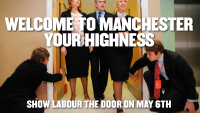
In a move designed to take advantage of everyone’s need to fill air time before the debates, the Tories have launched a new ad spoofing that picture of Brown walking through a set of double doors while two aides squat on the ground holding it open. The ad is just up here in Manchester but the Tories will be hoping to get it onto the news broadcast and in to tomorrow’s paper. This is another example of how the Tory cash advantage is helping them.

Advantage Cameron | 15 April 2010

From our UK edition

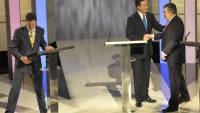
I’ve just been watching the feed coming out of the studio where the debate is taking place and what struck me was how much of an advantage his central position will give David Cameron. In all the shots of the studio, the middle lectern is where your eye is drawn first. The leaders, I’m told, have all had half an hour in there to familiarise themselves with the surroundings. They now appear to be white-washing parts of the studio.

A night to remember?

From our UK edition

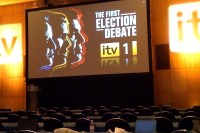
I’ve just arrived in the press room in Manchester where the media will be watching the debate; the hotel lobby is full of hacks and spin doctors. The question being asked is whether this is the moment that the electorate begins to engage with the election. Although I know that some in CCHQ worry that tonight’s debate could be so he said, she said that it deepens the public's cynicism about politics. Today’s extreme weather has added an intriguing angle to tonight’s proceedings. Douglas Alexander, who along with Peter Mandelson will be working the spin room after the debate, has already claimed that Brown is concentrating more on the lines at the airports than lines for tonight’s debate.