Uk politics

David Miliband kicks off his “unity” leadership campaign

From our UK edition

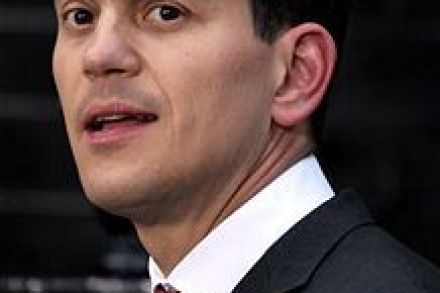
Surprise, surprise – David Miliband has just announced his candidacy for the Labour leadership, and there wasn't a banana in sight.  His address only lasted a few minutes, but it contained a number of hints about how, I suspect, he will look to run his campaign.  The emphasis was on newness, natch – "a new era, new dangers, new possibilities, new opportunities" – but also on unity.  He praised the leadership of Gordon Brown; claimed he was looking forward to a "warm, generous and comradely" contest; and said that he would go on a tour of non-Labour constituencies to "listen" to the public.  All of which was meant to reinforce one impression: that he would take Labour beyond the fierce tribalism of the Blair and Brown years.
The story of the Tory campaign

From our UK edition

If you read only one thing today, then make a cup of tea, sit in a comfy armchair, and make sure it's Tim Montgomerie's 7,000-word review of the Conservative election campaign.  Tim has opened up his address book and spoken with many of the main players in the Tory operation - and the result isn't all that flattering.  Here's a summary passage which gives a sense of it all: "For a period, the 'Big Society' was put at the heart of the campaign. Amazingly, the Big Society was never tested in focus groups and it failed on the doorstep. One leading adviser to the campaign complained of a 'cavalier' approach to research. 'They latched on to research that backed their views and ignored any research that challenged it.

The coalition passes the easy bit with flying colours

From our UK edition

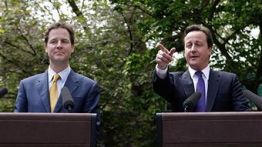
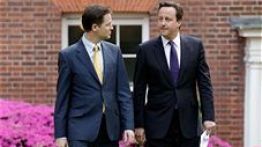
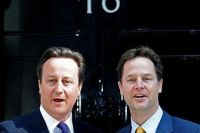
The first press conference of this new era was a definite success. The body language between Cameron and Clegg was good. When Clegg called Cameron ‘Dave’ it sounded very natural. Cameron’s argument was that the two parties could have come to a confidence and supply agreement but that would have been ‘uninspiring’ and could have broken down at any time. What the Prime Minister didn’t mention is that the coalition agreement ties the Lib Dems into cuts as well as providing stable government. Clegg was excellent, as in the debates he is helped by being a little bit taller than Cameron. He defused any tension when Andy Bell reminded Cameron that he had dismissed him as his favourite joke with a bit of humour.

The coalition agreement at a glance

From our UK edition

I have just had a quick read through the coalition agreement and a few things jumped out at me. First, this new government will not abolish Lord Mandelson. The agreement states that while the parties are committed to a wholly or mainly elected Lords ‘likely there will be a grandfathering system for current Peers’.   The Tory manifesto commits a Conservative government to introducing ‘new rules so that legislation referring specifically to England, or to England and Wales, cannot be enacted without the consent of MPs representing constituencies of those countries.’ The coalition agreement has watered this commitment down significantly. The new government will merely ‘establish a commission to consider the ‘West Lothian question’.

Victory! | 12 May 2010

From our UK edition

This magazine had hoped for a Conservative government. We have what is arguably the next best thing: a government led by David Cameron but supported by some political mercenaries put in the positions where they inflict the least harm — and reform-minded Tories in positions where they can do most good. The strategy is fairly clear: give Lib Dems more Cabinet crowns and chauffeurs than they could have dreamed of. Tie them in for five years, and have them defend Tory policy on the airwaves. And then, crucially, let them share the blame for the Irish-style spending cuts to come. Three appointments make this government, on balance, a victory for Conservatism.

Iain Duncan Smith’s appointment is a triumph for the welfare agenda

From our UK edition

Of all the Cabinet positions announced so far, one is more eyecatching, and holds more promise, than all the rest: Iain Duncan Smith has been appointed Secretary of State for Work and Pensions.  Through his work with the Centre for Social Justice, IDS has shown that he not only knows his way intimately around the welfare brief, but cares deeply about it too.  The hope now is that this will energise the Tories' welfare-to-work policies, and also put the CSJ's crucial benefit reforms on the government's agenda.  On a day when unemployment has risen once again, this may prove to be one of the best decisions that Prime Minister Cameron ever makes.

The new power broker

From our UK edition

Ed Llewellyn, David Cameron’s chief of staff, is going to be one of the most influential people in Downing Street these next few years. He has already played a crucial role in the negotiation between the Tories and the Lib Dems; having worked for Paddy Ashdown in Bosnia and being friends with Nick Clegg’s wife from his Brussels days he has good relations with the Lib Dems.   Llewellyn has extensive links across government and it is telling that Sir Peter Ricketts, who was appointed as the national security advisor this morning, has worked with Llewellyn twice. He was Hong Kong desk officer at the Foreign and Commonwealth Office when Llewellyn was in Chris Patten’s office in Hong Kong.

Who is missing?

From our UK edition

The Cabinet is taking shape, admittedly with one or two surprises and not all of them good ones. There is still a way to go, even though action has already been taken on the NI increase. I understand that Michael Gove will be education secretary, which obviously leaves the hugely impressive David Laws to find another brief. Work and Pensions is a possibility, a job that has also been earmarked for the equally impressive Philip Hammond. There is a very obvious lack of women – Sarah Teather is highly regarded on the Lib Dem side, probably more so than her counterparts on the Tory side. I’ve heard rumours that she’s possibly headed for Transport or Communities. Though, of course, nothing is certain. So, who has lost out?

Game on for the Labour leadership

From our UK edition

The Coalition Cabinet remains unformed as yet - it's rumoured that Chris Huhne is going to environment and Michael Gove and David Laws are out doing one another in the 'I've no idea where I'll be' stakes. All the sounds are very positive but the contents of would-be ministers' statements are careful, as doubtless final decisions are being made. The Labour leadership has its own spot on Westminster's backdrop of delicate intrigue. Yesterday, Andy Burnham positioned himself as the candidate of sense, opposing Lib-Lab talks and acknowledging that Labour needed to reorganise itself in the aftermath of defeat. The preferred path to renewal is clearer this morning. Alan Johnson has declared he will not stand and has backed David Miliband.

The Deputy Prime Minister speaks

From our UK edition

Just as the midnight oil burns out, the Lib Dems have finally agreed to a coalition deal with the Tories.  Speaking in Transport House, Nick Clegg confirmed that the parliamentary party and federal executive had "overwhelmingly accepted" the deal.  And ... well, that was it, really.  There were few other specifics from the new Deputy Prime Minister.  No confirmations of other Cabinet positions, no firm indications about the Lib-Con policy trade-offs – just "thanks and admiration" for Gordon Brown, and a few assurances that the new government would work towards "fair" ends, even though " there will, of course, be problems".  I'm sure that full details will emerge in the morning.

The government takes shape

From our UK edition

Here are some details of the LibCon deal, and my brief comments: 1. Clegg as Deputy PM. It’s a non-job, but a senior one – it means Clegg will take PMQs in Cameron’s absence, and will defend all those nasty cuts (sharing the blame for these cuts is the main rationale for coalition). This follows the 1999 Lib-Lab deal in Scotland, where Jim Wallace was made Deputy First Minister to everyone’s surprise. 2. Laws replaces Gove in education. This has not been confirmed yet, and I will not believe it until I see it. Of all of tonight's moves this is potentially the most concerning – especially for all those (including myself) who had said that the Gove schools policy was the best single reason to vote Tory.

David Cameron is Prime Minister

From our UK edition

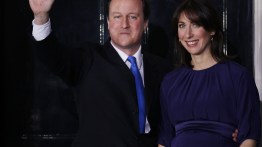
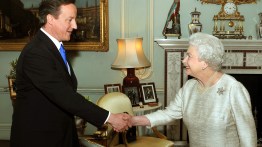
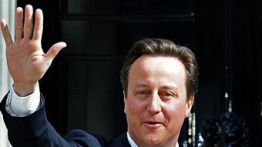
And he begins his tenure with an unfussy speech outside the door of No.10.  All of the main Tory touchstones were mentioned: the deficit, responsibility, political reform and social breakdown.  But this wasn't a strident or triumphant performance.  Cameron went out of his way to pay tribute to Gordon Brown and his "long record of public service," and to highlight the role that the Lib Dems will be playing in a "proper and full coalition".  Almost with a dash of regret, Cameron noted that this coalition will "throw up all sorts of challenges". Perhaps he's had a first taste of those challenges with the protestors who greeted his entry, with banners and boos, into Downing Street.

The waiting game | 11 May 2010

From our UK edition

Westminster is working itself into a frenzy as we wait for the official announcements, statements and rituals of state which will surely come in the next few hours.   The very latest is that Cabinet ministers are saying Brown will go either tonight or tomorrow morning; Vince Cable has suggested a Lib-Con deal is "very close"; and all the noises are about a full coalition, perhaps with Nick Clegg as deputy Prime Minister. But enough of that: we shall soon have something more concrete to grasp than all the rumours and helicopter imagery.  And it will be nothing less than the end of 13 years of Labour government.

Lib-Con deal in the bag

From our UK edition

The Lib Dems are holding a meeting of both their MPs and the Federal Executive at 7.30pm. It is now widely expected that this meeting will approve a coalition deal with the Conservatives. Those who have taken the temperature of the Lib Dem Federal Executive say that approval is in the bag.