Uk politics

The new power broker

From our UK edition

Ed Llewellyn, David Cameron’s chief of staff, is going to be one of the most influential people in Downing Street these next few years. He has already played a crucial role in the negotiation between the Tories and the Lib Dems; having worked for Paddy Ashdown in Bosnia and being friends with Nick Clegg’s wife from his Brussels days he has good relations with the Lib Dems.   Llewellyn has extensive links across government and it is telling that Sir Peter Ricketts, who was appointed as the national security advisor this morning, has worked with Llewellyn twice. He was Hong Kong desk officer at the Foreign and Commonwealth Office when Llewellyn was in Chris Patten’s office in Hong Kong.

Game on for the Labour leadership

From our UK edition

The Coalition Cabinet remains unformed as yet - it's rumoured that Chris Huhne is going to environment and Michael Gove and David Laws are out doing one another in the 'I've no idea where I'll be' stakes. All the sounds are very positive but the contents of would-be ministers' statements are careful, as doubtless final decisions are being made. The Labour leadership has its own spot on Westminster's backdrop of delicate intrigue. Yesterday, Andy Burnham positioned himself as the candidate of sense, opposing Lib-Lab talks and acknowledging that Labour needed to reorganise itself in the aftermath of defeat. The preferred path to renewal is clearer this morning. Alan Johnson has declared he will not stand and has backed David Miliband.

The Deputy Prime Minister speaks

From our UK edition

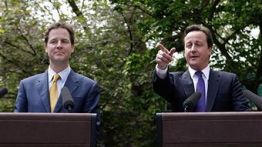
Just as the midnight oil burns out, the Lib Dems have finally agreed to a coalition deal with the Tories.  Speaking in Transport House, Nick Clegg confirmed that the parliamentary party and federal executive had "overwhelmingly accepted" the deal.  And ... well, that was it, really.  There were few other specifics from the new Deputy Prime Minister.  No confirmations of other Cabinet positions, no firm indications about the Lib-Con policy trade-offs – just "thanks and admiration" for Gordon Brown, and a few assurances that the new government would work towards "fair" ends, even though " there will, of course, be problems".  I'm sure that full details will emerge in the morning.

The government takes shape

From our UK edition

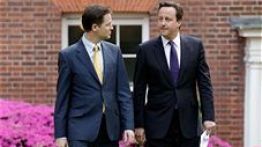
Here are some details of the LibCon deal, and my brief comments: 1. Clegg as Deputy PM. It’s a non-job, but a senior one – it means Clegg will take PMQs in Cameron’s absence, and will defend all those nasty cuts (sharing the blame for these cuts is the main rationale for coalition). This follows the 1999 Lib-Lab deal in Scotland, where Jim Wallace was made Deputy First Minister to everyone’s surprise. 2. Laws replaces Gove in education. This has not been confirmed yet, and I will not believe it until I see it. Of all of tonight's moves this is potentially the most concerning – especially for all those (including myself) who had said that the Gove schools policy was the best single reason to vote Tory.

David Cameron is Prime Minister

From our UK edition

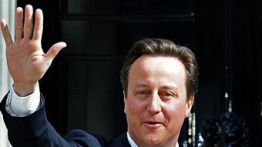
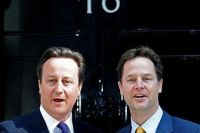
And he begins his tenure with an unfussy speech outside the door of No.10.  All of the main Tory touchstones were mentioned: the deficit, responsibility, political reform and social breakdown.  But this wasn't a strident or triumphant performance.  Cameron went out of his way to pay tribute to Gordon Brown and his "long record of public service," and to highlight the role that the Lib Dems will be playing in a "proper and full coalition".  Almost with a dash of regret, Cameron noted that this coalition will "throw up all sorts of challenges". Perhaps he's had a first taste of those challenges with the protestors who greeted his entry, with banners and boos, into Downing Street.

The waiting game | 11 May 2010

From our UK edition

Westminster is working itself into a frenzy as we wait for the official announcements, statements and rituals of state which will surely come in the next few hours.   The very latest is that Cabinet ministers are saying Brown will go either tonight or tomorrow morning; Vince Cable has suggested a Lib-Con deal is "very close"; and all the noises are about a full coalition, perhaps with Nick Clegg as deputy Prime Minister. But enough of that: we shall soon have something more concrete to grasp than all the rumours and helicopter imagery.  And it will be nothing less than the end of 13 years of Labour government.

Lib-Con deal in the bag

From our UK edition

The Lib Dems are holding a meeting of both their MPs and the Federal Executive at 7.30pm. It is now widely expected that this meeting will approve a coalition deal with the Conservatives. Those who have taken the temperature of the Lib Dem Federal Executive say that approval is in the bag.

Burnham strikes a blow to the Lib-Lab coalition

From our UK edition

As James suggested, the mood is shifting against a Lib-Lab coalition this afternoon. And now the idea has been dealt its biggest blow so far: Andy Burnham has spoken out against it public. Taking the kind of deliberate step that suggests he may be up for the Labour leadership after all, the Health Secretary said: "I think we have got to respect the results of the general election and we can’t get away from the fact that Labour didn’t win." And there's more. According to the irrepressible Paul Waugh, Burnham first made his discontent known in Labour's Cabinet meeting last night – where, according to Channel 4's Gary Gibbon, he was joined by Bob Ainsworth, Sadiq Khan and Jack Straw. So, then, have the rainbow coalition-ers given battle in vain?

The obstacles to a Lib-Lab deal

From our UK edition

The main development of this morning has been Labour MPs throwing up obstacles to a Lib Lab deal. At the moment there are four main problems. First, David Blunkett and others arguing that Labour would be better off going into opposition and—this is implicit—letting the Tories and the Lib Dems make the cuts. One union fixer told me Labour couldn’t go into a coalition with a party committed to cuts to benefits and tax credits. Second, Jon Cruddas, a champion of party democracy, has demanded that the parliamentary party, the NEC and the unions be consulted on the terms of any deal. Third, there are lots of Labour MPs letting it be known that they’d vote against AV so the Lib Dems might not get the main thing they want from a coalition.

The Tory right strikes back

From our UK edition

Sam Coates reports that the Tory right want Cameron to renege on the commitment to a referendum on AV. You can see why they want to do this but it’s ill-advised. The Lib Dems have destroyed their credibility by indulging blatant self-interest and the Tories should avoid making a similar mistake. The need for unity is absolute. It’s time to put-up and shut-up in the national interest. Right now, that means reaching an accommodation, either in coalition or in a minority government with Lib Dem backing or abstention. If that requires a referendum on voting reform then so be it. Besides, facilitating a referendum is not to endorse reform. The Tories have everything to gain - power and the moral high-ground.

The developing picture

From our UK edition

The emnity between Labour and the SNP is legendary. Scenting opportunity, Angus Robertson has tried to appeal to Labour's progressive instincts and substantial Scottish support to secure protection from cuts. John Reid and David Blunkett have talked sense about the damage a dalliance with nationalists would do to Labour's English position. Now Douglas Alexander has said that he can't envisage an deal with the SNP. This adds to the growing sense that the grand coalition will never form - a minority Lib-Lab coalition remains a possibility but an increasingly unlikely one. Boris has it right. This is the lurid politics of proportional representational laid bare.

Game on for a Lib-Con Coalition

From our UK edition

Gary Gibbon reports: 'Last night’s two-hour meeting of the Lib Dem MPs (with a sprinkling of peers) seems to have swung the party decisively behind a Lib-Con coalition deal. An announcement is widely expected now today.' It’s preferable to the alternative and as George Osborne made clear this morning the Tories can do nothing without Lib Dem support. There’s a suggestion that Clegg may have forced Cameron’s hand into further concessions with his sudden wooing of Labour, in which case he’s a very clever and brave shyster. I’ll believe it when it happens though. PS: A note of caution, as if one were needed. Clegg can't put a time on any deal. Incidently, there is no appetite for a Lib-Lab coalition among centre-left bloggers.

This isn’t English

From our UK edition

‘The Tories are stuffed,’ a resigned Shadow Cabinet minister tells Gary Gibbon. Endorsing any such view is premature but, with Lib Dem elders counselling Clegg to join Labour, the most likely outcome is a coalition of the losers, albeit nice progressive ones. Ah, the irony of the New Politics – plus ca change and all that. Politics has descended into a grotesque spectacle of blackmail, and bungled devolution is to blame. As James reported last night, talks with the Tories ran aground on sands that are the territory of Holyrood and Scottish Liberals presented every obstacle possible.