Uk politics

Brown resigns as Prime Minister

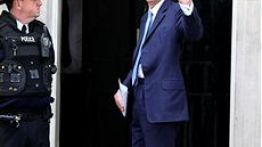
That No.10 lectern has had a lot of use over the past two days. Yesterday, it was wheeled out for Brown's resignation announcement; today, for his resignation proper. It was quite dignified, as it happened. He said that he he loved the job for its "potential to make this country fairer, more tolerant, more green, more prosperous and more just," and wished his successor well. And he finished by paying tribute to his wife and his children, who he said represented the "most important job" he could ever hold. So that is that, as one T Blair once said. The end.

The waiting game | 11 May 2010

Westminster is working itself into a frenzy as we wait for the official announcements, statements and rituals of state which will surely come in the next few hours.   The very latest is that Cabinet ministers are saying Brown will go either tonight or tomorrow morning; Vince Cable has suggested a Lib-Con deal is "very close"; and all the noises are about a full coalition, perhaps with Nick Clegg as deputy Prime Minister. But enough of that: we shall soon have something more concrete to grasp than all the rumours and helicopter imagery.  And it will be nothing less than the end of 13 years of Labour government.

Lib-Con deal in the bag

The Lib Dems are holding a meeting of both their MPs and the Federal Executive at 7.30pm. It is now widely expected that this meeting will approve a coalition deal with the Conservatives. Those who have taken the temperature of the Lib Dem Federal Executive say that approval is in the bag.

The obstacles to a Lib-Lab deal

The main development of this morning has been Labour MPs throwing up obstacles to a Lib Lab deal. At the moment there are four main problems. First, David Blunkett and others arguing that Labour would be better off going into opposition and—this is implicit—letting the Tories and the Lib Dems make the cuts. One union fixer told me Labour couldn’t go into a coalition with a party committed to cuts to benefits and tax credits. Second, Jon Cruddas, a champion of party democracy, has demanded that the parliamentary party, the NEC and the unions be consulted on the terms of any deal. Third, there are lots of Labour MPs letting it be known that they’d vote against AV so the Lib Dems might not get the main thing they want from a coalition.

Whatever happens, Clegg has sullied his credibility with the Tories

Let's not get ahead of ourselves: some sort of deal between the Lib Dems and the Tories is still a distinct possibility, even if negotiations have been rocked by the events of yesterday. But whether it goes through or not, Clegg has seriously dented his credibility in Tory circles. Backbenchers who were warming to the idea of a formal Lib-Con coalition a few days ago – if only to scupper Labour's hopes – are now dead set against it. The very notion of Clegg as Home Secretary is becoming a collective anathema. The question now is whether – failing a Lib-Lab coalition – the Tory leadership is more inclined towards a confidence and supply deal than they were before.

The Tory right strikes back

Sam Coates reports that the Tory right want Cameron to renege on the commitment to a referendum on AV. You can see why they want to do this but it’s ill-advised. The Lib Dems have destroyed their credibility by indulging blatant self-interest and the Tories should avoid making a similar mistake. The need for unity is absolute. It’s time to put-up and shut-up in the national interest. Right now, that means reaching an accommodation, either in coalition or in a minority government with Lib Dem backing or abstention. If that requires a referendum on voting reform then so be it. Besides, facilitating a referendum is not to endorse reform. The Tories have everything to gain - power and the moral high-ground.

The developing picture

The emnity between Labour and the SNP is legendary. Scenting opportunity, Angus Robertson has tried to appeal to Labour's progressive instincts and substantial Scottish support to secure protection from cuts. John Reid and David Blunkett have talked sense about the damage a dalliance with nationalists would do to Labour's English position. Now Douglas Alexander has said that he can't envisage an deal with the SNP. This adds to the growing sense that the grand coalition will never form - a minority Lib-Lab coalition remains a possibility but an increasingly unlikely one. Boris has it right. This is the lurid politics of proportional representational laid bare.

Game on for a Lib-Con Coalition

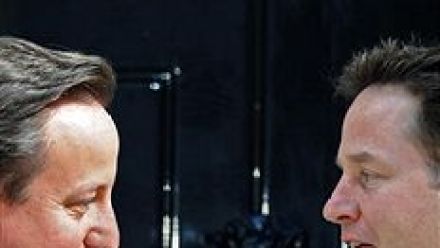
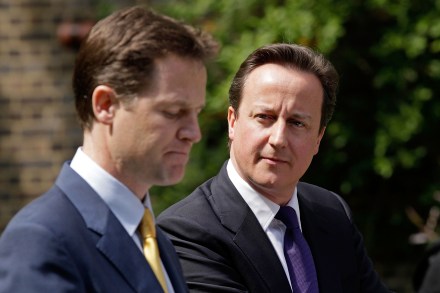
Gary Gibbon reports: 'Last night’s two-hour meeting of the Lib Dem MPs (with a sprinkling of peers) seems to have swung the party decisively behind a Lib-Con coalition deal. An announcement is widely expected now today.' It’s preferable to the alternative and as George Osborne made clear this morning the Tories can do nothing without Lib Dem support. There’s a suggestion that Clegg may have forced Cameron’s hand into further concessions with his sudden wooing of Labour, in which case he’s a very clever and brave shyster. I’ll believe it when it happens though. PS: A note of caution, as if one were needed. Clegg can't put a time on any deal. Incidently, there is no appetite for a Lib-Lab coalition among centre-left bloggers.

This isn’t English

‘The Tories are stuffed,’ a resigned Shadow Cabinet minister tells Gary Gibbon. Endorsing any such view is premature but, with Lib Dem elders counselling Clegg to join Labour, the most likely outcome is a coalition of the losers, albeit nice progressive ones. Ah, the irony of the New Politics – plus ca change and all that. Politics has descended into a grotesque spectacle of blackmail, and bungled devolution is to blame. As James reported last night, talks with the Tories ran aground on sands that are the territory of Holyrood and Scottish Liberals presented every obstacle possible.

The Lib Dem big hitters pushing Clegg towards Labour

Today's papers have the lowdown on the events of the past few days, and one thing is becoming increasingly clear: a Lib-Con deal faces not just the opposition of the Lib Dem base, but also some of the party's most influential figures.  In a Times account of a Lib Dem meeting yesterday, it's revealed that Sir Menzies Cambell "urged his successor not to bind the party into a irrevocable deal with the Tories."  Meanwhile, the Telegraph reports that "Vince Cable played a significant role in resisting an agreement [with the Tories]."  And Paddy Ashdown was across the airwaves this morning, explaining how a Lib-Lab coalition could provide "stability" and "legitimacy," against a "rabidly anti-European" Tory party.

The Scottish angle

I am told that one of the Lib Dems groups most opposed to doing a deal with the Tories was its Scottish MPs. Their view was that Scotland had voted massively against the Tories and that any party seen as their representatives in Scotland would be massacred. This has set off chatter in Tory circles. There was already irritation that the party has a majority in England and Wales but was still having to compromise on issues that have been devolved to Scotland. But to not be able to make a coalition deal because of your unpopularity north of the border is to add insult to injury.

The Tories should shine a light on Labour’s leadership machinations

One striking aspect to this evening's brouhaha is how senior Labour figures are going out of their way not to endorse anyone as Gordon Brown's successor.  Brown himself has said that he won't back an "individual candidate," and Peter Mandelson and Alastair Campbell have made similar noises in television interviews. There are, I imagine, two main reasons for this.  First, it's all too soon: Labour won't want to engage in full internecine combat while there's still the chance of a deal with the Lib Dems.  And, second, they will want to create the impression that – contrary to Gordon Brown's ascension to power in 2007 – the next Labour leader has been chosen in an open and clean contest.

The Tories work to seize the moral high ground

Well, well today just keeps getting more and more extraordinary. The Tories have responded to the Lib Dems beginning formal negotiations with Labour by offering the Lib Dems a referendum on AV in exchange for a full coalition with Lib Dems in the Cabinet. The Tories stress that this is their final offer to the Lib Dems. Having spoken to several members of the shadow Cabinet, it appears that the offer is designed to allow the Tory party to seize the moral high ground. They believe that if the Lib Dems were to join with Labour to ram through a change in the voting system—Labour are offering the Lib Dems AV without a referendum and then a referendum on STV—then they would be discredited.

Brown saves the worst till last

We have just witnessed Gordon Brown’s last and most audacious confidence trick. “Gordon Brown to resign” says the television newsflash: but the story was the very opposite. Gordon Brown is staying on, saying – pretty much – that it will take an SAS operation to get him out of No.10 before the autumn. He declared a "constitutional duty" to stay until a new administration is formed "with majority support in the House of Commons". Untrue. You just need a majority to pass laws. One can govern with a parliamentary minority (see Alex Salmond in Edinburgh, and Harold Wilson in 1974). Cameron won the right to govern, when he last week secured a greater share of the vote than Blair in 2005 and two million more votes than Brown.

Brown statement: now with added video

And here's a transcript of the statement "We have a parliamentary and not presidential system in this country and as I said on Friday, with no party able to command a parliamentary majority arising from the general election, my constitutional duty as prime minister is to ensure that government continues while parties explore options for forming a new administration with majority support in the House of Commons. "The business of government has continued including concerted action in Europe today to avert the financial crisis in the Euro area. Alistair Darling the chancellor spent much of his time yesterday in the European finance ministers meeting in Brussels.

The best possible news for the Tories

Gordon Brown’s announcement that the Liberal Democrats have requested formal coalition talks is the best news that the Conservative party has had since the polls closed on Thursday. David Cameron can now say that his party has negotiated in good faith and that his broad, comprehensive, and open offer to the Lib Dems is on table and they can take it or leave it. If the Lib Dems do end up going into coalition with Labour they would completely discredit themselves and be slaughtered at any subsequent election, remember getting PR through the Lords would take at least a year. The markets would also not be impressed by a coalition that would not be able to take any tough decisions on the deficit.