Because it’s Friday…
From our UK edition
…the David Cameron rap, inspired by his speech on Wednesday: Hat-tip: Guido.
From our UK edition
…the David Cameron rap, inspired by his speech on Wednesday: Hat-tip: Guido.
From our UK edition
There are several eyecatching appointments in Ed Miliband's shadow cabinet. Ed Balls at Shadow Home puts Labour's most vicious scrapper up against a wobbly government department. Yvette Cooper as Shadow Foreign Secretary is a suitable reward for her showing in the elections, but it is a counterintuitive use of her background in economics. MiliE loyalists Sadiq Khan and John Denham have duly received plum jobs in Justice and Business, respectively. But perhaps the most surprising appointment is also the most important: Alan Johnson as Shadow Chancellor. On a purely presentational level, you can see what Ed Miliband is thinking.
From our UK edition
...and Yvette Cooper is shadow foreign secretary. Ed Balls gets shadow home. So, looks as though Ed Miliband has bypassed the family psychodrama with an appointment that few expected, or even thought of, until this morning. Johnson was 16/1 with Ladbrokes for the shadow chancellorship going into today. UPDATE: Paul Waugh has the full list. Here it is: Leader of the Opposition --- Rt. Hon.
From our UK edition
Daniel Finkelstein and Philip Collins’ email exchanges are always enlightening. This week, they discussed child benefit. Both think it has altered the markings on the playing field of politics. Ed Miliband is yet to respond: how should he? ‘From: Daniel Finkelstein To: Philip Collins If you were Ed Miliband, where would you go now on child benefit? First option: total opposition to the Government’s plan. You get to hoover up discontent but you don’t look much like a governing force, do you? And it seems hypocritical. Plus, you said you were going to support the Government on many cuts. If not this, then what? Second: you go with it. You look big, you look grown up, but lots won’t like it.
From our UK edition
Earlier in the week, Liam Fox gaily described the Prime Minister as his ‘closest ally’ – a statement which aroused a little cynicism. But it seems that Fox was not exaggerating. According to the FT, Cameron now backs the navy’s grand blue-water strategy. Cameron’s about turn is striking: the last time the National Security Council convened he supported David Richards (he still does to an extent, pledging that army troop numbers will not be cut). The strategic arguments have not changed, which suggests that the politics has. Fox’s letter was one thing, the Clyde shipyards another.
From our UK edition
David Cameron clearly wants us to waltz into the weekend with the Big Society on our minds – so he's written an article on the idea for the Sun. It rattles through all the usual words and phrases, such as "responsibility" and "people power", but it strikes me how he applies them just as much to the public sector as to the general public. This is something that he did in his conference speech, describing the "Big Society spirit" of a group of nurses: "It's the spirit that I saw in a group of NHS maternity nurses in my own constituency, increasingly frustrated by the way they were managed and handled, who wanted to set up a co-op to use their own expertise, their ideas, their contacts to provide a better serice for the mums in their area.
From our UK edition
One of the most intriguing questions about the decision to take child benefit away from households with a higher rate taxpayer in them is whether it marks the beginning of the end for universal benefits. The quotes today from Michael Fallon, the Tory vice-chairman, certainly suggest that it does. Fallon ridicules Ed Miliband with the line: “He wants to tax the poor to give benefits to the better off.” Now, if you accept that the poor are currently being taxed to provide child benefits for the rich (a slight exaggeration given that higher rate taxpayers contribute far more than they take out in services) then this argument applies with equal force to all other universal benefits.
From our UK edition
John Hutton's interim report on public sector pensions today will go down as one of the most important moments in the public service reform story. John Hutton doesn't just set out the principles for putting public services on a sustainable footing, although he does do that (by explaining the inadequate levels of contributions into these schemes). More importantly, he confronts head-on the problem that public sector pensions pose for the opening up of public services to competition. One of the key reasons that many companies have waited on the sidelines of the public sector for years is the disparity between public and private pensions.

From our UK edition
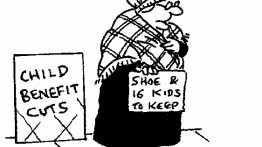
Should families on welfare limit the number of babies they have? Jeremy Hunt suggested so last night - kicking off a debate fuelled by our disclosure in today’s Spectator about just how many out-of-work claimants have 6, 7 and 8+ children. The moral argument is pretty clear. Before a worker wants to expand his family, he usually thinks about whether he can afford it. It’s far from uncommon to hear people say that they’d like, for example, three kids - but this brings with it a certain financial requirement (size of house, car, etc) which is prohibitive (and far bigger than can be offset by child benefit). Yet the reverse financial incentives exist for parents on benefits. The more children they have, the more the state gives you.
From our UK edition
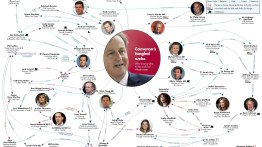
How do you get from David Cameron to Simon Cowell in two, easy steps? Answer: Andy Coulson. The former News of the World editor is, of course, Cameron's director of communications – but he also happens to be on friendly terms with the X-Factor impresario. We set out this, and all the other tangled relationships around the Prime Minister, in a spider graph for this week's magazine. From Nick Clegg to the designer Anya Hindmarch, from Steve Hilton to Baroness Ashton: it's not a map of the government, but rather of the people both in and around No.10 who form what we call the New Establishment. To see them in their entirety, all CoffeeHousers need do is click on the image above, or download a pdf .
From our UK edition
The coalition’s immigration cap is, as several Conservative Cabinet ministers have pointed out privately, flawed. It threatens to cap the kind of immigration that bothers almost nobody, high skilled foreign workers coming to this country to do a specific job. As Ken Clarke has told colleagues, the problem is that Labour — albeit right at the end of their time in office — stopped non-EU low-skilled immigration. So all there was left to cap was high-skilled immigration. But there is a potential solution that would enable the cap — a Conservative manifesto promise — to remain in place, but also deal with Vince Cable and businesses’ objections http://www.thisislondon.co.

From our UK edition
Eureka, the science magazine from The Times, is in many ways a brilliant accomplishment. Advertising is following readers in an online migration - but James Harding, the editor, personally persuaded advertisers that a new magazine, in a newspaper, devoted to science would work. And here it is: giving the New Scientist a run for its money every month. That's why it's such a shame that today's magazine opens on an anti-scientific piece denouncing those who disagree with the climate consensus. My former colleague Ben Webster, now the paper's environment correspondent, is an energetic and original journalist - so it's depressing to see his skills deployed in a game of hunt-the-heretic.
From our UK edition
You can say what you like about Labour's penchant for internal elections, but at least it makes for good, political entertainment. Tonight, the results of the shadow cabinet elections will be released, and we'll discover which of the 49 nominees made it into the final 19. Then it will fall to Ed Miliband to force some very square pegs into the round holes on his party's front bench. Good luck with that, Mr Miliband. According to most observers, Yvette Copper is favourite to come top – a forecast supported by a readers' poll published on Left Foot Forward today. In the same poll, Ed Balls finished second. It rather encapsulates the toughest choice facing Ed Miliband: who to pick as shadow chancellor?
From our UK edition
Put aside all the post-match analysis of David Cameron's speech: the most intriguing story in the papers this morning is this one in the FT. It claims that the Treasury is working on plans to "reprofile" the spending cuts, which basically means "delay" them. The idea would be to push the bulk of the cuts back to the end of this Parliament. And the underlying concern is, apparently, that early cuts could trigger various financial penalties, such as those for breaking contracts. The paper even suggests that ministers are worried that, "deep deficit reduction in 2011-12 could undermine the fragile recovery." The Treasury have firmly denied the story, and I'd certainly be surprised if we saw significant delays in the cuts.
From our UK edition
David Cameron was speaking in odd circumstances today. He was talking to a party that was back in power after more than a decade in opposition. But unlike Tony Blair in 1997 he couldn’t devote his speech to a celebration of that both because his party did not win a majority and because of the situation the country is in. To compound this, Cameron was speaking a fortnight before the spending review; further tying his hands in terms of what he could say. Politically, the principal argument that Cameron wanted to make was about fairness. He was trying to move fairness from being purely about redistribution to one about reciprocity, about people deserving the help that they are given.
From our UK edition
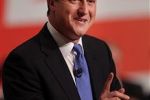
Pressure brings out the best in David Cameron and right now he’s coasting. He gave, as Pete and Fraser have said, a subdued speech. The content was there but his delivery was calm, except on two occasions when he spoke rather than read the autocue. He attempted to sell the Big Society (third time and no luckier). Then he said, with conviction, ‘I don’t believe in laissez faire.’ Those six words are pure Tory Reform Group, pure Iain Macleod, pure One Nation. He evoked that traditional form of Torysim with a firm description of how his government seeks to empower people as responsible groups not just free individuals.
From our UK edition
This was the perhaps the lowest-octane speech David Cameron has ever given to the Tory conference. He didn't need to give the speech of his life, for once - so he didn't. He dutifully ran through all the various points of government policies, but there were too many of what Art Laffer calls MEGO figures (my eyes glaze over). It's odd, because Cameron can speak so well when he needs to. Compared to the speeches we heard yesterday - from Gove and IDS - it was oddly uninspiring. He spoke about his government's "beating, radical heart" with no real enthusiasm - as if he received the speech only recently, and didn’t rehearse too much. It was too long, was repetitious in places.
From our UK edition
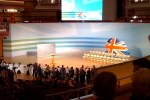
Ok, so that was a peculiar kind of speech from David Cameron – neither wholly successful, nor wholly unsuccessful. In terms of its general tone, it was much as we expected: a dose of bitter realism about the public finances, lacquered over with heavy optimism about what the country can be. But its content was more surprising, brave even. For this was the moment when the Big Society returned with a vengeance. In truth, we haven't heard much in recent months about the idea that framed the Tories' election campaign. Coalition seemed to have displaced it from the Cameroonian lexicon, if not their thinking. But it made an early appearance in one of the most unconventional sections of Cameron's speech.
From our UK edition
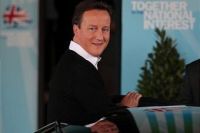
1537, PH: And Cameron ends on that note, calling on the public to get involved in fixing society: "So come on: let's pull together. Let's come together. Let's work, together, in the national interest." Standing ovation. More reaction on Coffee House shortly. 1537, PH: This is good, liberal-conservative stuff from Cameron. He says that the government recognises that it is there to push power to the people. "I know the British people: they are not passengers, they are drivers." 1535, PH: Strong line: "Mine is not just a vision of a more powerful country, it is of more powerful people." 1536, PH: The Big Society returns, with a lenghty section on volunteering and social action. Cameron calls this a "call to arms".
From our UK edition
We have heard much since the coalition was formed about how Cabinet government has been restored. The child benefit flap reveals how limited this restoration is. There was no Cabinet approval of the decision and, as Andrew Grice confirms this morning, Iain Duncan-Smith was unaware of the change until the morning of the announcement. The other thing that strikes me, as someone who supports the idea and thinks it is potentially good politics, is the very odd approach to spinning this story.