Uk politics

A 2015 Afghan exit will be tricky

From our UK edition

William Hague told the Foreign Affairs Select Committee that British combat troops will leave Afghanistan in 2015 - even if parts of the country remain violent. Speaking to a number of senior military officers and civilians who have recently returned from Kabul and Helmand, I have come away with the clear sense – whisper it – that the tactical tide is in fact turning against the Taliban insurgency but that a number of facts will complicate further progress. First, the next few months in Helmand may unfortunately be quite bloody.

The curious case of the Guantanamo Bay pay-outs

From our UK edition

What to make of the out-of-court settlement that has been paid to around a dozen former detainees of Guantanamo Bay? According to unofficial reports, taxpayers might have to shoulder £10 million as a result. One of the men is thought to be receiving £1 million. The explanations seeping out of Westminster are understandable enough. Security chiefs, we're told, were keen to avoid a lengthy process – not just because it could mean more cost for the taxpayer, but because it would drag the practices of our intelligence services out into the public realm. David Cameron, speaking on the matter in July, highlighted that Mi5 and Mi6's time could be spent more usefully than sifting through documents in preparation for a court case.

Cameron: it’s all about the economy

From our UK edition

A minor landmark for David Cameron tonight, as he delivers his first Mansion House speech as Prime Minister. Like occupants of No.10 before him, he will use the occasion to talk about foreign affairs – although the result may be rather more like the Chancellor's annual speech at the same venue. Judging by the extracts that have been released so far, Cameron's overall emphasis will be on the economy, and on Britain's fiscal standing. As he will say, "we need to sort out the economy if we are to carry weight in the world." Cameron develops this point by claiming that, "whenever I meet foreign leaders, they do not see a Britain shuffling apologetically off the world stage.

General Well-Being is back

From our UK edition

Spectators might smile wryly at the news that the government is to devise a method for tracking the well-being of the nation. This idea of General Well-Being (GWB) was common currency in the early days of the Cameron project, when the Tory leader was going all out to "detoxify the brand". But it soon hit a downturn-sized snag. Any talk of happiness might have sounded a little complacent and New Age-y in the face of job losses and bank bailouts. And so the Tories backed away from GWB, and it was relegated to little more than branding for the coffee stalls at Tory conference. It was quite a surprise to see it mentioned in the party's manifesto in April, although they did keep it on the hush, hush at the time. Yet now it's back at full volume. And the question is – why?

Ireland’s nightmare becomes Europe’s problem

From our UK edition

"We certainly haven't looked to Europe." That was the message spilling from the mouths of Irish Cabinet ministers last night – but, as Alex suggested in a superb post on the matter this morning, their utterances may come to naught. After all, Europe has certainly looked to Ireland – and it doesn't like what it sees. Already, Brussels' moneymen are urging a bailout on the country, and Ireland's moneymen are thought to be in "technical discussions" about how that might work. The upshot is that a financial intervention from Europe is now considerably more likely than not. And with that come European demands over how Ireland should manage its public finances – and raise its taxes. There are plenty of lessons for all sides in this.

Richards: we’re in it for the long haul

From our UK edition

General Sir David Richards does like thinking in decades, doesn't he? A year or so ago, he was warning us that "the whole process [in Afghanistan] might take as long as 30 to 40 years." Today, in interview with the Sunday Telegraph, he says that the wider battle against al-Qaeda could last around 30 years. In both cases, he deserves our attention. To hear the head of our military suggest that the West's current conflicts will stretch across generations is sobering, to say the least. More noteworthy, though, is Richards' claim that a "clear cut victory" over Islamist terror is "unnecessary and would never be achieved" – but that we can "contain it to the point that our lives and our children's lives are led securely.

Laws and the coalition

From our UK edition

David Laws’ eagerly awaited account of the coalition negotiations contains some great lines. Peter Mandelson’s declaration on being told of the Lib Dem’s desire for a mansions that ‘surely the rich have suffered enough already’ is classic. While William Hague’s description of the Conservative party as an 'an absolute monarchy, moderated by regicide’ is a candidate for the dictionary of quotations. But politically the thing that struck me about it most was what it tells us about Ed Balls. Balls had worked with Gordon Brown for years and had been one of the most ardent Brownite. Yet it was Balls who effectively pulled the plug on the idea of a Lib Lab pact when Brown was still desperate to try and make it work.

IDS shows how arguments are won

From our UK edition

For years, I have complained that the Conservatives have timidly stayed within Labour’s intellectual parameters, arguing that they need “permission” to make certain arguments and need to stay within the limits of what the public find acceptable. Such intellectual timidity confined them to opposition: they can never win, playing by Labour rules. Iain Duncan Smith is breaking free of this. It may be rash to predict it now, but I believe he is on the brink of a breakthrough in the way that welfare is regarded in Britain. This victory in a battle of ideas could be the greatest single blow against poverty in a generation. The extent of this was crystallised by Polly Toynbee in the Guardian yesterday.

Whatever happened to Labour’s economic message?

From our UK edition

For some weeks now, Labour have struggled to project a clear voice on the economy. You can see what they've been trying to do: pitch themselves as an alternative to immediate, deeper cuts, whilst also accepting the requirement to deal with the deficit. But, as I've said before, this all too often comes across as nervous equivocation; a kind of "on the one hand, on the other hand" stuttering that won't persuade many observers either way. You sense that Team Miliband have tried to correct this in recent weeks, with a few punchier performances, but, even then, mistakes and deceptions have greased into their offering. Anyway, I mention this because Alan Johnson's interview with the Times (£) today only adds to the confusion.

The Gove reforms grow even more radical

From our UK edition

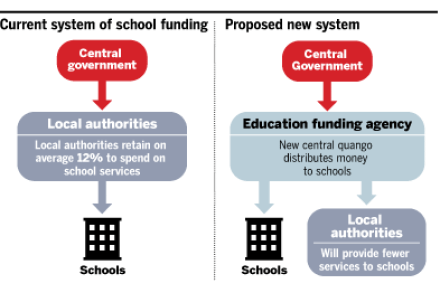
Local authorities are already doing their utmost to block the coalition's schools reforms, so just how will they respond to this story on the front of today's FT? It reveals how Michael Gove is planning to sideline local authorities from the funding of all state schools – not just free schools and academies. The idea is that state schools will get cash directly from the state, without any need for the council middlemen that currently control the system. Here's an FT graphic that captures the change: The money would be allocated to schools in proportion to the number of pupils they have, and headmasters would have much more freedom in how to spend it. This is the same simple but transformative dynamic that inspirits the rest of the Gove reforms.

The pledge divide

From our UK edition

Over at the FT's Westminster blog, Alex Barker asks why it is that David Cameron's expensive personal pledge on pensioner benefits has survived the spending review while Nick Clegg's personal pledge to scrap tuition fees, which would have cost roughly the same amount, has been spectacularly ditched. As Alex argues, one reason is that Clegg himself was not particularly attached to his pledge on fees. Indeed, he had tried to change the policy several times in opposition. The other is that George Osborne, who is the Tories' chief election strategist as well as the Chancellor, is determined to protect the Cameron brand.

Going beyond the IDS reforms

From our UK edition

Iain Duncan Smith deserves credit for fully understanding the nature and scale of the welfare problem. But that’s the easy bit. Finding a solution with the right balance of carrot and stick and making it somehow affordable in these austere times is the tougher part of the equation. And it’s not at all clear that the IDS proposals have either enough carrot or enough stick.   He has certainly gone some way to tackling the lunacy of huge withdrawal rates – if by entering the workforce your new post-tax pay packet is less than the benefits you stand to lose, then don’t be surprised when an entrepreneurial work ethic fails to emerge in some of the country’s poorest areas.

Ten things you need to know about the welfare White Paper

From our UK edition

I've sifted through yesterday's welfare White Paper, and thought CoffeeHousers might appreciate a ten-point guide to its contents. This is by no means the entire picture – and some of it will be familiar from past Coffee House posts – but hopefully it should capture the broad sweep of IDS's reforms: 1) The problem. Fundamentally, the issue is that there are a lot of people stuck on out-of-work benefits: around 5 million at the last count. This means different things for different groups. For the Treasury and taxpayers it contributes towards an unwieldy working-age welfare budget that has increased by 45 percent, in real terms, over the past decade – to around £80 billion.

50p tax: the coalition’s most expensive policy

From our UK edition

In my cover story for this week’s magazine, I say that the damage of the 50p tax, various bank levies and general banker-bashing is far greater than Osborne realises. Here are the top points I seek to make:   1. We may hate to admit it but the British tax base, and our chances of reducing the deficit, are heavily reliant on a handful of very rich people. The highest-paid 1 percent will generate 23 percent of income tax collected in the UK in the year before the 50p tax (see the table below). And spot the correlation between the top tax rate, and the burden shouldered by the richest and the poorest. Which are the most progressive – the figures on the right, or the figures on the left? 2.

Johnson’s deceptions and out-of-date figures

From our UK edition

Oh, how Labour enjoy misleading the public about their record on the public finances. Ed Miliband did it a couple of weeks ago, with some very loose rhetoric about how the previous government had "paid down the debt". And now Alan Johnson's at it, with a fiery speech at the RSA which reheated many of the themes in his recent New Statesman article. The passage that struck me was this: "In 2007/08 as the crisis hit, we have the second lowest debt level in the G7 reduced by 14 percent in the 10 years we'd been in office... …The year before the crisis hit we were borrowing 2.4 percent of GDP compared to the 3.4 percent we inherited from Ken Clarke." Some points: 1) Second lowest debt level in the G7.

Poppy season

From our UK edition

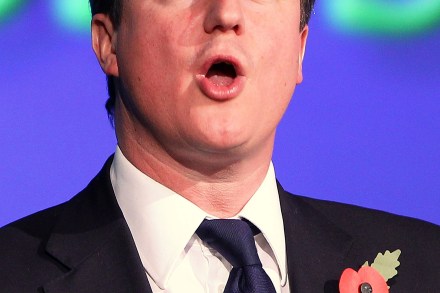
Keen-eyed spectators might have noticed Danny Alexander and Michael Gove wearing a slightly different type of poppy over the last few days: the Scottish Poppy. At the beginning of the poppy-wearing season they are for sale at the Scottish Office in Whitehall and are worn by certain Scots down here – any money that Andrew Marr will be wearing one on Sunday, for example.   What’s the difference? Scots poppies have four petals, and no green leaf.  The English version costs a little more to produce, and – one might argue – looks more sophisticated. But the Scots version can claim to be anatomically correct, because poppies don’t have green leaves. The Scottish poppy is also an early grower: it’s worn a bit earlier north of the border.

A considerable achievement

From our UK edition

This morning's welfare event was one of the great "Who'da thunk it?" moments of this government so far. Here we had the Lib Dem leader providing backing vocals for a former Tory leader who has not only become a minister, but who is implementing an agenda that only a few months ago was little more than an idea in a think-tank report. Reviewing that Centre for Social Justice report for Coffee House at the time, I said it deserved to influence welfare policy for years to come. Now, it looks as though it will do just that. The immensity of Iain Duncan Smith's achievement should not be underestimated. No doubt, the path to a Universal Credit and a more robust version of workfare will be one that meanders into controversy.

What sort of country do we want to be? A soft one

From our UK edition

Admiral Lord West’s intervention was most striking in its language. He promised that a ‘national humiliation on the scale of the loss of Singapore’ would ensue unless his advice was heeded. Writing in the Times (£), Sir Menzies Campbell notes West’s seething tone and concludes that his frustration was the product of a review of defence resources, not strategy. At no point, Campbell says, did the government ask ‘what sort of country do we want to be’ and plan accordingly. Campbell continues: ‘Is Britain ready now or likely to be ready to go to the aid, alone or with allies, of a nation that becomes the target of aggression, as we did in Sierra Leone and Kosovo?