Uk politics

Unpicking Miliband’s deceits

From our UK edition

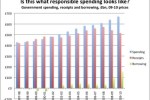
Ed Miliband has penned a combative but incredible piece in today’s Times (£). He makes two substantial points. First, that the coalition is deceiving people: Labour was not to blame for the deficit. And second, the coalition’s cuts package (in its entirety) is unnecessary. Oh what a tangled web he's weaved. His argument is a maze of conceits, sleights of hand and subterfuge, and he interchanges between debt and deficit at his convenience. But, occasionally, his position is exposed. As this Coffee House graph recalls, Labour built a substantial structural deficit prior to the economic collapse.

Winding down Control Orders

From our UK edition

David Cameron has reiterated that Control Orders are to be scrapped. He told an audience in Leicester yesterday: ‘The control order system is imperfect. Everybody knows that. There have been people who've absconded from control orders. It hasn't been a success. We need a proper replacement and I'm confident we'll agree one.’ Whether the new arrangement will replace both the name and the letter of the law remains to be seen, but the government is expected to lessen some of the more severe elements of Control Orders. When this story broke at the weekend, Cameron was happy to spin the reforms as a Lib Dem initiative, despite considerable Tory input. Not anymore.

The right has little cause for alarm

From our UK edition

It is to his credit that nuance is a word inimical to Lord Tebbitt. The unashamedly independent voice of the past has written a cutting piece about the coalition, the Lib Dems and the Oldham East by-election. He says: ‘A Lib Dem win would tilt the Coalition even farther Left and away from Conservative policies.’ Many Tory ministers joke that they thought themselves right wing until meeting their Liberal colleague. This is a radical government that many on the right can cheer.

Gove’s school reforms approach a tipping point

From our UK edition

Today marks something of a milestone for Michael Gove’s school reform agenda. Free schools – i.e. ‘Academies’ which are independently run, yet within the state sector – now account for more than 10 percent of British secondaries. This is what I have always thought of as a tipping point – where independent schools offer real competition to council schools (i.e. those run by their local authority). One hesitates to sound too confident, but the genie of choice seems to have been yanked out of the bottle, and a few facts are worth nothing: 1. There are now 407 Academies open, twice the amount in May 2010. The 400 mark was, for Tony Blair, totemic - a goal that he made Gordon Brown sign up to as a condition of the handover.

All to play for in Oldham East

From our UK edition

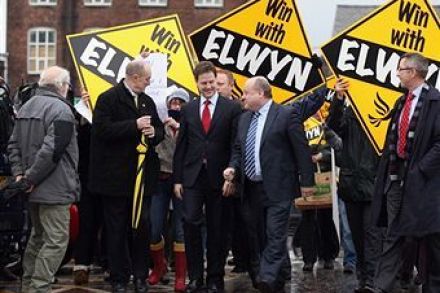
The Oldham East and Saddleworth by-election is fast shaping up to be the event that will set the tone for the first quarter of the political year. The unique circumstances in which the vote was called makes it particularly hard to predict, no one is quite sure whether there’ll be a backlash against Woolas or one against the Lib Dems for going to court to overturn the result. As I say in the magazine tomorrow, if the Lib Dems were to win, it would give Clegg the breathing space he so needs at the moment. Lib Dem worries about what the coalition is doing to them politically would subside, temporarily at least, and Ed Miliband would find himself under pressure.

Central government and local government lock horns over bin collection

From our UK edition

It seems that Cardinal Walter Kasper was right: parts of Britain are suggestive of the Third World. The Sun has been leading the tally-ho against council leaders in Exeter and Birmingham, who have allowed rubbish to lie in the streets for more than a month. And today, Local Government Minister Bob Neil joined (£) the fray, condemning councils for failing to deliver ‘one of the most basic services’. (He also mentioned executive pay, again.) Recalcitrant councils have issued a plethora of meteorological excuses, but these are mostly a distraction. Many councils managed to remove rubbish over Christmas; David Cameron commended them for their efforts.

IPSA’s olive branch to angry MPs

From our UK edition

The foreword to IPSA's latest consultation document is certainly more conciliatory than combative. "The last eight months have been demanding, both for MPs and their staff, and for IPSA," it starts – in subtle reference to the mutual frustrations that have overtaken the expenses operation to date – before asking whether the current system can be made more "fair and workable". And that tone carries across into the main body of the text. Although IPSA insist that nothing has been decided yet, they do at least moot the possibility of raising certain allowances back up again. As James Kirkup writes on his Telegraph blog, this document is, in some respects, IPSA's last chance.

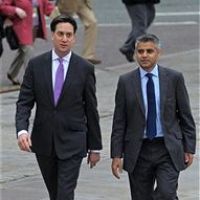
Khan to Miliband: What life experience do you have?

From our UK edition

Ok, not quite. But this snippet from GQ's interview with Shadow Justice Secretary Sadiq Khan is almost a description of Ed Miliband's rise to the Labour leadership: "One of my criticisms of a lot of politicians of all parties is that they're career politicians. Since they were 11 years old they dreamed of being an MP, being the Prime Minister, and so they'll do A-Level Politics, Politics degree, get a job with an MP, work for a think tank, become an MP, Prime Minister. And my criticism is what life experiences do you have? The reason most MPs aren't popular is that people can see through that." He makes up for it later, though, saying of Miliband that "I believe in him, I really do, he's a mate.

Stable house prices won’t happen by themselves

From our UK edition

Grant Shapps has impressed in the housing brief, arguing that house prices rising faster than wages is not a good thing (with which Policy Exchange’s report, Making Housing Affordable, agreed). He has probably been encouraged by the fact that some recent polls have shown even a majority of owners want prices to stop rising. Perhaps having your kids live with you until they are 40 just isn’t a popular option? More so, rising house prices only benefit those who downsize (now rare) or own multiple properties; and in the wider economy it mostly discourages productive investment and encourages borrowing – hardly good things.   But while Shapps’s aim is laudable, he needs to be clearer about how we get there.

Clegg and Cameron decouple

From our UK edition

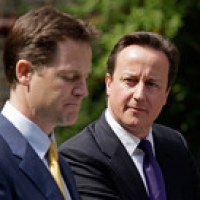
Cameron and Clegg are putting on a show for the in-laws. After mounting disquiet from the fringes of their respective parties, the two leaders are journeying to Oldham East to quash rumours of a merger and reaffirm that theirs is a marriage of necessity. David Cameron will travel north in due course. God knows what he will say? Presumably that he no longer wishes his partners well – get out there and biff ‘em, or words to that effect. On the other hand, Nick Clegg will declaim his lines today. His script is hyperbolic, replete with wishful fantasy about a ‘two-horse race between Labour and the Liberal Democrats’.

Across Europe, students are protesting against the end of their entitlements

From our UK edition

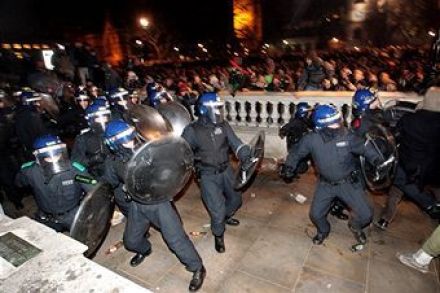
A month ago I found myself in the space of one week in two different countries, yet in the midsts of what felt like the same phenomenon: the political awakening of a new generation. In both London and Rome, students took to the streets to protest against government policies in numbers and in ways that those who graduated just a few years before would have found anachronistic, odd even. Unsurprisingly, given the historical, political and even emotional differences between Britain and Italy, there were differences between the protests. But as I walked the packed streets, listened to the protests, read their slogans, I heard similar arguments - particularly about the lack of fairness. When both events were finished, Whitehall and Via del Corso looked similarly destroyed.

The Tories turn their fire on ‘lamentable’ Johnson

From our UK edition

Come back, you insufferable relatives, all is forgiven: the political class has devoted an afternoon to trading insults about who said what about VAT and when. However, there have been some intriguing exchanges amid the New Politics’ latest outing. First, Labour seems to be fighting the two coalition partners as a single entity in Oldham East. Cameron, Clegg and Simon Hughes have received equal measures of opprobrium this afternoon and all have been lumped together. This was always a danger, but, as Fraser noted, Clegg and Cameron invited the manoeuvre by uniting their parties’ central operations in the cause of government. If Cameron and Clegg don’t differentiate in the general, Labour won't in the particular.

Will Osborne be vindicated in 2015?

From our UK edition

VAT, VAT, VAT – but what's this? The main headline on today's FT doesn't mention the sales tax at all, and the piece below it only does so in passing. Instead, a declaration that "UK austerity measures [are] expected to pay off," based on a survey of economists conducted by the paper. Although those polled have concerns about inflation and the eurozone, only 13 percent say that George Osborne needs a Plan B for dealing with the public finances. As always, we shouldn't place too much stock in this kind of thing. Some economists will back the coalition, others will back Labour; some will be right, others will be wrong. But, today of all days, the coalition will appreciate a presentational leg-up such as this.

There is no reason to raise VAT

From our UK edition

It is very clear that the government cannot carry on borrowing at current rates and the coalition’s proposals for reducing government borrowing are prudent. However, today’s VAT rise is unnecessary. As has been said before, we did not get into this situation because the government taxes us too little. Ever since Gordon Brown abandoned his self-imposed restraint in 2000, government spending, financed mainly by stealth taxes and increased borrowing, has expanded rapidly to its current level of over 50 percent of national income. As such the whole of the balance of fiscal adjustment should come through spending cuts. The coalition’s spending reductions have reflected political expediency, not sound economics.

Boles beats his old drum

From our UK edition

To accompany Fraser’s suggestion that Cameron and Clegg are planning a merger, it is notable that the ubiquitous Nick Boles has renewed his calls for a formal pact. Previously, Boles averred that Liberal Democrat ministers should be protected in three-way or Conservative-Liberal marginals. This time round, his argument is more philosophical. He told Radio 4’s PM: ‘The Coalition has enabled the Conservative party to be more radical than it would have been able to had it formed a government on its own with a small majority... Jacob Rees Mogg who’s a fellow MP who’s certainly not a sort of liberal Tory like I am in the sort of modernizing sense.

Wrong to be too Right

From our UK edition

From a right-wing perspective, there are several things wrong with David Cameron's leadership - not least the fact that he did not win the 2010 election outright. As an unassailable report by Lord Ashcroft showed, the Tory campaign squandered a historic lead over Labour. The policy disagreements - over the EU, civil liberties, and the AV referendum - are compounded by personal grievances. The Prime Minister, despite investing quite a lot of time placating quarrelsome  MPs - calling them, writing them letters, inviting them to No 10 - cannot shake the impression of a man who is buoyed by confidence verging on arrogance, and someone who is reliant on - indeed most comfortable with - a small, largely unelected group of friends.

Miliband swings into action by warning of inflation

From our UK edition

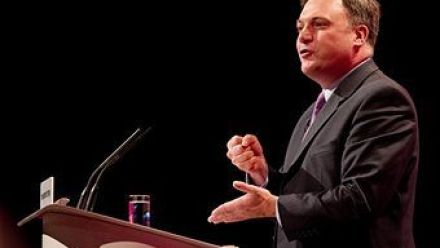
The seasonal interlude has ended and Ed Miliband is sallying north to Oldham East. He will resuscitate old favourites from 2010: progressive cuts, fairness and a government bent of an ideological mission: but he will illustrate his point with reference to tomorrow’s VAT rise. Miliband will say: ‘Today we start to see the Tory-led agenda move from Downing Street to your street. At midnight VAT goes up, hitting people's living standards, small businesses and jobs. The VAT rise is the most visible example of what we mean when we say the government is going too far and too fast, because it's clear that it will slow growth and hit jobs.’ And he will add that the ordinary voter’s wallet will be £389 lighter by the end of the year, courtesy of the rise.

Is it a merger?

From our UK edition

When a Conservative leader wishes the LibDems well in a three-way marginal by-election, then what is going on? Andrew Gilligan’s piece today shows that the Conservative campaign there is muted, and my colleague Melissa Kite reported earlier that Cameron personally called off  the hunt supporters, Vote OK, who were planning to boost the Tory campaign. Little wonder that Conservative MPs are beginning to smell a rat. They are being told this is the cohabitation of rival parties; in the Daily Telegraph tomorrow, I ask if this is actually a merger.   From the start of this coalition, I’ve been struck by the differences between the coalition in Westminster, and that I witnessed during my tour of duty in the Scottish Parliament.

Control Orders: a pyrrhic victory for the Lib Dems?

From our UK edition

Coalition is a tricky business, full of compromise and connivance. Emblazoned across the front page of the Sunday Times (£) is the news that Control Orders are to be scrapped. A victory for Nick Clegg, we are told, won to nurture wounded Liberal Democrats and preserve the coalition. The Liberal Democrat 2010 manifesto maintained that Control Orders would be abolished and many senior Liberal Democrats have been volubly opposed to Lord Carlisle’s report into Control Orders, which was understood to propose their retention. Certainly, Nick Clegg needs an outright victory on policy.