Uk politics

The AV referendum hasn’t captured the public’s imagination

From our UK edition

It is odd to think that in just a few months we’ll be having only the second nationwide referendum in our history and no one is particularly excited about it. This is largely because the plebiscite is on AV, an unloved voting system that is a half-way house between first past the post and a proportional system. (Just imagine the level of conversation there would be if the vote was to do with Europe not electoral reform). At the moment, the yes side has a growing lead in the polls http://ukpollingreport.co.uk/blog/archives/3115. But, given the vast number of undecideds, this could change very quickly. The No campaign, though, will have to come up with some clearer, crisper messages to turn the tide.

DD’s having a shindig

From our UK edition

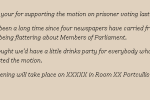
The FT’s Alex Barker has a sweet little scoop. David Davis is having a knees-up for all 234 of his comrades in the prisoner voting debate. Here’s the invitation: It's been a while since newspapers and the public commended parliament, so why not throw a ‘little party’. True, normal service will be resumed if Mark Reckless and friends fall into old habits; but last Thursday was a great moment for parliament, they've a right to some latitude. Of course, as Paul Goodman has conceded, it was a greater day still for Davis.

Is Cameron’s counter-offensive headed in the wrong direction?

From our UK edition

As James has noted, Downing Street has turned its energies to the big society. Op-eds are being written, airtime used and speeches made. This morning saw the centrepiece: a former Labour donor, Sir Ronald Cohen, has joined the campaign and Cameron devoted a speech to what he described as his "political mission". Cameron was fluent and passionate, determined in shirt-sleeve order. He was not exactly clear, but I don’t think that’s a problem. There is no concrete definition of what the big society is. As I argued yesterday, Cameron has changed tactics and is now using it as a descriptive term of the sort of voluntary and philanthropic instincts his government will support. Cameron needs a barrage of examples of these practices in action, something that he lacks currently.

China eclipses the Japanese economic miracle

From our UK edition

Official figures suggest that China has replaced Japan as the world’s second largest economy, after an estimated 10 percent growth rate left China with an economy worth close to $5.8trillion at the end of quarter four 2010. Japanese growth hovered around the 3 percent mark in 2010 with a total GDP value of $5.47 trillion. Analysts have told the BBC that it is ‘realistic’ that China will overhaul the US’ economy in about a decade, which, as Pete has demonstrated, does not look too outrageous a suggestion.  All of this puts me in mind of the European Union. The CIA World Factbook records that the EU leads the globe in GDP (purchasing power parity): with an estimated value of $14,890,000,000,000, against the US’ $14,720,000,000,000.

Developments in the Middle East are beginning to affect Europe

From our UK edition

After yesterday’s spontaneous clean-up operation on the streets of Cairo, protestors gathered at Freedom Square today to maintain the revolution’s momentum. There have been minor developments, with the army and its interim civilian administration dissolving President Mubarak’s gerrymandered parliament, preparing the way for an election in the future. The timetable for that election remains a mystery – something about which the international community, led by President Obama and assorted European leaders, is questioning without yet expressing concern.

Why work experience matters more than ever

From our UK edition

In my recent BBC2 documentary, Posh & Posher, I explained how networking and contacts played a crucial role in giving those with the right connections an early leg up in their careers. Internships and work experience are proving increasingly crucial to opening doors and opportunities in later life. Many have expressed the view that the best intern and work experience opportunities in fields like politics, finance and the media are going disproportionately to those who are already privileged and well-connected. From what I've seen myself in recent years I suspect that to be true. The Mail on Sunday gives a classic example (and a potentially embarrassing one for the Tories) of how it can work.

Cameron downgrades the Big Society

From our UK edition

It’s written in print: the Big Society has become the “big society”. David Cameron has responded to criticism of his flagship agenda by downgrading it from a proper noun to a compound adjective. He makes no attempt to define "big society"; rather, Cameron suggests that the term is descriptive of the impulses he hopes to encourage. He writes in today's Observer: ‘Take a trip with me to Balsall Heath in Birmingham and I'll show you a place once depressingly known as a sink estate but now a genuinely desirable place to live. Why the transformation? Because even in a tough neighbourhood, the seeds of a stronger society were there and residents boldly decided they'd had enough and drove out the crime.

Britain’s coming crunch with Europe

From our UK edition

It did not take David Cameron long to realise that there were three parties in his coalition. A few months into government, the Prime Minister worked out that only half of the policies he was enacting came from the shared agenda drawn up when the Tories and LibDems got together. The other half comes from the EU. Or, more specifically, the Civil Service machine, which is busy implementing various EU Directives, often passed many years ago. Cameron is trying to put the brakes on this process. As I say in my News of the World column, this has led to much frustration in Whitehall. And dismay: the Civil Service remembers how easily Labour waved through EU regulation and the piles of fat that Whitehall likes to pile on top of the EU regulation.

A massive failure of communication

From our UK edition

I have farmer friends in the Highlands who are forbidden from felling trees in their own backgarden - and, ergo, can’t extent their house. The poor souls have to wait until there’s a windstorm and head out with their chainsaws at 3am to fake the death of trees - and, even then, it’s touch-and-go if they are later caught by the tree coroners. The regulation of privately-owned trees is extraordinary, which is why the fuss about forests - and yesterday’s climbdown - is such a farce. The government’s decision to postpone the selloff of the treeland estate that it proposed fits a pattern of u-Turns that I wrote about last weekend. But it is, fundamentally, a colossal failure of communication.

Clarke: Middle England hasn’t got a clue

From our UK edition

Ken Clarke’s political career has had the resilience of a cockroach, but even he now seems to be cracking. Tim Montgomerie has shot a vicious broadside at Clarke's dated politics in today’s Mail. And Clarke, for his part, has given an interview to the Telegraph, where he gives a convincing impression of a man completely out of touch. Clarke concedes (just) that the ECHR needs reform, but he defends its supreme jurisdiction: ‘Some people are very angry [about prisoner voting], but we should be able to resolve that. The jurisdiction of the [European] court remains the fraught issue. I don’t see how we can say that we don’t obey courts if we don’t want to.

Clegg for freedom

From our UK edition

Restoring individual liberty has long been a Liberal Democrat aspiration. Nick Clegg has pursued the cause in government; with mixed results it must be said, particularly on control orders. But Clegg is unperturbed and today he is introducing the Freedom Bill. He previews its contents with a typically clear piece in today’s Telegraph. The measures are extensive. Pervasive CCTV is to be curbed; ContactPoint, the database containing the personal details of every child in England, is to be switched off. These liberal measures accompany those that have already been taken, such as scrapping the ID cards.

Spelman’s a-turning

From our UK edition

The BBC reports that the government has dropped some of its plans to privatise forestry. The general scheme will proceed, but the sale of 15 percent of publicly owned forests will be stalled while the government re-examines the criteria for sale. Obviously this is a set back, but far from a terminal one. The forestry consultation document contains some very sensible ideas. There is no reason for commercial forestry to remain in public ownership. The Forestry Commission loses money and its predominantly coniferous crop and wasting agricultural land wrecks the environment and damages wildlife habitats. Privatisation would not lead to the spoliation of the shires.

Overall, a win for Gove

From our UK edition

Michael Gove has won on the substance in the judicial reviews of his decisions on Building Schools for the Future. The judge has rejected the claim that Gove acted irrationally and found that he has the authority to make the decisions he did. There will have to be reviews of six of the decisions because of a failure to consult fully and a full equalities assessment will have to be done - yet another example of one of the traps that Labour has left behind and that the coalition needs to scrap as soon as possible. But this is hardly the victory that it is being portrayed as by some. Crucially, the judge has ruled that “the final decision on any given school or project still rests with him [Gove].  He may save all, some, a few, or none.

Cameron’s Eric Morecambe problem calls for the wisdom of Corporal Jones

From our UK edition

It looks like the most almighty mess. The government’s communications are tongued-tied, the Big Society is flightless and the reform agenda is being neutered by inertia. The political will has been met by the administrative won’t. But, despite the gloom, the government should pay heed to Corporal Jones: don’t panic. The slow progress of public service reform is a positive. Haunted by the memory of Blair’s paralysis, the government embarked on its programme in fevered delirium. Its ambitions were much too great. It is now time to halt and concentrate on delivering cuts. Rome was not built in a day and it certainly cost more than Britain can currently spare.

The Commons rejects prisoner voting rights

From our UK edition

The Davis Straw motion on keeping the ban on prisoner votes has just passed by 234 votes to 22. It is a crushing victory on what was a very good turnout given that both front benches were not voting. The 22 against the motion were a bunch of Liberal Democrats plus the Ulster MP Lady Hermon, the Plaid MPs Jonathan Edwards, Elfyn Llwyd and Hywel Williams, the Green Caroline Lucas,   Labour MPs Barry Gardiner, Kate Green, Glenda Jackson, Andy Love, Kerry McCarthy, John McDonnell, Yasmin Quereshi  and  one Tory Peter Bottomely, David Cameron now finds himself between a rock and a hard place. His MPs hate the idea of giving prisoners the vote and if he tries to force them to do it, he’ll end up in a very messy fight.

Unpicking Oakeshott’s exit

From our UK edition

The resignation last night of Lord Oakeshott, the Liberal Democrat’s Treasury spokesmen in the Lords, over his criticisms of Project Merlin is more important than it might appear. Despite not being a coalition minister, Oakeshott is one of the bigger figures in the Liberal Democrats and is extremely close to Vince Cable, who skis with him. There is a certain nervousness in coalition circles that Oakeshott’s departure over Project Merlin could be a forerunner of Vince quitting over the government’s response to the Vickers’ review on banking. But it should be said that these fears are based more on hunches and suspicions than anything else. Oakeshott has been irritating Clegg loyalists for a while.

Lost in the woods

From our UK edition

The government’s plans for state forestry are so weak and feeble that it is hard to understand why there is so much fuss about them. Maybe people do not realise that three-quarters of the English woodland that they love so much is already privately owned. And those private owners face strict standards on public access and recreation, environmental quality, and conservation. So why is there so much fuss about selling the rest? People forget that broadleaf woodlands comprise just 8 percent of the Forestry Commission’s estate. The other 92 percent is farmland and conifer plantations, and it is hard to get worked up about who owns either of those.

Looks like Devine’s going down

From our UK edition

Twitter has exploded at the news that former Labour MP Jim Devine has been found guilty on two counts of false accounting, and is likely follow to David Chaytor to the slammer - another argument against votes for lags. Sentence will be passed in four weeks As James Kirkup wrote at the time of Chaytor’s sentencing, this is a victory for the British justice system; proof that those who make our laws and subject to them also. The purge on the most heinous expenses cheats is a painful but necessary passage for restoring dignity to parliament and probity to public life. And the process is far from over. News of Devine's imminent fate will make several MPs shift uncomfortably in their seats.