Uk politics

Osborne’s voteless recovery?

From our UK edition

This is a strange old recovery. The News of the World has an interesting ICM poll today, showing that 66 per cent think the economy is getting worse. It’s not: GDP is growing and we have the second-highest job creation in the G7. Rather than losing jobs to China, we’re flogging Coventry-made Jaguars to Beijing billionaires (one of the random gems uncovered by our new Twitter feed @LocalInterest). So why is everyone so glum? And why do 52 per cent think that David Cameron and George Osborne are doing “a bad job” with the economy?   In theory, Osborne’s recovery is coming on well. His "cuts" agenda is simply a souped-up version of Alistair Darling’s, but Osborne cuts about 1 per cent a year faster.

Cooper takes on the coalition from the right

From our UK edition

What an intriguing interview Yvette Cooper gave to Sky's Dermot Murnaghan show this morning — and not just because she was standing, ruffled and incongruous, in a field somewhere. I was live-tweeting proceedings here, and there was much to anticipate even before she appeared. On top of today's stories about housing benefit, social care and immigration, the shadow home secretary would also have to deal with the comments made by Lord Goldsmith during the show's newspaper review. "It's not clear what Ed Miliband stands for," said Goldsmith, to cheers from the Tory press team. "I don't think the rifts in the party have been healed.

Europe, the times they are a-changin’

From our UK edition

Before writing my column for The Spectator this week I asked one of the most clued-up Eurosceptics on the centre right what opt-outs Britain should push for in any negotiation over an EU treaty change. His answer, to my surprise, was "forget that, we should just leave". This answer took me aback because this person had been the embodiment of the view that the European Union could be reformed from within. But people are dropping this view at a rapid rate for reasons that Matthew Parris explained with his typical eloquence in The Times (£) yesterday. I wrote in The Spectator this week that two Cabinet ministers now favour leaving the EU only to learn soon afterwards that the real number is three. Iain Martin writes that half of all Tory MPs now favour leaving.

Boris comes out against high-speed rail

From our UK edition

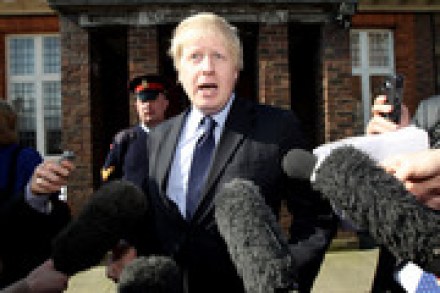
The news, via a leaked letter, that Boris Johnson now opposes high-speed rail will come as little surprise to the government. Boris has been moving to this position for quite some time and the Department for Transport resigned itself to the mayor coming out against the scheme earlier this week. Recently, one of Boris’ senior aides visited the Department for Transport and said that the mayor would only support the scheme if there was an additional tube line from Euston as part of it. But when the Department for Transport pushed for details of where this line would go to, and how it would be engineered it became apparent that this was more of a rhetorical point than a negotiating position. Oddly, the politics of Boris’ position could work out for both sides.

No paramilitary link to last night’s riots in East Belfast

From our UK edition

The PSNI is clear that last night’s riots on Castlereagh Street, East Belfast, were not linked to sectarian paramilitary activity. Rather, this was a ‘spontaneous demonstration’ against the police. As I wrote last week, gangs on both sides of the Ulster divide have been targeting the police in recent months; and they rely on exploiting current economic hardship and ancient sectarian divisions to further their criminal ends. The continued violence is a test of Stormont’s ability to govern without the close supervision from Westminster.

In for a penny, in for a trillion

From our UK edition

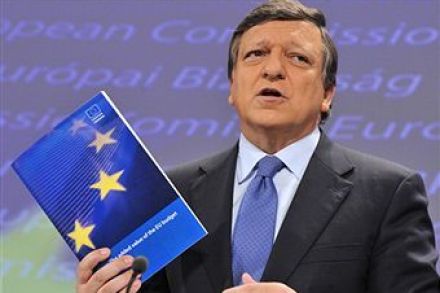
The news that the EU seeks a budget of £1 trillion between 2013 and 2020 inspired disbelief rather than ire. President Barroso’s almost childlike insistence that the proposal was ‘relatively small’ was amusing, certainly not alarming. It’s a classic EU trick: pitch for 5 per cent and a string of crazy financial measures (including a ‘Tobin tax’ on financial transactions) in the hope obtaining more modest gains of say 2 per cent. Barroso will also throw the odd concession into the bargain: the announcement of a £5.4bn saving on the Commission’s staffing costs represents a concession. But, Barroso has his work cut out to secure even a 1 per cent rise on this occasion.

An American view of tuition fees

From our UK edition

When I visited the US recently, I got talking to some American teenagers about university. They (like me) had just left school and were trying to decide where to go next. I explained that in the UK, the Government's plan to raise tuition fees to £9,000 a year had led to riots. Their jaws dropped. They couldn't understand what the fuss was about. In the US, fees can reach $40 000 a year for the private Ivy League colleges. The reaction in the UK seemed ridiculous to them. They felt we should be grateful that we didn't have to pay $40,000. [Although, to be fair, some state universities only charge around $5000].

IDS’ great expectations

From our UK edition

There is no rest for IDS. Yesterday he was in Madrid talking about youth unemployment and immigration and today he turns his attention to child poverty. Of all life's accidents, the accident of birth is the most decisive. It is said that a child’s prospects are determined by the age of five, and numerous other statistics and factoids lead to a similar conclusion. IDS rehearses some in a piece in today’s Guardian. IDS and Labour MP Graham Allen have conducted a report into these matters, and have concluded that early intervention in a child from a deprived or broken family is vital if the poverty gap is to be closed, and for opportunity and prosperity to be extended.

From the archives: how The Spectator beat the strikes

From our UK edition

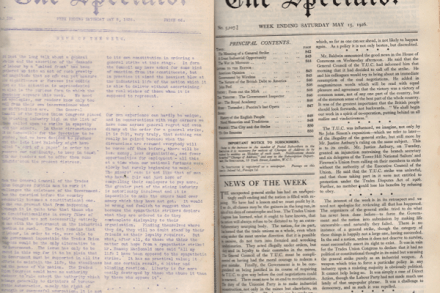
A change from the usual for this week's excavation into The Spectator archives — which is to say, we won't be digging out an article from the magazine's 183-year back-catalogue for CoffeeHousers' delectation. Instead, the images above, and a quick, little story. Given how nostalgic some people have recently been for the General Strike of 1926, my thinking was to present The Spectator's coverage from the time. (It is critical of both government and unions, as it happens). But it was the appearance of the issue dated 8th May 1926 that caught my eye, rather than its content. Its pages are thicker and rougher than the typical Spectators of that year. Its imprint looks straight off a typewriter, faded and blue. Its page-count is measlier.

A good day to bury boring news

From our UK edition

When a Labour press release landed in my inbox saying, ‘Ministers must come clean over attempt to bury bad news on strike day,’ I was expecting quite a story. But the reality of it turns out to be rather underwhelming. Labour’s accusation centers round a shift in direction on charging points for electric cars, not exactly a subject that I would expect to keep the government’s communications director Craig Oliver up at night. Ironically, the Department of Transport did publish a press release on the story yesterday and it even attempted to set up a newspaper interview to trail the announcement but this effort failed as the story wasn’t deemed exciting enough.

Stopping Syria

From our UK edition

Syria is still ablaze and the West seems unable to do douse the flames. And the risk of the Assad regime committing even greater violence will increase when the world's media moves on. The reasons for Western impotence are manifold. First, for a long time Western leaders thought they could reason with Assad and therefore shied away from direct pressure. When they decided to act, they discovered that Assad is immune to European pressure because Syria does little trade with Europe. But, crucially, many Syrians are either loyal to the regime or fear triggering disintegration of the sort they have seen in neighbouring Lebanon and Iran. Finally, unlike Libya, the Syrian regime is not hated by fellow Arab states.

Why IDS is right raise the link between immigration and worklessness

From our UK edition

Before everyone gets too excited, Iain Duncan Smith is not saying in his speech today that immigration is a bad thing in itself. But he is saying that it has consequences, some of which impinge on native Brits. Many of these consequences are, as it happens, writ in the official statistics. As IDS highlights – and as Coffee House has detailed before – a good number of the jobs that sprang up during the New Labour years were accounted for by immigration; and there are signs that the process is continuing still. This is one of the reasons why the number of jobs in the economy can increase, while the dole queues barely shorten. Workers are imported, rather than nurtured.

Labour’s ambiguous victory in Inverclyde

From our UK edition

Amid all the union sturm und drang yesterday, it was easy to forget about last night's Parliamentary by-election in Inverclyde. But a by-election there was, after the death of the seat's previous Labour MP, David Cairns, in May. And the result was in some doubt, too. After the SNP's strong showing in last month's corresponding Scottish Parliamentary election, there was a sense, beforehand, that Labour's majority could be whittled down to naught. But, in the end, it wasn't to be. Labour won with a comfortable majority of 5,838 and a vote share of 53.8 per cent, albeit it down on the 14,416 and 56 per cent they secured in last year's general election.

Hague has been vindicated on the euro

From our UK edition

The Foreign Secretary finds himself in the rather unique position today of trying to deal with the consequences of a crisis that he largely predicted. In May 1998, William Hague gave a speech warning that the single currency would lead to social unrest as governments tried to cope with one size fits all interest rates. It is a reminder of how much Hague was swimming against the tide of bien-pensant opinion that Michael Heseltine claimed this prediction was so extreme as to drive the Tories off the centre ground. But what is, perhaps, more interesting than Hague’s vindicated view that the euro, in a crisis, would be the ‘economic equivalent of a burning building with no exits’ is his view on how European governments would resolve the problem.

It’s not just pensions, say teachers

From our UK edition

As any CoffeeHouser knows, the Spectator enthusiastically supports Michael Gove’s education reforms. But it’s always important to listen to opposing views – so we stepped outside our offices in Westminster to talk to some of the striking teachers. Some of their points, it must be said, were a little peculiar. “It was wonderful under Balls, a golden age,” said one “we’d like to get back to that.” But others were more realistic in their concerns. For example, they criticised Michael Gove’s inconsistency: the official government policy is that modular exams will remain, but he appeared on television this weekend saying that he intended to remove modular exams by 2012.

Will Britain recognise Palestine?

From our UK edition

Will Britain recognise Palestine as a state if, as planned, the matter comes to a vote at the UN General Assembly in September? Right now, the government says it has not decided. But if France were to push, the likelihood is that William Hague will order British diplomats either to accept or abstain from the vote. The strategic rationale for a Yes vote is obvious: at a time when Britain is waging war in Libya and rallying support against Syria and Iran, it would be disadvantageous to be seen by Middle Easterners as blocking Palestinian aspirations. And having accepted the case for Palestinian statehood in principle why not support it in practice?

A fierce debate on a religious matter

From our UK edition

The Spectator hosted a debate at the Royal Geographic Society yesterday evening with a rather meaty motion: “Secularism is a greater threat to Christianity than Islam”. We have two reviews of the occasion. The first, by Kate Maltby, is below. Lloyd Evans' can be found here. Last night’s Spectator debate on the motion “Secularism is a greater threat to Christianity than Islam” was marked by a highly personal level of investment from the speakers, a sudden swing in the vote, and the uncharacteristic sight of Chair Rod Liddle acting as the most conciliatory person in the room.