Uk politics

An open letter to Will Straw about deficit reduction…

From our UK edition

…or why the US cuts are actually faster than, and just as deep as, ours. Dear Will, We hope you don't mind us writing a letter-form response to your latest post on Left Foot Forward, which argues that the "coalition government's cuts are deeper and faster than the Tea Party's". But, as we see it, there are several problems with your figures which are easier to explain in a conversational format. Here they are, as best as we can express them: i) The first obvious problem comes when you say that Obama set out $83 billion of deficit reduction for 2012 in his March Budget. Actually, he didn't.

The IMF manages to please everyone

From our UK edition

A bet-hedging sort of report into the UK's economy from the IMF today, which largely supports George Osborne's deficit reduction plan, but will also give some encouragement to his detractors. By way of a summary, here are the parts that might satisfy Osborne himself, as well as Vince Cable, Ed Balls and Mervyn King: The passage that the Chancellor will flash around Westminster comes on the very second page of the IMF document. "Strong fiscal consolidation is under way," it reads, "and remains essential to achieve a more sustainable budgetary position, thus reducing fiscal risks.

Which department could be replaced with a mathematical equation?

From our UK edition

I answer the question in an article for the Times (£) today, in response to Francis Maude’s announcement yesterday. But for those CoffeeHousers who can't vault the paywall, here's the relevant passage: "I have been told of an internal report that makes the argument sublimely well. Before last year’s spending review, the Treasury asked a group of outside experts whether plans for a 40 per cent headcount reduction at the Department for Communities and Local Government were too ambitious. Their response? It wasn’t nearly ambitious enough. The staff cut ought to be at least 90 per cent. Responsibilities for fire prevention could be transferred to the Home Office; responsibilities for troubled families to the Education Department; responsibilities for .

Pickles lands a small blow for growth

From our UK edition

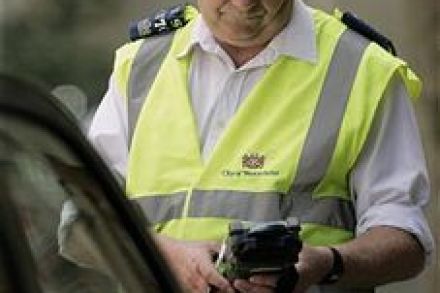
Eric Pickles’ decentralisation revolution continues, with the announcement that Whitehall is relinquishing control over car parking restrictions in town centres. From now on, town halls will decide how much space will be devoted to parking and at what price. It is hoped that this will stimulate commerce in the localities by improving the experience of high street shoppers.      This, I concede, is not the most thrilling news ever to have graced these pages. But it is quite significant nonetheless. It was understood that Pickles was unlikely to achieve this objective, due to Whitehall’s intransigence.

Petrol woes set to continue

From our UK edition

Despite small falls in petrol prices last month, the consequence of a supermarket price war according to the AA, motoring becomes ever more expensive. Political campaigns have opened as pressure builds at the pumps; and these campaigns have been co-opted by influential organs such as the Sun. The government has reacted: taking part in the International Energy Agency’s decision to release reserves onto the market to counter those members of OPEC that connive to sustain high oil prices. The government has also relaxed some of its windfall taxes on companies operating in the North Sea.

Bitter Turkish delights

From our UK edition

Turkish accession to the EU is apparently no more than a dream of those who desire it at present, but it remains a point of contention across Europe. The British government, for instance, are in favour of enlargement, believing Turkey’s economy to be essential to Europe’s continued economic strength. Accession would also hamper the goal of political integration in the EU, which is expedient to Britain. Not everyone in Britain shares the government’s unqualified enthusiasm for Turkey. The Home Affairs Committee has issued a report this morning, criticising aspects of the government’s policy and insisting on careful management of accession.

Alexander rallies behind the 50p rate

From our UK edition

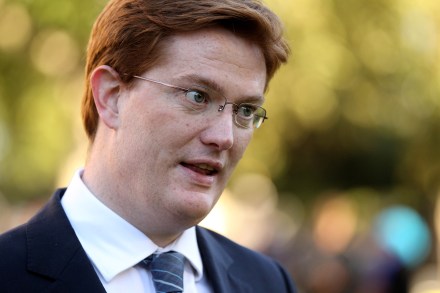
Danny Alexander is usually the very model of collective responsibility: sober, unfussy and diligent, he sets about the coalition's work without ever causing a scene. Which is what makes his televised comments about the 50p tax rate earlier all the more striking. When pressed on the subject by interviewer Sophie Rayworth, the Chief Secretary to the Treasury was forceful in response. The government doesn't necessarily want to cut the rate, he suggested, and those who thought it would are inhabitants of "cloud cuckoo land". He went on: "We set out in the Coalition agreement, and it's something that we as Liberal Democrats pushed very hard for, that the Government's first priority in tax reductions would be tax cuts for people on low and middle incomes.

Some context for the death penalty debate

From our UK edition

Something quite remarkable has happened over the past couple of the days. It started with the launch of the government's new e-petition site, which promises that any petition which secures 100,000 signatures will be "eligible for debate in the House of Commons". And it continued with Guido Fawkes submitting a petition to reinstate the death penalty for "the murder of children and police officers when killed in the line of duty." Now national newspapers and MPs alike are adding their voice to Guido's campaign. And an issue that has huge public resonance, but which is rarely discussed in Westminster, is suddenly getting an airing. Even if — like me — you don't agree with the death penalty, there is still something encouragingly open and democratic about it all.

Ed Miliband needs David Miliband if he’s to make proper headway

From our UK edition

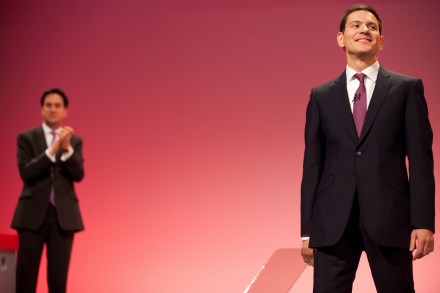
Are the seeping knife wounds healing at last? This morning's Guardian reveals that Ed Miliband has offered his older brother a role as Labour's "unofficial ambassador on university and college campuses", and that David Miliband has accepted. Although party sources tell the paper that "this should not be seen as a sign that [MiliD] is being lined up for an early shadow cabinet return," it surely is a sign that the two brothers are repairing their damaged relationship. From barely speaking to each other to mutually preaching the Labour gospel to a bunch of students. It's progress.   Putting aside the fraternal aspects of the story, it is also an encouraging political development for Ed Miliband.

‘Fessing up to drug use, the Mensch way

From our UK edition

Just the thing to liven up a slow news day: a response from the Tory backbencher Louise Mensch to a series of insinuating points put to her by "David Jones Investigative Journalists". The points were all about her time working at the record company EMI in the 90s; about her drug use, night-clubbing habits, that sort of thing. And she has answered them in marvellously unapologetic fashion. You can — and should — read the whole exchange here, although Mensch's response to the question of whether she "took drugs with Nigel Kennedy at Ronnie Scott's in Birmingham, including dancing on a dance floor, whilst drunk, with Mr Kennedy, in front of journalists," is worth pulling out: "Although I do not remember the specific incident, this sounds highly probable.

Coffee House, distracting civil servants since 2007

From our UK edition

A cracking, little story that we arrived at via the Daily Mail website: thanks to an FoI request put in by the Taxpayers' Alliance, the Department for Transport has revealed which websites its staff visited on work computers between January 1st and May 31st this year. The full list is here, and there are some eye-catching entries to say the least. Take the role-play site bearsfaction.org.uk, where you are advised to "conduct yourself as a Bear would" — that got 183 hits per day. Or the infamous sexymp.co.uk on 142 hits per day. Even the website of the website of Page 3 girl Claire Tully got 5 hits per day. And there's more more, much more. The Department's sad cohort of Arsenal fans visits a trio of Gooner sites to the tune of 412 hits a day.

The shifting sands of public opinion on Libya

From our UK edition

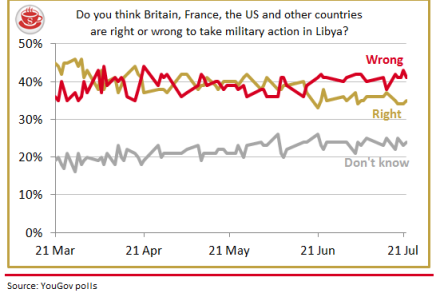
All of the buccaneering rhetoric has been sucked from the Libyan conflict this week, replaced with words of concession, compromise and caution. A few days ago, it was the news that — contrary to what they might previously have said — the government is prepared to let Gaddafi remain in the country after all. Today, William Hague deploys the same line in an interview with the Times (£), in which he also warns that there are "a lot of problems and even convulsions" to come in northern Africa. As it happens, the depressed mood of our foreign-policymakers reflects the tide of public opinion. Here, for CoffeeHousers' benefit, are a couple of graphs that we've made from YouGov's polling questions on Libya.

The phone hacking scandal rumbles on

From our UK edition

"The News of the World proved is is a force for good." So said Sara Payne, the mother of the murdered schoolgirl Sarah Payne, in a column for the final edition of the paper. Its writers and editors had supported her unerringly, she wrote, in her campaign for tighter laws against child molesters. "I shall miss you all and to you I say thank you and good luck." All of which makes the latest phone hacking allegations particularly disquietig. According to the Guardian, Glen Mulcaire, the private investigator hired by the News of the World, had Sara Payne's phone number in his extensive collection.

The romance isn’t dead on Downing Street

From our UK edition

Westminster, today, is all a-titter about an anecdote contained within this FT article about Steve Hilton. It is, it must be said, a good 'un: "Mr Hilton’s crusade against employment legislation also saw him suggest that Mr Cameron just ignore European labour regulations on temporary workers, prompting an exasperated exchange with Jeremy Heywood, Downing Street’s permanent secretary. 'Steve asked why the PM had to obey the law,' said one Whitehall insider of a meeting in March to discuss the government’s growth strategy. 'Jeremy had to explain that if David Cameron breaks the law he could be put in prison.

Alexander’s balancing act

From our UK edition

Remember that merry dance between the government and the unions over public sector pensions, a few weeks ago? Expect a minor reprise today, and much more over the summer. The government today announces how much extra public sector workers will have to pay to maintain their pension levels, and already the Telegraph has the numbers. When it comes to the 40,000 best-paid public sectorees — all on considerably over £100,000 — their contributions will rise by around £3,000 a year. And then it's a sliding scale all the way down to the 750,000 least well-paid workers, who will face no increase at all. The unions, who will rejoin the government in talks soon, are unlikely to respond kindly.

One year to go, but the public aren’t convinced

From our UK edition

Boris may think next year's London Olympics will be "the most exciting thing that's happened in the eastern part of the city since the Great Fire", but - according to a slew of new polls - he's got some way to go to persuade the rest of the country. Here's an opener from YouGov:   In the same poll, there's also widespread scepticism over what benefit the Olympics the bring to Britain:    The clearest perceived benefit is for London's sporting facilities, with 54 per cent agreeing that they will be much better "not just for the games themselves but for years afterwards". However, when it comes to London's public transport, only 32 per cent think it will see significant improvement, while 41 per cent disagree.

The scramble away from cosiness

From our UK edition

Aside from Boris's exhortations to George Osborne, one of the most ear-catching lines of the day has been uttered by Jeremy Hunt. "I think the relationships between politicians and the media got too cosy," said the culture secretary on Radio 5 this morning. He's certainly not the first to make the point, but he is one of the most prominent Conservatives to do so. The words, I suspect, were chosen to cool the heat rising from yesterday's lists of meetings between ministers and media organisations. Hunt himself, it was revealed, has met seven times with News Corp types since the general election. Hunt's admission also opens the prospect of a fevered struggle between the Tories and the Lib Dems to appear less cosy with the media establishment.

Universally speaking

From our UK edition

As Paul Waugh notes, James Purnell's article for the Times today (£) is striking for its attack on universal benefits. "I have never bought the argument," writes the former welfare secretary, "that universal benefits bind the middle classes in. It feels too much like taxing with one hand to give back with another." Although this is, in truth, a point that he has been making for some time. He said something similar in a speech back in April. The question, really, is how much Purnell's viewpoint will percolate down through Labour circles.

Boris to the fore

From our UK edition

Politics has a big, blond hair-do today, with Boris wiff-waffing all across the airwaves. The Mayor of London has already, this morning, called on George Osborne to do more to cut taxes, specifically the 50p rate and national insurance. And he will be leading a series of events, throughout the day, to mark the fact that the Olympic Games are exactly one year away. The Aquatic Centre will be baptised, the medal designs revealed, and general celebration staged across the city. It's difficult not to see all this as part of Boris's re-election bid, and perhaps as a marker for his wider ambitions. Although London's Olympics have not been an unambiguous positive so far, they still give him a bigger and friendlier platform than most politicians will enjoy over the coming year.