Uk politics

Blunt’s flawed rehabilitation programme

From our UK edition

The decisions of Crispin Blunt, the prisons’ minister, are hard to fathom. One wonders why-as the Daily Mail reports today — he allowed a man convicted of killing five people to give an unapologetic interview to a magazine. Blunt’s defence is that it wouldn’t have been right for him to stop it. That may be the case but that doesn’t explain his decision to send a press officer to assist with the whole procedure. Rehabilitating prisoners is vital if we are going to tackle crime in this country. But it is hard to see how this kind of thing — or parties in prison — help that noble aim. Rather they are actions that do nothing but upset the families of victims and undermine public confidence in the judicial system.

Cameron lands Supercop as police acrimony mounts

From our UK edition

Internationally renowned policeman Bill Bratton has agreed to advise the government on how to defeat gang culture. Bratton’s role is not official, but he will arrive for duty in the autumn nonetheless. The former LA police chief has already offered a diagnosis of Britain’s problems. In an interview with the Telegraph, he says that hoodlums have been “emboldened” by timid policing and lenient sentencing. Quite what this means for Ken Clarke’s justice policy, supported by the Liberal Democrats, remains to be seen. But the indications are that the government will bolster its law and order policies. Doubtless a wry smile will have broken across the face of Andy Coulson, who warned that it would be so from the outset.

In response to CoffeeHousers | 13 August 2011

From our UK edition

CoffeeHousers have been generous in their response to my post on the need for an inquiry. I thought I’d respond in a post, rather than the comments. 1) Why rush to think that poverty is the problem? Rhoda Klapp raises this very good point. In 1996, American academics looked at various riots round the world since the war – I’d urge CoffeeHousers with a serious interest to read the report here). They found “little evidence that poverty in the community matters” – ie, there are much poorer cities, where people don’t riot. Other factors matter, mainly risk versus reward. I used this study as when writing the leader for this week’s magazine.

Why we need a post-riot inquiry

From our UK edition

Today we learnt that David Cameron is looking at the experience of Los Angeles’ recovery from the 1992 riots. The first lesson he should learn is the value of an inquiry, as Ed Miliband suggests. Californian policymakers held an inquiry, and it taught them plenty about the nature of modern poverty, urban unrest — and how to tackle it. Part of the reason that poverty in Britain is so ingrained is because so few politicians look at it in any detail, and even mentioning the word ‘underclass’ solicits squeals of disapproval. We remain aloof. As I argued in the magazine last month, we like harmless sketches about British poverty (Rab C Nesbitt, Little Britain etc.) but think that The Wire represents an American malaise that could never take root in Britain.

Time for action

From our UK edition

The facts of life are Conservative, as the old phrase has it. The events of the past few days have shown the urgent need for Tory social policies. The case for reforms to the police, welfare and education has been amply demonstrated.  Some in the government appear to get this. But there is also an odd hesitancy about getting on the front foot. As Tim Montgomerie said yesterday, why wasn’t a minister put up for Question Time last night? They could have used the programme to push Cameron’s reform agenda.

May intervenes to restore order

From our UK edition

Theresa May has banned an EDL march in Telford tomorrow, although the organisation will be allowed into the town to conduct a static demonstration. May has been a hive of hyperactivity since she returned from holiday, and this is yet another example of the government making a decisive gesture to amend for its perceived earlier indifference. It also looks like a strategic decision to contain that other unspoken working class resentment: immigration, and the hint of racial tension that it inspires from time to time. David Cameron was at pains yesterday to insist that the riots were a cultural issue, not a racial issue. He’s right.

Justice is being done as relations between Downing Street and Sir Hugh Orde sour, again

From our UK edition

“Busy?” I asked a friend who’s training as a criminal barrister. “You could say that.” Magistrates’ courts have sat through a second straight night. “I finished at five,” said my friend. “Back in court at 8.” The courts are determined to deliver what David Cameron described as “the full force of the law.” These are bail hearings for the 600 people charged so far. Defendants are apparently being arraigned in groups of three in some courts, an indication of the strain caused by these extraordinary circumstances. There will be little respite in the coming days.

The scale of IDS’ task

From our UK edition

This afternoon’s parliamentary debate touched on the sociological issues that may have inspired the recent looting. Naturally, there are plenty of competing views on the subject, but I bring your attention to Harriet Sergeant’s, which she has expressed in the latest issue of the Spectator. Sergeant has conducted extensive investigations into the teenage gangs in London, acquainting herself with gang members and their way of life. Her observations are intriguing, albeit terrifying. An extended version of her magazine article is available online and I urge you to read it. But here is a short extract: ‘The young men I interviewed had very obviously failed to make the transition to manhood and a successful adult life.

Should evictions from social housing be broadened?

From our UK edition

I understand that the government’s view is that social housing tenants whose children live with them and are convicted of looting should be evicted from their homes. The law already allows for this, although only if the criminal act occurred within the borough in which the family lives, and the Department for Communities and Local Government is encouraging councils and housing associations to use these powers. Although, the final decision on any eviction would be for the courts. Personally, I think there might be a case for broadening this out. The problem with the current approach is that it lets off those dead-beat dads who take no interest at all in the upbringing and disciplining of their children.

Cameron sets out his stall

From our UK edition

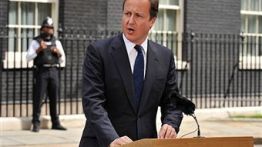
David Cameron’s statement to the House of Commons was clear about the circumstances that led to these riots. ‘This is not about poverty, it’s about culture. A culture that glorifies violence, shows disrespect to authority, and says everything about rights but nothing about responsibilities.’ Later in the session, he said ‘you don’t hit moral failure with a wall of money.’ On this, Cameron is surely right. In a respectful atmosphere in the House of Commons, Cameron set out the government’s proposed response to the riots. The major legislative action he set out was a change to the law to allow the police to force people who they suspect of being involved in criminal activity to remove face coverings.

Cameron has the opportunity to lead the nation

From our UK edition

The recall of parliament today offers David Cameron the chance to take command of the current situation. The police might have horribly mishandled the situation on the first few nights of the riots and Cameron’s government might have been caught flat-footed by them. But he now has the opportunity to build on the successful policing of the last two nights and his strong statement yesterday and lead the national response to this crisis. The mechanics of a parliamentary statement allow Cameron to set the terms of debate. He also has the huge advantage of simply being the Prime Minister. The nature of his office affords him the opportunity to speak for the country.

The public wants firmer action

From our UK edition

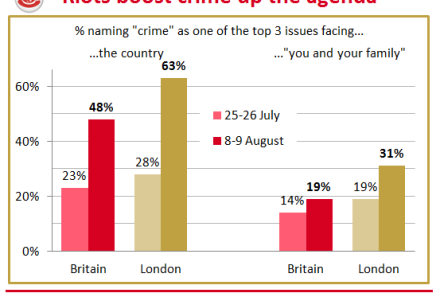
Judging by today's YouGov polls, the riots have pushed crime sharply up the national agenda: it now ranks second, behind only the economy. In all, almost half of Brits think crime is one of the top three issues facing the country, more than double the number who said so a fortnight ago. The effect has, unsurprisingly, been strongest in London, where around two-in-three now see crime as a major concern: As for the causes of the riots, the majority blame "criminal behaviour" and "gang culture". Contrary to what Harriet Harman may insinuate, just eight per cent blame the government's cuts, and this is largely the 16 per cent of Labour voters who put the blame at the Coalition's door.

Gove versus Harman

From our UK edition

The Guardian's Nick Watt already has a detailed and insightful post on last night's Newsnight bout between Michael Gove and Harriet Harman.

Cameron gets forceful

From our UK edition

So far as words matter, David Cameron has just delivered one of the most forceful statements of his political career. It contained all the anger of his address yesterday, but went much further in its diagnosis. "There are pockets of our society that are not only broken, but frankly sick," he said, adding that, "the one word I would use to sum it up is irresponsibility." His most memorable line was that, "It is as much a moral problem as it is a political problem." This was the campaigning Cameron that we have glimpsed only briefly, most notably during his conference speech in 2009. Tim Montgomerie is saying that Cameron has found his mission — but I'd disagree.

The politics of police cuts

From our UK edition

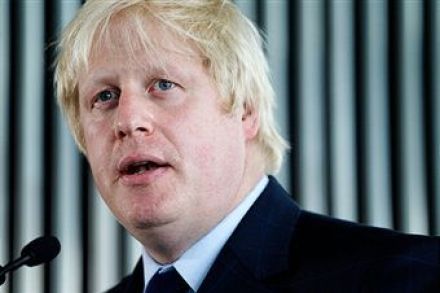
Wow, that was a howitzer of a performance from Boris Johnson on the Today Progamme earlier. And all his shells were aimed at Downing St. Not only did the Mayor of London slander Cameron’s Broken Society thesis, not only did he support Diane Abbott against the jibes of Tory HQ, but he also committed the gravest act of all, given the current climate. He lined up with Labour in attacking the coalition's police cuts. "This is not a time to think about making substantial cuts in police numbers," said BoJo. "I think it would be a good thing if the government had another look," he added, for emphasis.  There's little doubt that Boris has hit upon a potent attack here.

London slept as violence spread across England

From our UK edition

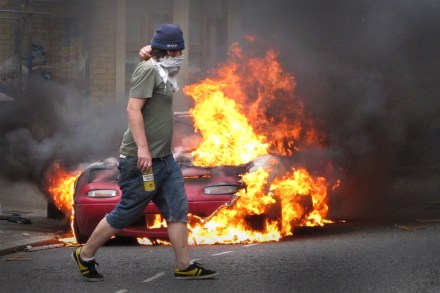
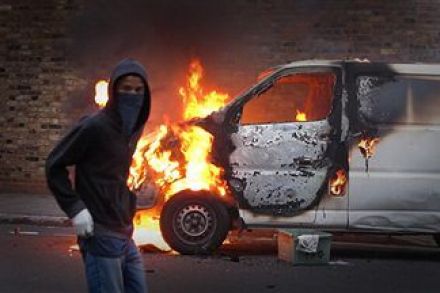
The presence of 16,000 police officers in London deterred looting, but violence spread in provincial towns across England, with tragic consequences. Riots in Birmingham left three men dead after a car ran them over; police are treating the incident as a murder. There was also disorder in Salford, Manchester, Gloucester, West Bromwich and Nottingham. Each separate incident was characterised by the same pattern of events: looting, muggings, arson and confrontation with the police. Once again, the Molotov Cocktail was a favoured weapon, and one assumes that the deprived rioters stole the expensive fuel required to make them.

When the underbelly roars

From our UK edition

When the first riots hit Brixton, I was 12 years old. My mates and I came from south London council estates and, while we were no angels, we certainly couldn't be described as bad kids. I can't pretend that I had any real grasp on why people were rioting but I knew it was against the same police who would stop and bug us constantly — even though none of us had either the balls or inclination to commit crime. It may sound like a tired cliche but the police didn’t feel like our protectors. They felt like more like an occupying force. And why? There were countless incidents to explain it, but one that sticks in my mind was in 1981 — the same year as the first Brixton riots.

Joining the clean-up operation

From our UK edition

It was 8am this morning when I first saw Sophie and Ella's clean-up call trending on Twitter. I duly trotted down to Clapham Junction to find the whole area wreathed in smoke and in lockdown. With only four of us there so far, and the police busily trying to restore order, there wasn't anything we could do at that moment. And so I ventured down there again later in the morning, joining a procession of locals carrying brooms and bags in wheelbarrows. Dress code: hoodless tops, Marigolds and brooms. I spent a cathartic hour with two other girls cleaning up the streets behind Debenhams. We bagged scores of coat hangers (sizes 40 and 42 most popular), empty BlackBerry boxes, shoe boxes, lots of drinks cartons and bottles (looting's obviously thirsty work).