Uk politics

Salmond lays the ground for his referendum

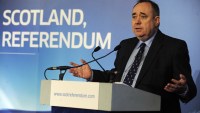
So now we have it: the ten words which Alex Salmond hopes will end Scotland’s 300-year-old membership of the United Kingdom. ‘Do you agree that Scotland should be an independent country?’ The First Minister unveiled his consultation paper on an independence referendum today and, to the surprise of many, actually did what David Cameron has been asking of him. He came out with a short, simple, clear question on independence which he wants to put on the ballot paper. The debate will now rage as to whether this question is fair (is it, for example, too positive? Should it perhaps include something about the United Kingdom?), but this does mark a fairly big step on the road towards agreement.

Academies work, now let them expand

ARK Schools, one of the leading City Academy providers, has just released another amazing set of results with GCSE passes 11 percentage points higher last year than were achieved in 2010. This is staggering progress, given that these schools are serving the same neighbourhoods with the same demographics as the council-run schools which they replaced. It is also a reminder that the City Academy programme, started by Tony Blair and Andrew Adonis and expanded by Michael Gove, can claim to be the most rapidly-vindicated social experiments in recent history. The results of ARK’s schools speak best for themselves: ARK’s formula clearly works, and I’d like to see it applied to many more schools rapidly.

The recession: four years and counting

It is now four years since recession hit the UK. It took just over three years for GDP to return to pre-recession levels in the much milder downturns of the ‘70s and the ‘90s. Even after the Great Depression of the 30s, the economy had fully recovered by this point. By contrast, economic output in 2011 Q4 was still 3.8 per cent down on 2008 Q1. And it’s going to take a while longer to get back. The OBR’s projections suggest the economy won’t have fully recovered until the end of 2013. Other forecasts are gloomier still. But even if we do manage it by then, it’ll have taken us two years longer than it did to recover from the Great Depression.

Miliband delivers for once, but Cameron’s left unharmed

Incredible events in the chamber today. An absolute sensation at PMQS. For the first time since last summer, Ed Miliband got through the session without triggering talk of a leadership crisis. There was gloomy news aplenty to dwell on. Debts soaring; growth flat-lining; dole queues snaking back through blighted high streets and bankrupt business parks. The Labour leader chose to wallop Cameron with a well-prepared attack on the NHS. Quoting the prime minister’s vow, ‘to take our nurses and doctors with us’, he asked why the government had stopped listening. The prime minister’s reply was frivolous and desperate. He giggled and smirked like a teenager at the despatch box and tried to make light of his loathed policy.

Europe gives Osborne the context he needs

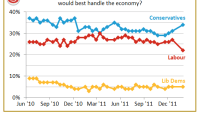
The political implications of today’s growth numbers are complex. On one level, a contraction in the economy should provide Miliband and Balls with an opportunity to make their economic case against the government. Indeed, Balls is already out with a statement calling the GDP figures a ‘damning indictment of David Cameron and George Osborne’s failed economic plan’. I suspect that Miliband is also looking forward to PMQs rather more than normal.   But on the other hand, as long as Cameron and Osborne enjoy a big lead on the economy — 18 points in the last ICM survey — bad economic news will reinforce voters’ tendency to stick close to nurse for fear of something worse.

Bad news doesn’t have to be surprising

I'm still of the mind that Westminster fusses too much about these quarterly growth figures, particularly when parts of the country have been in economic decline for decades. But there's no doubting that they have the capacity to shift the political mood, both here and around the country. There is something disheartening about the idea that the economy returned to shrinkage in the final quarter of last year (even if today's preliminary figure of -0.2 per cent might be revised upwards, or downwards, in due course). You can expect Ed Miliband to make much of it in this afternoon's PMQs. The politics of the situation are not stacked entirely against George Osborne, though. His major consolation today is that everyone expected this sort of minor contraction.

In defence of the Welfare Bill

The government’s welfare reforms seem to be staggering on, despite the concern from the Lords that they’ll harm those who need help most: children and the disabled. But before the Bill goes back to the Commons, and everyone becomes more agitated, let me put the case for the Bill from the perspective of someone it might affect.  I have a vested interest in the impending changes to disability benefits, because both my brothers are autistic – one severely so. My family depends on the Disability Living Allowance; caring for my brothers is a full time occupation for both my parents, and without support they simply wouldn’t be able to cope.

Osborne owes Darling an apology

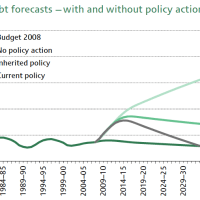
Britain's national debt rose to over £1 trillion last month, and will never return below this threshold. George Osborne is increasing net debt by 61.5 per cent in real terms over this parliament, more than the 59.9 per cent which Labour proposed when it fought the last election. Here's how the OBR's current projections for debt contrast with what Darling proposed in his last Budget: At the time, Osborne said Labour's debt plan was reckless and unsustainable. I think he owes Alistair Darling a generous apology. Then, Darling said he'd halve the deficit over four years. Too slow, said Osborne. Now, he's taking five years to do it – as the below graph shows: Osborne has kept to his spending plans, which cut departmental totals by 2.

The bias towards migrant workers

Why are you never served by a Londoner in a London branch of Pret A Manger? I asked this in the Telegraph recently, and yesterday’s Evening Standard had a great piece tracking down four who applied, and were rejected without an interview. Some suspect there is a bias in favour of immigrants: if your name doesn’t sound exotic, game over. I doubt that a company like Pret, whose most valued ingredient is the famous enthusiasm of its staff, can afford to discriminate in any way. But the wider point is a very serious one: that British employers have come to prefer immigrants, believing that they work harder. And that a bias for foreign workers is adding to the problems facing Britain’s young unemployed.   In general, I do think this is an issue.

UK government debt hits £1 trillion

New figures out today show the UK's public sector net debt at just over £1 trillion for the first time ever. In the first 19 months since it took over, the coalition added £225 billion to the £779 billion debt it inherited. And it's projected to rack up another £390 billion by the next election.

A defeat that delights the Tories

Rarely can a government have been so pleased to have been defeated. The Tories are, privately, delighted that the Lords have voted to water down the benefit cap, removing child benefit from it. The longer this attempt to cap benefit for non-working households at £26,000 stays in the news, the better it is for the government. It demonstrates to the electorate that they are trying to do something about the injustices of the something for nothing culture. The matter will now returns to the Commons where the coalition is confident it can be reversed. I understand that Nick Clegg remains solid on the issue, despite the fact that Ashdown and Shirley Williams led the Lib Dem rebellion in the Lords on this amendment.

Bringing the squeeze into focus

The ‘word of the year’ for 2011 is already featuring prominently in 2012. Yep, the ‘squeezed middle’ is the focus of the Resolution Foundation's latest report, which they launched in central London earlier today. It’s a fascinating and nicely presented study, and I’d recommend you read it in full: this think tank really is very good at choosing the most revealing metrics to bring some clarity to an often vague debate. But, in the meantime, here are some of the things that stood out to me from today’s event:   1. The squeeze started long before the recession.

Cable teaches Umunna a lesson about the past

If you were in a particularly soggy mood, you'd almost feel sorry for Chuka Umunna. He'd managed to force Vince Cable into the House this afternoon, to announce the coalition's plans for curbing executive pay a day earlier than planned, and he must have been feeling pretty swell about it. This was, on paper, the initiative seized; a chance to prise open the Business Secretary's differences with his Tory colleagues. But, in practice, it was something completely different. In practice, Cable dispatched his opponent with ruthless ease. You might even have found yourself in the unthinkable position of cheering him on. A large part of it was Umunna's petty, needling set of questions.

Benefitting the Tories

The longer the row over the benefit cap goes on, the better it will be for the Tories. The cap chimes with the public’s sense of fairness. Polls show massive public support for capping benefits at £26,000 a year for non-working households (the cap won’t apply to the disabled or war widows), and if Labour oppose it, they’ll be handing the Tories a stick with which to beat them. Chris Grayling has already declared that tonight’s vote in the Lords is ‘a test of Ed Miliband’s leadership’. Those who argue that the cap isn’t fair because it will force people to move out of their house are missing the point.

Sorry, Tristram — but capitalism is just what the British public does

Tristram Hunt, the historian and Labour MP, has written a brilliant rebuttal to my piece in the Telegraph last week, in which I said that capitalism is hardwired in Britain’s DNA. Socialism, he says, is also hardwired into our country’s mindset. Writing for Comment Is Free, he says: ‘There is another story of Britishness a long way from the template of Cameron and the Spectator.