Uk politics

Revealed: the grey recovery

From our UK edition

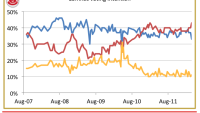
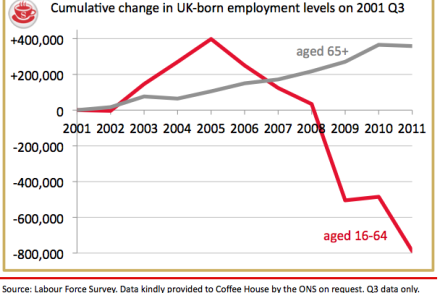
Are pensioners doing their bit for the recovery? The agenda of ‘intergenerational fairness’ has arisen in response to the idea that they are not, and ought to be taxed more. Daniel Knowles has made the case, in our cover story this week. Carol Sarler responds to him. In the leader, we reveal some data hitherto undisclosed: the way the oldies are responding to the recession. They're working as never before — the below graph shows (stripping out foreign-born workers) the change over the past decade: Between 2001 and 2011, all the employment increase for UK-born people was from pension-aged workers, while working-age employment dropped. This challenges the idea of the over-65s as a burden on the rest of society.
Pasty wars

From our UK edition

David Cameron earlier: https://www.youtube.com/watch?v=mCovGqMiZyA And Labour's response: https://www.youtube.com/watch?

A plan that could change the face of future Budgets

From our UK edition

‘I’ve never seen a government document with a Laffer curve in it before’, declared Ed Balls last week. Well it looks like he might be seeing a lot more of them, if George Osborne gets his way. Yesterday, as James noted, the Chancellor told the Treasury select committee that: ‘I think the Treasury can now, and I've asked this to happen, start undertaking some real research into dynamic scoring, and what the broader economy effects are of changes to taxation’. Now, it’s hard to get all that excited about something with a name like ‘dynamic scoring’. It was never going to make the front pages, especially when there’s a ‘pasty tax’ to get worked up about.

Riots report undermines the Tory diagnosis, but spreads itself too thin

From our UK edition

After last August’s riots the debate became quickly polarised. Were socio-economic factors like unemployment to blame, or was it all down to the individual choices of the rioters? David Cameron and other Conservative ministers knew which side of this debate they wanted to be on. They had been taken by surprise by the riots, initially failing to realise how serious things were, but when they got back from their holidays they set out a clear and confident line, brushing off most questions about links to the state of the economy or youth attitudes, and condemning the riots as ‘criminality pure and simple’. The soundbite was deliberately simplistic; Conservative ministers’ actual views were more complex.

Osborne opens the door to dynamic costings

From our UK edition

George Osborne’s announcement that the Treasury is going to start looking at the dynamic effect of tax changes is significant. The aim, I understand, is for them to gather data on this which could then be used to work out the costs of various tax and spending changes. This would mean that most tax cuts would, in the Budget Red Book, cost the government less. The decision, though, about what system to use is no longer in the Treasury’s hands. The independent Office for Budget Responsibility now does all forecasts and policy costings so the decision on what model to use ultimately rests with them. Osborne made this announcement in his appearance before the Treasury select committee today, an absurd amount of which was taken up by questions about Budget leaks.

The government’s keen to avoid the petrol chaos of 2000

From our UK edition

So, once again, we face the prospect of disruption at the pumps, as tanker drivers have voted for strike action over their terms of employment. According to the union Unite, their demands are 'industry minimum standards and industry wide bargaining on pensions, terms and conditions, training and health and safety'. In all, around 2,000 drivers at seven fuel distribution companies voted, with 61 per cent of them in favour. A majority approved strike action at five of the seven firms, while at DHL and Suckling drivers rejected it. The government is, naturally, keen to avoid such a disruptive strike and has been quick to condemn it. Energy Secretary Ed Davey told the Today programme this morning that 'This strike is completely unnecessary. It should not go ahead.

Money for Maths

From our UK edition

If you get the incentives right, the rest should follow. So Liz Truss’ push for a subject premium should be applauded. If sixth form colleges received more money for pupils studying Maths, it is reasonable to assume that they would encourage more of them to do it. At the moment, colleges receive more money for people doing Media Studies than Maths or English on the grounds that the equipment required to teach the subject makes it more expensive. But, frankly, this is perverse. I expect that nearly every employer, including newspapers, would rather that their employees had Maths A-Level than Media Studies. Truss’ other point is that more money for Maths would enable more schools to hire good quality Maths teachers.

The Tories’ perception problem

From our UK edition

Introducing Ed Miliband, Labour's best hope since Tony Blair. Oh, I'm kidding, of course — but it's still striking that, this morning, Labour have their biggest lead in a ComRes poll for seven years. And the size of the lead? Ten points, but it could be even bigger. The Peter Cruddas revelations fell right in the middle of ComRes's polling. Apparently, those interviews conducted after Sunday had Labour with a 17-point lead. Of course, you can slap every caveat across this that you like: we're still ages away from the election; one poll does not make a trend; the 17-point figure is based on a subset of a subset of people; and so on. But this ComRes poll, and a few others out today, will still jangle nerves and fray tempers along Downing Street.

Replacing control orders: an unsatisfactory compromise 

From our UK edition

A small silver lining for David Cameron in the ‘cash for access scandal’: on a quieter day, today’s report on the coalition’s replacement of control orders with ‘Terrorism Prevention and Investigation Measures’ (TPIMs) might have got more attention. The report, published by the Independent Reviewer of counter-terrorism legislation, David Anderson QC, makes for difficult reading for ministers. Before looking at the detail of the report, it is worth remembering that control orders were always a second-best policy.

Transparency isn’t just for scandals…

From our UK edition

While the #cashforcameron scandal (as it is being called on Twitter) rumbles on, the calls for state funding of political parties are increasing. But as James said yesterday, and as I argued on Sky News afterwards, this is not the answer — and it seems that the majority of the public agree. Yesterday's YouGov poll had 59 per cent of its respondents opposing the idea of taxpayers funding political parties. But will transparency work instead? Blowing open the doors on all meetings and donors would certainly help the public see who is donating what and the effect (if any) that money is having on policy — but only if it is properly followed through.

How will the Lib Dems respond?

From our UK edition

The key thing to watch for during Francis Maude’s statement is the Lib Dem reaction. At the moment, the Tories can rebut Labour’s criticisms of them by pointing to both union funding and the Ecclestone affair. But if their coalition partners start turning up the volume on this story, then the Tories are in a far more difficult position. What will drive the Lib Dems is their desire to get a deal on party funding. The Lib Dems are very keen to reduce the advantages that the Torties and Labour have on this front and this scandal presents the perfect opportunity to press for a restrictive cap on donations and more state funding for political parties.

Cameron u-turns on donor secrecy — but what now?

From our UK edition

One distinct feature of the ‘cash for access’ row is that we've seen it all before. And not just the glutinous mix of politics and money, but also the debate over what should be done to fix it. Last November, Sir Christopher Kelly, chair of the Committee on Standards in Public Life, released a report into the funding of political parties that featured many of the options we're hearing today. It landed on 24 recommendations, of which one stood out: ‘the only safe way to remove big money from party funding is to put a cap on donations, set at £10,000’. But to prevent a subsequent shortfall in parties' funds, it also proposed that state funding be increased to the tune of an extra £23 million.

The problem for Cameron is his proximity to the problem

From our UK edition

The happiest news for David Cameron this morning is that the ‘cash for access’ story hasn't quite made it onto every front page. But that's it, really, so far as the glad tidings are concerned. All the rest is poison for No.10. The Prime Minister is now fighting off calls — including from his own MPs — to release the names of those donors who enjoyed dinner at his Downing Street flat. Labour are, of course, pressing for him to go further than an internal party inquiry, and launch an independent investigation instead. Today's furore is not going to simmer down after a few days, or even after a few weeks. In several respects, all this is trickier for Cameron than, say, the expenses scandal.

Transparency, not state funding

From our UK edition

Cutting the 50p rate was economically the right thing to do, but the politics of it are hugely complicated. The biggest danger is that it bolsters the sense that the Conservatives are the political wing of the privileged classes. For this reason, it is particularly unfortunate for the Conservatives that it is this Sunday that The Sunday Times has done an expose (£) on how potential donors were being lured with the offer of supper with Cameron and Osborne and the chance to influence policymaking. Labour are already trying to link the two, asking the Prime Minister to ‘provide details of all donors who have made representations, both written and orally, on changes to the 50p tax rate’.

The borrowing behind Osborne’s Budget

From our UK edition

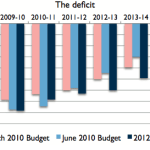
Will George Osborne’s refusal to look again at high levels of state spending become the greatest risk to Britain’s economic stability? There have been plenty of rude comments about the Chancellor’s supposed tactical ineptitude in the weekend press, but he has still managed to keep on borrowing and have almost no one notice. Osborne’s iron commitment is to spending, and a programme of cuts which total just under 1 per cent a year. His commitment to deficit reduction is flexible, as his three Budgets have demonstrated: Osborne spent the election campaign berating Labour for its lack of ambition in halving the deficit in four years. He’s now doing it in five, but no one points this out. Quite a result.

Why access Cameron? The Lib Dems would be an easier target…

From our UK edition

Why would anyone pay £250,000 to change Tory policy when the Liberal Democrats would do it for £2.50 and a hug? The brilliant Sunday Times investigation today makes you wonder whether businessmen don't actually realise that out that, in this coalition, it doesn't matter what you persuade David Cameron of. Policy is decided by horsetrading with the Lib Dems, who wield disproportionate power (for good or for ill). For example, Osborne was personally inclined to bring the top rate of tax down to 40p, but the Lib Dems told him they'd only allow this in exchange for their mansion tax. Cameron refused to do the deal, so 45p it was. The rise in capital gains tax was a Lib Dem demand, and would only be changed by Lib Dem agreement.