Uk politics

What would count as a success for Labour?

From our UK edition

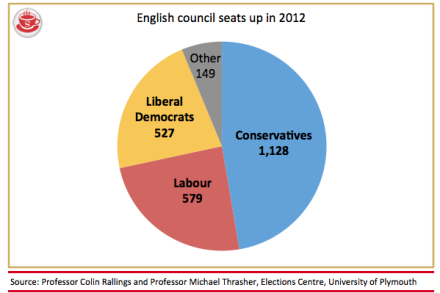
In today’s English council elections, there’s no doubt that Labour will do better than in 2008 — the last time most of these seats were contested. Experts Colin Rallings and Michael Thrasher predict that they’ll improve their ‘national equivalent vote share’ by 13 points compared to four years ago. But how many seats can they pick up of the back of that improvement? Rallings and Thrasher say a figure of 700 would justify a five-point lead in the polls. LSE’s Tony Travers expects Labour’s gains to be around 700-800, and says that: ‘If Labour only manage to put on a further 500 seats, that would be seen as seriously underperforming expectations. Ed Miliband will need 900 gains for a good night.
Why Labour supporters should shun Ken

From our UK edition

The single funniest thing about the London mayoral election has been watching the Left trying to excuse tax avoidance. After I revealed that his idol, Ken Livingstone, had saved a fortune by channelling six-figure earnings through a personal company, the Guardian’s Dave Hill pleaded that Ken’s previous condemnations of tax-dodgers ‘had been aimed at extremely rich people — which he isn't,’ so that’s all right, then. The Independent’s Owen Jones frothed that ‘the 1 per cent have an interest in demonising Ken Livingstone.’ But, Owen, Ken is the 1 per cent!

Just in case you need another reason not to vote Benita, she’s now being backed by Jonathan Ross

From our UK edition

I doubt that many CoffeeHousers are planning on voting for the independent candidate for Mayor of London, Siobhan Benita. As Leo McKinstry said in this magazine recently, she’s really the civil service, establishment candidate. But fair play to her for standing for election unlike her mentor Gus O’Donnell, Jeremy Heywood or any other members of the permanent governing class. But if any Spectator reader was contemplating voting for Benita, another reminder of why you shouldn’t comes today from Jonathan Ross who has endorsed her on Twitter.

Fears heighten as the Eurocrisis rumbles on

From our UK edition

For all the coverage of hacking, pasty tax and the like, the continuing crisis in the eurozone remains the most significant political story. Until it is resolved, it is hard to see how the UK returns to robust economic growth. I suspect that the market reaction to a Hollande victory will be limited as it is already pretty much priced in. Those expecting a degringolade will be disappointed. However, if Hollande does actually try and implement some of his more extreme ideas, the markets could take fright. What is far more worrying than France is Spain. There’s a growing sense of inevitability that the Spanish banks will need a bailout before the autumn.

Boris has won already, says bookie

From our UK edition

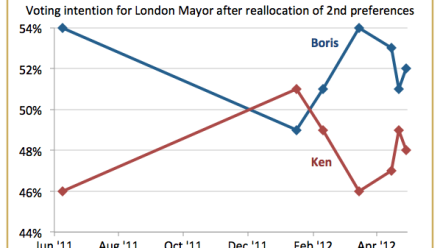
We may still be 19 hours away from the polls opening — and more than 48 away from hearing the result — but bookmaker Paddy Power has already paid out £20,000 to punters who bet on Boris. It’s a publicity stunt by the company, but one that's unlikely to backfire, with the pollsters agreeing that Boris is set for re-election — the only question seems to be how much he’ll win by. YouGov show him 4 points ahead of Ken in the second round, ComRes have him up by 8, Survation 10 and Populus 12. Paddy Power says that 94 per cent of the bets they took on the race in the 24 hours before they paid out were for Boris. Similarly, Ladbrokes announced yesterday that 88 per cent of the cash bet had been for the current Mayor.

The political effects of all this hacking talk

From our UK edition

I doubt that many votes will be moved by the split report on hacking of the Culture, Media and Sport select committee. This is not a subject that sets the public's pulse racing. But all this hacking talk does create political problems for David Cameron. First, it obscures his attempt to talk about other things that matter more to the electorate. This was rather summed up yesterday when the News at Ten led on him facing questions in parliament about Jeremy Hunt rather than the speech he had had to cancel about the economy. This is a particular problem given that the next six weeks at least are going to be dominated by the appearances of various Cabinet ministers and politicians at the inquiry.

The Lib Dems jostle for airtime

From our UK edition

Yep, they’re inescapable, those Lib Dems. Even when the airwaves are dominated by Rupert Murdoch and Tom Watson, they’re there in the background, quietly adding to the day’s pile of political news. We’ve got Ken Livingstone making a pitch for their votes in the London Mayor’s contest, for instance. And we’ve also got Nick Clegg on what seems like every radio show on air, giving his account of why folk should be Lib Dem voters in the first place. There have been two more significant scraps of LibDemmery than those, though.

MPs squabble over their own phone hacking report

From our UK edition

The education select committee reported earlier, but it is the report of another select committee that will get all the attention today. The culture, media and sport select committee has just delivered its verdict on the phone hacking scandal, naming names and apportioning blame — or at least in theory it has. In practice, ‘its verdict’ may be stretching it a bit. During the press conference just now, the individual members of the committee could barely put up a united front at all. There are the parts of the report that they all agree upon: that the former News International employees Les Hinton, Tom Crone and Colin Myler misled the committee in their testimony, for instance. And then there are the parts that they disagree upon among themselves.

Gove gets covering fire

From our UK edition

Good teaching matters; that’s something we don't need to be taught. But how much does it matter? What are its measurable benefits? Today’s education select committee report collects some striking, if pre-existing, research into just those very questions, and it is worth reading for that reason. There is, for example, the IPPR’s suggestion that ‘having an “excellent” teacher compared with a “bad” one can mean an increase of more than one GCSE grade per pupil per subject.’ Or there’s the American study which found that the best teachers can ‘generate about $250,000 or more of additional earnings for their students over their lives in a single classroom of about 28 students.

Tricolour Britain

From our UK edition

With unionists getting grubbed in Scotland and Labour being driven to near-extinction in vast swathes of the south, a new map of political Britain is emerging. In my latest Telegraph column, I called it ‘Tricolour Britain’ — the SNP at the top, Tories at the bottom and Labour stuck in the middle (with Wales). Policy Exchange has today released research which throws more light on this slow-mo political segregation. I thought CoffeeHousers may be interested in what strike me as the top points.   1. Scottish Tory Syndrome is when a once-dominant party loses and doesn’t recover. The party has failed to capture the imagination of voters, so when its apparatus is knocked down there’s no political force to bring it back.

Cameron goes on the attack to defend Hunt

From our UK edition

I don’t think I’ve ever seen David Cameron as angry as he was for that urgent question on Jeremy Hunt. He had clearly decided that attack was the best form of defence and went for his Labour critics in the most aggressive manner possible. But he did make one important concession in his opening answer when he said that if there is evidence of wrongdoing by the Culture Secretary, ‘I will not wait until the end of the Leveson inquiry to act’. In other words, Hunt’s appearance before Leveson will decide his fate. The dynamic in the Cameron-Miliband exchanges was genuinely personal. Cameron told the House that ‘we’ve learned something about the Labour leader today and it is something he’ll regret’.

Boris drops the f-bomb (again)

From our UK edition

More ‘colourful language’ from Boris Johnson today. Interviewed by the BBC about his reported attempts to secure sponsorship from News International while they were being investigated for phone hacking, he dismissed the claims as ‘f***ing b****cks’.

The two Eds go electioneering

From our UK edition

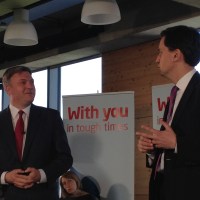
The leadership duo of Ed and Ed made an appearance this morning to rev up support for Labour ahead of this week’s elections. Today was all about appealing to those who have felt hard done by the government and want something different, whatever it may be. Miliband concentrated on setting out five ‘priorities’ for next week's Queen's Speech — the sorts of policies that, he claims, Labour would be enacting in government, and which we've heard from him before. Balls meanwhile was in full attack mode, deploying the usual buzz words and phrases, such as ‘alternative’, ‘fair’ and ‘Robin Hood tax’ to back up Miliband.

An anti-Labour leaflet in a pro-Labour font

From our UK edition

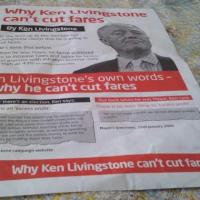
The leaflet pictured above landed on my doorstep in Peckham last week. It's the most interesting piece of election literature I've received this year — not because of its words, but because of its graphic design. If you read it closely, it appears to be an official communication from the Tories. The legally mandated imprint declares it to be ‘Promoted by Ian Sanderson on behalf of the Conservative Party, both of 30 Millbank, London SW1P 4DP’ — and that would accord with its strongly anti-Ken Livingstone text. If you don't examine it closely, however, it appears to be an official communication from Labour. The highlighted details are red, and all the text is set in the Labour party's favourite font, Neo Sans.

Modernisation comes to the 1922 Committee

From our UK edition

Christopher Chope is the only officer of the 1922 Committee who will be challenged by the 301 Group backed slate of broadly pro-leadership candidates. It is running two candidates for the two posts of secretary: Charlie Elphicke the popular, campaigning MP for Dover and Karen Bradley, the MP for Staffordshire Moorlands. Where the slate is running the most candidates is for the executive, full list below. But here great care appears to have been taken to come up with an inclusive list. For example, the group is supporting Adam Holloway who resigned as a PPS to vote for the EU referendum motion. It is also endorsing Penny Mordaunt, one of the leading Tory opponents of Lords reform.

IDS turns up the volume on welfare cuts

From our UK edition

Iain Duncan Smith is quietly spoken. His interview with today’s Times (£) is a case in point. The political elite are ‘distanced’ from the people, he says. The Leveson inquiry is there to ‘clean the house’. The job of government is to govern well, not be loved. The ‘omnishambles’ will pass because David Cameron has 'the capability to pull himself and us all through'. But, amid these placid notes, is a subito fortissimo. The welfare secretary sets himself against George Osborne’s wish that a further £10 billion in welfare cuts be found by 2016. He says: 'This is my discussion with him... My view is that it’s not [all going to come from welfare]...

Leveson shows his teeth

From our UK edition

The Leveson inquiry has rebuffed the government’s suggestion that it should decide on the probity of Jeremy Hunt’s actions during the notorious BSkyB bid. The inquiry says that alleged breaches of the ministerial code do not fall within its remit. A spokesman for the inquiry also quashed Nick Clegg’s claim that ‘we've already got an agreement Jeremy Hunt will go to the Leveson [inquiry] pretty quick.’ An inquiry spokesman said that it would not be fair to bring forward Hunt’s appearance. The Culture Secretary will appear in the middle of May. These developments are an embarrassment for David Cameron, emphasising that he has not called an inquiry into the Hunt affair.

Boris has the greatest global clout

From our UK edition

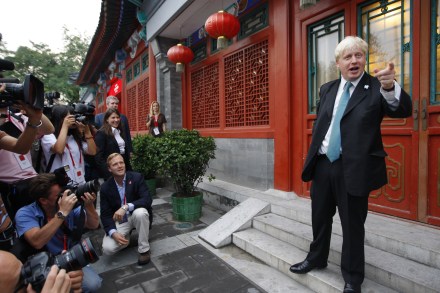
Ni hao. In recent days, Boris, Ken and Brian have all leapt headlong onto Weibo, China’s highly popular version of Twitter. It's an obvious effort to win the votes of Chinese-speakers living in London. Boris was the first — which, I suppose, says all you want to know about his sense of initiative, brio, élan, and whatever the Chinese word is for ‘mojo’. Ken and Brian both jumped in about two weeks later, around April 21.   Inevitably, because the vast majority of Weibo users live in China, our three London mandarins have ended up attracting followers based in the Middle Kingdom. A look at the mayoral candidates’ individual Weibo accounts gives a pretty accurate picture of the recognition and popularity they hold abroad.