Uk politics

Measuring well-being: a tough but important job

‘If you treasure it, measure it.’ So Gus O’Donnell said when addressing the All Party Parliamentary Group on Wellbeing Economics in November. Well, the government has decided it treasures our well-being, and so is determined to measure it. It’s an incredibly tricky task — as I’ve noted before — but it’s a significant step forward that the Office for National Statistics has at least begun to try, and has finally started collecting a wealth of well-being data. In April, the ONS began asking people four questions to measure their subjective well-being on a scale of one to ten: Overall, how satisfied are you with your life nowadays? Overall, to what extent do you feel

Tony Blair’s legacy on tackling extremism

It may be unpopular to say, but there is reason to be charitable to Tony Blair and his latest warnings about Islamist extremism. The former Prime Minister gave afascinating interview to Charles Moore in yesterday’s Telegraph where, inter alia, he talks about the challenge of militant Islam. ‘The West is asleep on this issue,’ he tells Moore. Blair has been more vocal and unequivocal on the issue than almost any other politician in recent years. He notes that the success of his Africa Governance Initiative faces ‘this threat above all others’. Failed states in the Horn of Africa have accentuated this, while one of the unintended consequences of the Libyan revolution

1,200 extra troops to calm Olympic concerns

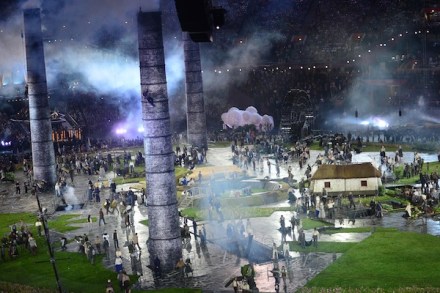
Ministers held their daily Cobra meeting this morning to check the progress of the Olympic preparations, with just three days before the opening ceremony. Following the meeting, Jeremy Hunt released a statement – about 15 minutes after the Crown Prosecution Service announced the latest charges in its phone hacking investigation – which started by describing how London 2012 ‘remains very much on track’. The statement continued to describe the arrival of the athletes, praise for the organisation of the Games from International Olympic Committee president Jacques Rogge, and the rising numbers of staff provided by beleaguered security firm G4S. Anyone who wasn’t immersed in the phone hacking charges might still

Why Miliband doesn’t need to agree with Nick

Ed Miliband’s comments in the Independent today were clearly based on the assumption that Nick Clegg will not be around if and when it comes to negotiating a possible Lib-Lab coalition in 2015. Vince Cable has already thrown his fedora into the ring to be the next Liberal Democrat leader, and Miliband backed the calls for a change of chief in his interview today. ‘I would find it difficult to work with him,’ he said, when asked about Clegg. Clegg cannot go from being Deputy Prime Minister in one government to Deputy Prime Minister in the next: it would look ridiculous. A coalition with Labour would also not suit Clegg’s own political

Briefing: HSBC, money laundering and Lord Green

What’s HSBC done wrong? Put simply, HSBC was not rigorous enough in preventing money laundering through its banks. Last week, the United States Senate’s Permanent Subcommittee on Investigations released a damning report finding that HSBC had ‘exposed the US financial system to a wide array of money laundering, drug trafficking, and terrorist financing risks due to poor anti-money laundering controls’. In particular, the committee criticised the way HSBC treated its Mexican arm. HSBC Mexico, the report says ‘operated in Mexico, a country under siege from drug crime, violence and money laundering; it had high risk clients, such as Mexican casas de cambios [bureaux de change] and US money service businesses; and it offered high

The caveats to nil Zil lane usage for ministers

How many ministers will be using the Zil – sorry, Games – Lanes during the Olympics? The Prime Minister’s official spokesman said this morning that the lanes would be used on a flexible basis, and that ministers would stick to public transport. ‘The approach is that where possible they will use public transport,’ he said, but he added that ‘operational or security reasons’ might mean ministers are forced to use the lanes. ‘Operational’ and ‘security’ offer a conveniently wide range of situations in which someone might have cause to hop in the ministerial car and zoom down a clear road,  including the tube being too rammed with tourists for a

The Treasury sides with the consumer over climate policy

Tim Yeo is now posing as a friend of the consumer. Launching the latest report from the Energy and Climate Change Committee this morning, he attacked the Treasury for ‘refusing to back new contracts to deliver investment in nuclear, wind, wave and carbon capture and storage’. The report argues that could ‘impose unnecessary costs on consumers’. The basic logic of his claim is this: investments are more expensive when they are riskier. Investors expect to be compensated for the risks being taken with their money. If the Government offers guarantees that reduce the amount of risk energy companies run by investing in expensive sources of energy like offshore wind, then those firms

The new rebel PPS

Tim Montgomerie has some excellent intelligence on ConHome this morning that Francis Maude is about to gain a new PPS. The Cabinet Office Minister’s former aide was Angie Bray, who was sacked after voting against the government at the second reading of the House of Lords Reform Bill. But Maude’s replacement PPS, Stuart Andrew, is also a rebel. He was one of the 81 who defied the three-line whip in the autumn to vote for a backbench motion calling for a referendum on Britain’s relationship with the European Union. As Tim points out on his blog, this is a sign that rebels might still have a hope of a job in the

The UK Border Agency’s Bermuda Triangle

Bringing the UK Border Agency to heel has been one of the mammoth tasks facing ministers since the coalition formed. Ministers have recently been rather keen to suggest that backlogs in claims and migrants disappearing without a trace were coming under control – Immigration Minister Damian Green said at the start of this month that ‘we have gripped it and dealt with’ the problem of people overstaying their visa, for instance. But lest senior staff at the UK Border Agency were starting to pat themselves on the back for a good job well done, the Home Affairs Select Committee has released a damning report this morning which says performance is

More smoke from the Libor fire

A new cache of emails released today by the Bank of England reveal its deputy governor Paul Tucker was warned that it was ‘plausible’ that Libor rates were being ‘influenced by commercial incentives’. Tucker insisted in his appearance before the Treasury Select Committee that he and colleagues ‘thought it was a malfunctioning market, not a dishonest one’. But an email sent by an unnamed official to Mr Tucker on 22 May 2008 points to a possible manipulation of Libor. It contains notes of a meeting which say: ‘There is a long-standing perception that Libor by virtue of the manner in which it is set is open to distortion: panel banks have no obligation to

Letwin fails to consult about the consultation on consultations

Oliver Letwin’s decision to launch a consultation on reducing the amount of time that government has to spend on consultations has sparked controversy in Whitehall. Sticklers for procedure are complaining, in a way that only Sir Humphrey himself could do justice to, that other ministers hadn’t been consulted about the decision to launch a consultation on shortening consultations. Now, this is all quite trivial. But it does reveal just how bureaucratic modern-day government has become. This problem has been exacerbated by the Equalities Act and the rise of judicial reviews. Indeed, I understand that there is now a board of civil servants whose job is to review the equality impact assessments being

Public finance statistics point to a miserable autumn statement

Today’s round of public finance statistics bring mixed news for the government. The headlines have focused on the fact that borrowing last month — at £14.4 billion — was £0.5 billion higher than in June 2011. But considering that the monthly borrowing figures end up being revised by an average of £1.7 billion (usually downwards), we shouldn’t get too fixated on a difference of a few hundred million. What is perhaps more worrying is the trend in the financial year so far. Superficially, the numbers look pretty good: a total of £14.9 billion in borrowing since April, compared to £38.4 billion in the same three months of last year. But this year’s

We need a minister to defend the City of London

Is the City of London worth defending? Not many in the government seem to think so. Vince Cable, the Business Secretary, calls it a ‘cesspit’. George Osborne blames the financial sector for causing the crisis – the Barclays Libor scandal, to him, was not an isolated incident but indicative of the whole rotten system, ‘the epitaph to an era of irresponsibility’. The City’s global enemies look on, amazed. Not even the Brits are prepared to stand up for their extraordinary financial sector. As I say in my Telegraph column today, now is their time to strike. As the Americans are pointing out, much Wall St woe can be traced back to

When should George Osborne switch to Plan B?

Announcements from the International Monetary Fund are worded in such a way that everyone reading them comes away with something slightly different. So shortly after today’s report on the UK economy was released, Ed Balls put out a statement saying the report was a ‘very serious warning to the Chancellor that urgent action to boost jobs and growth is needed’. He concluded his press release by asking ‘how much worse do things have to get before the Chancellor finally changes course?’. Now, today’s report from the IMF is not cheery reading for George Osborne. It passes this bleak judgement on the economy: ‘Recovery has stalled. Post-crisis repair and rebalancing of the UK

Childcare costs could be election battleground

Parents of children under two now pay on average over £5000 a year on childcare, with costs increasing much faster than either earnings or inflation. In response, both the government and Labour have launched Childcare Commissions as vehicles for developing new ideas. Ministers have today asked for the views of ‘everyday experts’ –- parents, childminders and nursery owners –- in a consultation period lasting until the end of August. So far, so unspectacular. But there are a couple of reasons to think that childcare -– traditionally a second or third tier issue -– could become a key political battleground between now and 2015. First, electoral maths. Those struggling with high

How long can the government ignore demands for free grammar schools?

The argument about grammar schools had been stuck in a rut. Opponents argued that the division between grammar schools and secondary modern was too binary. But with the advent of free schools this argument has lost its force. There is now a diversity of provision meaning that there’ll be no return to the old stark grammar/secondary modern split. Free grammars would also boost the number of state school children going to our best universities and unleash a new wave of educational philanthropy. As Terry Leahy, the former boss of Tesco who has as good a claim as anyone to the title of Britain’s most successful businessman, tells The Spectator this week,

Too much government meddling undermines the energy market

Pity Ed Davey. At some point in the next few months, the Energy and Climate Change Secretary is going to have to sit down and decide how much nuclear power is going to cost for the next few decades. It is not an easy decision. On one side are nuclear firms threatening to pull out of building new power plants if they do not get the price they want. All those jobs not created. All that low carbon energy not generated. All those windfarms that will have to be built instead, with all their protest groups and angry backbench Tories. On the other side are households and business, already worried

Miliband and monopolies

Ed Miliband used his speech this morning on policing to attack the shambles on Olympic security staffing created by G4S. That was a sensible thing for an opposition leader to do, and he managed to give quite a sensible speech, all in all. He did not fall into the trap of saying that all outsourcing is bad – which would have been a strange thing for the Labour leader to say, anyway, given it was under his party in government that firms like G4S flourished. But he did point to what many across the political spectrum agree is a problem: that G4S effectively holds a monopoly on security and policing