Uk politics

Herman van Rompuy’s revelatory Downing Street lunch

From our UK edition

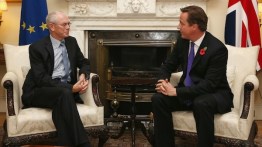
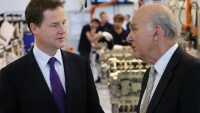
David Cameron had lunch with Herman van Rompuy in Downing Street today to discuss the UK's position on the EU budget. Despite the Prime Minister's tough talking in public about his determination to veto any real-terms increases in the money available for the multi-annual budget, the Downing Street spokeswoman refused to confirm that there was in fact any mention of this threat at today's meeting, which Nick Clegg apparently popped into briefly. She said: 'Discussions focused on the multi-annual budget. Both the Prime Minister and the Deputy Prime Minister made clear the Government's position that we do not support a real-terms increase in the EU budget.

Ed Balls tells porkies about the deficit

From our UK edition

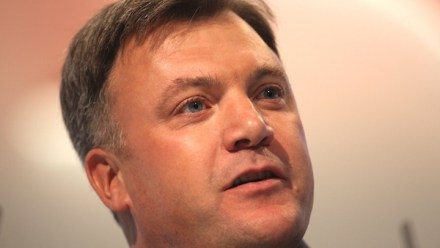
Ed Balls has just been given a thorough grilling by Andrew Neil on the Daily Politics — particularly on his past assertions that Labour were not running a structural deficit in the years leading up to the financial crisis.

Iain Duncan Smith’s latest welfare cut kite

From our UK edition

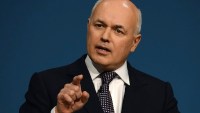
It is strange that the government has chosen to trail a speech by Iain Duncan Smith on an issue popular with voters on the same day as good economic news. The Work and Pensions Secretary has already reached an agreement with Chancellor George Osborne that it is possible to cut a further £10 billion from the welfare bill (when he originally said he would block those cuts), and is now starting to prepare the ground for some of those cuts to take place. He knows that while the public supports further welfare cuts, the Lib Dems will not without a credible package which ensures the rich are paying more. One of the proposals that Duncan Smith is flying as a kite today is limiting benefits paid to families with more than two children.

When a growing economy still feels bad

From our UK edition

David Cameron was right; the good news has kept on coming. This morning’s first estimate from the ONS puts GDP growth in the third quarter at 1.0 per cent. Cue much justified squabbling over what the 'real' number is. A significant portion of this growth will be a one-off, post-Jubilympics bounce-back, suggesting slower underlying growth. As Jonathan pointed out yesterday, ONS first estimates have a margin of error of 0.7 percentage points, meaning that even with these factors built in, the real figure could lie between 0.3 and 1.7 per cent. Gaps of this magnitude are no small matter. But behind these arguments about the number itself lies a different and in many ways much more politically important question: what will a return to growth actually feel like?

Economic growth faster than expected as Britain exits recession

From our UK edition

The economy is out of recession. It grew by 1 per cent in the third quarter of this year, which is the fastest quarterly growth rate since 2007. This positive number makes it a lot easier for the coalition to claim that the economy is ‘healing’. Expect to see ministers heading to TV studios to talk about how a million more private sector jobs have been created, how there are record number of new start ups and that inflation is down. Being out of recession makes it a lot easier for the coalition to defend its economic record. Today’s number should also serve to boost consumer confidence, to provide a little bit of a ‘feel-good’ factor. Now, there are obviously unique factors involved in this growth figure. Olympic ticket sales, for instance, added 0.

Labour prepares for the worst (good news on the economy)

From our UK edition

Whether or not he did accidentally suggest that he knew what tomorrow's GDP figures will be at Prime Minister's Questions, David Cameron did have a jolly good point about the way Labour responds to good news on the economy. He told Ed Miliband: 'It's only a bad week if you think it's bad that unemployment's coming down, it's only a bad week if you regret inflation coming down… every piece of good news sends that team into a complete decline, well, I can tell him, the good news will keep on coming.' As Fraser blogged at the weekend, Ed Miliband's strategy is predicated on the government continually cocking up.

Why British GDP figures are almost ALWAYS wrong.

From our UK edition

Will it be 0.5 per cent? 0.8 per cent? 1 per cent? Whatever figure the ONS tells us GDP grew by in the third quarter of 2012, there's one thing you can be pretty sure of: it won't be the actual amount GDP grew by in Q3. In the past 51 years, just 12 of the ONS's 205 first stabs at quarterly growth have survived later revisions. To be fair, the ONS recognises this, and cautiously labels tomorrow's figure a ‘preliminary estimate’. But just how wrong is it likely to be? If tomorrow's figure is +0.5 per cent, does that mean we can be pretty confident that growth was between, say, 0.3 per cent and 0.7 per cent — bad but not disastrous? It turns out we can't. In fact, a preliminary estimate of +0.5 per cent really means somewhere between +1.2 per cent and –0.

PMQs sketch: Miliband gives up on Songs of Dispraise and attacks Cameron on competence

From our UK edition

Goodness, he’s enjoying himself. Ed Miliband is brimful of confidence these days and he handles himself like a master juggler at PMQs. He flicks out deft gags and acerbic asides while keeping the central question in the air. He’s having fun. And it’s a pleasure to watch. Greatly helpful to him is the government’s pledge to deliver at least one major and one minor cock-up every week. Last Wednesday it was Cameron’s improvised announcement that energy companies must give customers the lowest tariff. Today he tried to explain this. ‘There were 400 different energy tariffs last year,’ the PM told the Commons. ‘That’s totally baffling.’ ‘The only people baffled,’ said Miliband. ‘were his ministers last week.

Salmond’s darkest day could be yet to come

From our UK edition

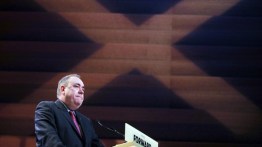
For years Scotland has been waiting to see when his luck would run out – well, now it has. Alex Salmond: gambler, tipster, political animal and First Minister now has another moniker: author of the country’s first scomnishambles. Yesterday marked, without doubt, the First Minister’s worst day in office. First, he lost two MSPs. Left-wingers Jean Urquhart and John Finnie announced they were leaving the SNP because of the party’s conversion to Nato. That decision, taken at SNP conference last weekend, has alienated many left-wingers in the party because they see it – rightly – as part of Salmond’s attempts to take the SNP into the moderate, centre ground of Scottish politics.

Did David Cameron break an embargo on GDP figures?

From our UK edition

Last week David Cameron found himself in trouble after Prime Minister's Questions over a slip of the tongue about energy bills: this week he's managed to get himself into trouble over what looks like yet another slip of the tongue at PMQs. The Prime Minster appeared to suggest that tomorrow's GDP figures, which are under strict embargo, will be good news for the government. The heat was on for Cameron, as Ed Miliband was performing reasonably well, with some good jokes (including 'I asked him a question about the railways - I have to say the Chancellor shouts, it's not the ticket that needs upgrading, it's the Chancellor of the Exchequer').

Nick Clegg to tell business leaders: we’re your friends

From our UK edition

Nick Clegg is giving a speech this evening in which he will try to re-sell the Liberal Democrats as friends of business. Admitting that he hasn't 'said enough' about the party's pro-business policies, he will tell the guests at Mansion House: 'Many in the corporate world do not - automatically - see the Liberal Democrats as natural allies. Perhaps that's because, most recently, we've rightly earned ourselves a reputation as loud critics of corporate irresponsibility… Not least in financial service following the crash in 2008. Yet, historically, the Liberal Democrats are a party of industrialists and small business… And, since coming into government, we've been taking decisions, day in, day out, to promote British business.

David Cameron must rule out votes for prisoners at PMQs

From our UK edition

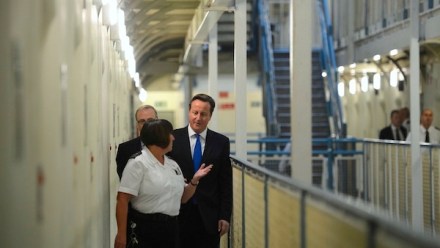
The issue of prisoner votes has turned into a question of trust between David Cameron and his backbenchers. Most Tory MPs well remember that the Prime Minister’s initial intention was to comply with the Strasbourg court’s ruling; he only changed his mind after seeing how strong feelings were on the issue on the Tory benches and in the country. For this reason, Cameron needs to scotch all this talk of a draft bill on votes for at least some prisoners at PMQs today. If he doesn’t, he’ll have just as large a rebellion on his hands as he did last time. The issue will also drive a further wedge between Cameron and his backbenchers.

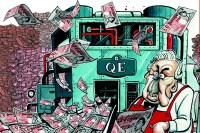
Sir Mervyn King: Quantitative easing is reaching its limit

From our UK edition

Quantitative easing isn't an eternal elixir of economic health. That was the admission from Bank of England Governor Sir Mervyn King last night at a speech in Cardiff. Sir Mervyn said there were limits to the BoE's policy of printing money to buy bonds, which could not 'continue indefinitely': 'One thing we can see clearly is that the recovery and rebalancing of the UK economy are proceeding at a slow and uncertain pace. At this stage, it is difficult to know whether some of the recent more positive signs will persist. The Monetary Policy Committee will think long and hard before it decides whether or not to make further asset purchases. But should those signs fade, the MPC does stand ready to inject more money into the economy. 'Printing money is not, however, simply manna from heaven.

Margaret Thatcher and the Tory party’s change on Europe

From our UK edition

Charles Moore’s biography of Margaret Thatcher promises to be the most important British political book in decades. Tonight, we got a preview of it when Charles delivered the Centre for Policy Studies’ second Margaret Thatcher lecture. The subject was Thatcher and Europe. I won’t say too much about it because we’re running a version of it in the coming issue of The Spectator. But one thing that Charles demonstrated was that even when Thatcher was campaigning for British membership of the European Community, as then was, she was never in favour of the European project. One of the other thing that Charles’s lecture brought out was the shift in the balance of power in the Tory party on Europe.

Despite everything last week, David Cameron is still on the up

From our UK edition

Finally, some good news for the government - the public seems unconcerned by its recent difficulties. In spite of plebgate and George Osborne's train ticket dominating this weekend's papers, polling out today shows the Conservatives have managed to reverse their voting share decline in the wake of their party conference. The Populus/Times poll places the Tories on 35 per cent, up five points from September while Labour are down by the same amount. This brings Labour's lead down to where it was before this year's budget in March 2012: The Guardian/ICM polling shows a smaller increase, with Labour on 41 per cent and 33 per cent for the Conservatives. This is still a two point improvement on their last poll: However, the ICM figures are adjusted in favour of the Tories.

A lesson for Alex Salmond from George Orwell

From our UK edition

I've written a piece for today's Scotsman noting that there are some parallels between Scotland's independence stushie and the pre-Iraq War rammy a decade ago. Only this time it's the nationalists who are, if you will allow the comparison, the neoconservatives. Just as pro-war advocates back then (and I was one of them) cheerfully labelled anyone who opposed the war of being "objectively pro-Saddam" so the nationalists today essentially argue that anyone opposed to independence is anti-Scottish and, implicitly, objectively so. This is as tedious as it is stupid and the kind of thing liable to further hamper the party's already faltering attempts to win what the Americans call high information voters (that is: those on above-average incomes).

The illusion of economic recovery

From our UK edition

GDP per head is still 7 per cent below its pre-recession peak. That's one of the sober reminders of the weakness of our recovery in a new ONS report, released as part of its National Well-being project. In fact, GDP per head fell by 7 per cent from 2008 Q1 to the recession's trough in 2009 Q2 — and has recovered by 0.0 per cent since. That is, the 2.4 per cent recovery in GDP up to 2012 Q2 (which still leaves us 4.1 per cent below our pre-recession level) has not been enough to outweigh population growth. The GDP index has risen, but only thanks to Britain's ever-rising headcount. When it comes to GDP per capita, there has literally been no recovery at all.