Uk politics

David Cameron needn’t fear renegotiating Britain’s relationship with the EU

From our UK edition

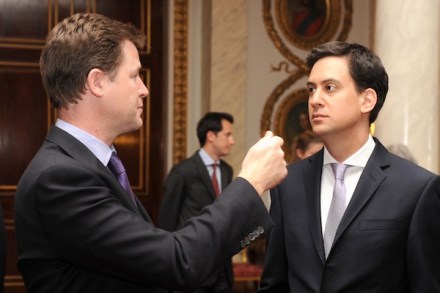
Nick Clegg has made a not-so-startling intervention in the debate about Britain's relationship with Europe today, warning that Britain must avoid selling itself short in a renegotiation. His interview with the Guardian is a necessary piece of positioning ahead of David Cameron's Big Europe Speech in mid-January, and this kind of differentiation is something the Tories are more than happy for the Lib Dem leader to continue doing. So in some ways, Clegg warning Cameron not to overdo it on Europe isn't at all significant. But the Deputy Prime Minister makes an important observation in his interview about Britain's bargaining power.

‘One Pound Fish’ singer deported

From our UK edition

Everything you need to know about the fallen state of our political and cultural capital is captured by the story of Muhammad Nazir. A Pakistani immigrant who came here to study at a now defunct college, he took part-time work in Queen’s Market, East London, and was filmed singing a bizarre yet inexplicably catchy song about ‘One Pound Fish.’ Nazir’s innocence, rubbery grin, and fluvial Bollywood cadences made the experience all the more endearing. The video went viral; Nazir went on X Factor; and he was signed by Atlantic Records. Nazir eventually ranked 29th in the Christmas charts, a formidable accomplishment considering he was just five spots behind the chicly grace of Adele.

High Court judge: Gay marriage is ‘wrong policy’

From our UK edition

Sir Paul Coleridge's intervention in today's Times (£) on gay marriage has ensured the debate won't go quiet after various angry Christmas Day sermons. The High Court Judge tells the paper that introducing weddings for same-sex couples is the 'wrong policy', adding: 'So much energy and time has been put into this debate for 0.1 per cent of the population, when we have a crisis of family breakdown. 'It's gratifying that marriage in any context is centre stage… but it [gay marriage] is a minority issue. We need a much more focused position by the Government on the importance of marriage.

Banking Commission to force Chancellor’s hand on reform

From our UK edition

As is becoming increasingly clear to David Cameron, the problem with answering calls for an inquiry into a scandal in one industry or another is that at some point that Inquiry will report back with a bunch of recommendations which may or may not be politically expedient to implement. The Parliamentary Commission on Banking Standards came up with proposals last week for an electrified ring fence, which the Treasury politely said it would look at, and Vince Cable rather more bluntly said the government should ignore, preferring instead that ministers get a move on with implementing the Vickers proposals, rather than opening up the whole debate again.

Will ‘plod-gate’ make voters more sceptical of class-based political attacks?

From our UK edition

The Andrew Mitchell story has always been about class. If all Mitchell was alleged to have said was ‘you supposed to f’ing help us’ there would have been some clucking and some mockery but no serious calls for his resignation. But the word ‘pleb’ and the phrase ‘know your place’ made the charge toxic. This was also what made some in Number 10 so queasy about any kind of robust defence of Mitchell; the Cameroons believe that whenever the conservation is about class the Tories are losing. This class angle is also what enabled the Labour Party to make political hay out of the issue.

Tory MP mulls boundaries rebellion

From our UK edition

In spite of the best efforts of its ministers in the Lords, it looks as though the government is going to face a vote on the dreaded boundaries legislation early next year, with the Electoral Registration and Administration Bill returning to the Upper Chamber in January. The big story is that the Lib Dems will be able to kick the reforms away until 2018 using an amendment, but it isn't just the members of the smaller Coalition party who will be rebelling against government policy. Tory MP Glyn Davies has now come out as an opponent of the reforms, too. On his blog, he writes that he is 'contemplating voting against my government for the first time' for a number of reasons.

The party of little tykes

From our UK edition

Whose fault is it that the Tory party is so rebellious? Some think it's the beastly backbenchers, while others argue it's the Tory leadership. I was amused to watch a beaming Brian Binley lead David Cameron into the 1922 committee on Wednesday, given the backbencher was only recently penning an angry letter to the press about how the Prime Minister was ruining everything. There will always be people like Binley in every party, and Downing Street has made very clear that it would answer his desire for a move to the right by staying firmly in the centre ground. But are there really are so many other Conservative MPs who started out as thorns in the flesh from their first day in Parliament?

An electric fence to keep the City of London’s light from dimming

From our UK edition

The Parliamentary Commission on Banking Standards was conceived in those tumultuous days following the first Libor revelations. At the time, some hoped that its report would lay the blame squarely at the feet of a certain former city minister. But the cross-party committee of peers and MPs has produced a sober report this morning which makes for relatively comfortable reading for those Labour politicians whose regulatory system saw the birth of Libor rigging as it does not name them. It is slightly less comfortable for the Coalition, which now has to consider whether to beef up its existing plans for banking reform. It doesn't contradict the spirit of the Vickers reforms, but it does go further, calling for an 'electrified' ring fence between the retail and investment arms of the banks.

The Mitchell row could plunge the Met into an even bigger crisis

From our UK edition

That Andrew Mitchell no longer has confidence in the Metropolitan Police Commissioner escalates this scandal. I understand from those close to Mitchell that he was particularly concerned by Bernard Hogan-Howe’s declaration a few days ago that he had seen 'nothing that causes me to doubt the original account' contained in the police logs. He felt that this risked prejudging the police’s own investigation into the matter. One other aspect of this affair is where it leaves the relationship between the police and those Cabinet Ministers they protect. After the Mitchell incident, many of them made their displeasure known. David Cameron’s own security detail were seen wearing ‘toffs and plebs’ cufflinks at Tory conference.

No, Mr Bond, I expect you to settle out of court

From our UK edition

Right now, there are about 60 assorted cases of people trying to sue Britain's intelligence services. Is that because our spies are unusually wicked, cavalier or brutal? Or because they may be caught in a legal trap with the laser beam of the human rights lobby moving ever-closer to their vitals? I argue the latter in my Telegraph column today, effectively a defence of what is wrongly described as 'secret courts'. For some years now, a game of British spy-catching has been going on. The rules are simple. Say a bomb goes off in Pakistan this Christmas and the police round up suspects with their, ahem, usual care and attention. They are all released, without charge. But it is now standard operating procedure to sue the Brits - especially if one had spent some time in London.

Iain Duncan Smith doesn’t support a welfare cash card

From our UK edition

Those nasty Tories, they're at it again. Now they're trying to stigmatise benefit claimants by giving them special welfare cash cards so they can't buy booze or cigarettes with their child benefit. That Dickensian Iain Duncan Smith was talking about the value of such a card on the lunchtime news, and has caused a bit of an uproar. Except they're not planning to do anything of the sort. I've just spoken to a source close to the Work and Pensions Secretary, who has completely refuted the idea that he's going to bring a card in. The only hint he was making was that some vulnerable claimants such as people struggling with drug addictions might be better helped by a card, not every benefit claimant. The source says: 'This is not something that is being considered, it is not in the pipeline.

Francis Maude strikes conciliatory note in stand-off over senior civil servants

From our UK edition

Francis Maude's latest plan to get the civil service working more effectively sounds very sensible: so sensible, in fact, that it's a wonder it has taken so long. The problem is that he currently can't be as sensible as he'd hoped when it comes to appointing senior civil servants. The headline announcement is that the government has published the personal objectives of 15 permanent secretaries, along with those for Sir Bob Kerslake and Sir Jeremy Heywood. The worst performing 10 per cent of those civil servants will be identified and put into a programme of performance management. Ministers will also have more involvement in assessing their permanent secretaries' performance. All very sensible. There's some interesting detail in the individual plans that's worth looking at.

Grant Shapps launches Tory target seats campaign

From our UK edition

If the Tories are to win a working majority at the next election, they are going to have to take seats off Labour. Even if the Tories won every single Liberal Democrat seat they are targeting — something that is highly unlikely to happen, they would still only have a majority of one. Doing this after five years of austerity government is going to be extremely difficult. The Tory strategy for it, involves boosting the party’s vote among groups that the party traditionally underperforms with. Tellingly, Grant Shapps is launching the Tory target seats campaign today in a Hindu temple in Harrow West, a seat where the Tories underperformed last time; the Labour majority there actually went up in 2010.

If they can frame a Chief Whip, they can frame anyone

From our UK edition

Lord Denning was perhaps the most beloved judge of the 20th century. He even inspired a Lord Denning Appreciation Society. But I and many others found something sinister behind his charming Hampshire accent. We noticed that his professed concern for the victims of injustice never extended to the victims of police fit-ups. In 1980, he heard an appeal by the Birmingham Six, the men falsely convicted for the IRA’s massacre of drinkers in two Birmingham pubs in November 1974. The six were suing the police for damages for the beatings they said they had received. Although it was not a full appeal, Denning understood the implications, and rejected the claim: 'Just consider the course of events if their action were to proceed to trial ...

We need a recipe to solve food poverty

From our UK edition

At Prime Minister’s Questions yesterday, the Opposition touted food banks as evidence of Britain’s regression into a Dickensian era. With 128,000 visitors passing through the Trussell Trust’s doors last year, today was not the first Wednesday on which the Government has been blamed for more children going hungry and more families struggling to put food on the table. But why are food banks multiplying at a rate of three a week and are they really a workable solution? One answer is that organisations such as the Trussell Trust can now place their leaflets in jobcentres. In addition, unlike under Labour, food banks can now receive referrals from a range of sources such as Community Nursery Nurses, Headteachers, and Health Visitors.

Mitchell row could make MPs think again before criticising a colleague in trouble

From our UK edition

Tory MPs - and the occasional Lib Dem, too - were flocking around Andrew Mitchell in the Commons yesterday to show their support for the former chief whip. He is enjoying a new wave of support in his party, rather than languishing as persona non grata on the backbench. But the picture is still not clear. Mitchell himself admitted that he swore during the exchange with the police: less politically toxic, perhaps, than 'pleb', but swearing at a police officer is still something that can land you with a fine in a Magistrates Court. And there are two other police officers who claim the chief whip said both words. Another person who has not emerged unscathed from this row is Sir Jeremy Heywood. He reviewed the CCTV footage himself, but seems not to have noticed that there were no witnesses.

We may soon know the truth about the Andrew Mitchell incident

From our UK edition

The plot is rapidly thickening around the whole Andrew Mitchell and police incident. By the end of this matter, I suspect several reputations will have been severely damaged. The email allegedly sent by a police officer, who was posing as a member of the public and an eyewitness to the incident, to his local MP John Randall is a quite remarkable document. It is well worth reading in full just to see the level of detail involved. Those close to Mitchell stress that he is more interested in clearing his name rather than returning to the Cabinet or seeking legal redress. But I understand that this whole scandal might well reach a denouement quicker than anyone currently expects.

David Cameron promises Tory MPs strong 2015 offer on Europe

From our UK edition

David Cameron's appearance before the 1922 committee was designed to reassure his party, and he tried to do this by promising them that the Conservative party would be strong on Europe in 2015. It has been a hard term, and today's PMQs was savage, so the Prime Minister decided to start his speech by telling them to think about the Conservative party's record in government. He touched on welfare, on schools, on the NHS - in particular mixed sex wards and waiting times - and income tax. He is clearly looking forward to the next election, too, as he mentioned the appointment of Lynton Crosby, to cheers from those listening, as well as attacking the Labour party. He also told the MPs about the importance of a strong and united Conservative party.