Uk politics

What David Cameron plans to say in his Europe speech

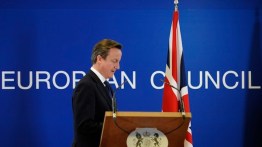
David Cameron’s big Europe speech is now less than a fortnight away. It will be, I suspect, the most consequential speech of his premiership. When you look at the challenges involved, one can see why the speech has been delayed so many times. Cameron needs to say enough to reassure his party, which has never been more Eurosceptic than it is now. But he also needs to appeal to European leaders, whose consent he will need for any new deal. At the same time, he’s got to try and not create too much nervousness among business about where all this will end up. I understand that he intends to argue

PMQs sketch: Labour unleashes Operation Starving Kiddie

Seemed a good idea at the time. Ed Miliband decided that the progress report published by the Coalition is a ‘secret audit’. At today’s PMQs he accused Cameron of sneaking it out in order to dodge bad coverage. Poor old Ed. He can’t read the chess-match more than one move ahead. The PM gave the obvious answer. Labour has never fessed up to the gap between its promises and its achievements. The Coalition has. ‘A week sitting in the Canary Islands with nothing else to think of,’ mocked Cameron. ‘Is this the best he can do?’ ‘Well, he’s going to have to do better than that,’ said Miliband from his

Could Jesse Norman be the next Tory leader?

He might want to stay Prime Minister until 2020, but who will succeed David Cameron once he’s gone? In this week’s Spectator, Bruce Anderson offers his own tip for the next Conservative leader: David Cameron has announced that he would like to stay in No. 10 until at least 2020. That is excellent news for one Old Etonian candidate for the succession. Although he is at least as good as anyone else in the 2010 intake (an outstanding vintage), this fellow could not promoted in the last reshuffle, because he had played a splendid innings as the captain of the revolt over House of Lords reform. He earned the gratitude

The press needs a regulator that outlives the memory of the last scandal

Ahead of a major Spectator debate on the implications of the Leveson report, Conservative MP Nadhim Zahawi explains why he supports a statute-backed system of press regulation. Yesterday’s mid-term review included the statement ‘We will continue to work on a cross-party basis towards the implementation of the Leveson Report on press regulation’. A welcome reminder that the question of what to do about press regulation has not been forgotten over the Christmas break. But what we should do is still very much up for debate. We now have two Bills, Labour’s ‘Press Freedom and Trust Bill’ and Hacked Off’s ‘Leveson Bill’, and of course the Government will be coming forward

Secret audit of Coalition pledges offers few clues on progress

Finally, the copper-bottomed, unvarnished Programme for Government Update, aka the Secret Audit, has landed. You can read the full document here, but in summary, it’s not immediately very helpful. It is laid out as a point-by-point ‘analysis’ of how the government is meeting its pledges in the Coalition Agreement, but the wording is such that you can’t actually tell whether there are any areas on which it has failed. Reading this document, you’d think everything was pretty hunky-dory with the government as there is no assessment of whether each pledge is completed, underway, or forgotten. This is the assessment of the House of Lords reform pledge: We published a draft

PMQs: Leaders trade dull insults as Andrew Mitchell holds court

No one could call today’s PMQs illuminating. Ed Miliband led on the whole embarrassment of a Downing Street aide being snapped with a memo about whether to release a full audit of the coalition’s performance. There followed some not particularly sharp PMQs knock-about. Miliband claimed the ‘nasty party is back’ while Cameron bashed Labour for having no policy and took his usual shot at Ed Balls. There was a brief flurry of excitement when David Cameron declared, unprompted, that he had never broken the broken the law. Lots of the press are now pointing out various incidents when we know that he has. But in the Chamber it was clear that

2013: Can the SNP move beyond preaching to the already converted? – Spectator Blogs

Alex Salmond is back in Bute House, refreshed and chippered by a much-needed holiday. If 2012 was a year in which the Referendum Guns were first deployed it was still, in the end, something of a phoney war. At the risk of exhausting an easily-exhausted electorate, 2013 should see more action. This week’s column at Think Scotland argues that the SNP need to broaden their vision and approach the campaign with a greater sense of generosity than is sometimes seen. At present they depend too heavily – in my view – on the idea that independence is a way to Tory-proof Scotland. That’s a negative, not a positive, case. Moreover

Unpublished Mid-Term Review annex acknowledges Coalition failures

The Coalition’s decision to publish a Mid-Term review reminded some of Tony Blair’s ill-fated annual reports, which strangely stopped appearing after 2000. Blair’s last report embarrassed him because it contained mistakes: the danger of this document was that while lauding the government’s progress to date, it might also have to accept a number of failures. That wasn’t the case on Monday: in fact, the report itself was largely a paraphrase of every government policy announced so far, which was quite Blairite in itself as it sought to dress up old announcements as new plans. There was no admission of failures, or at least not until David Cameron’s adviser Patrick Rock

Britain is dangerously vulnerable to crippling cyber attacks

Ill prepared, ill suited and irrelevant — that’s the conclusion a new report on Britain’s cyber defences. In a scathing analysis, the House of Commons Defence Committee’s demands the government take the cyber threat more seriously: ‘The Government needs to put in place — as it has not yet done — mechanisms, people, education, skills, thinking and policies which take it into both the opportunities, and the vulnerable, which cyber presents. It is time the government approached this subject with vigour.’ The constantly evolving threat from hackers has left the government struggling to stay one step ahead of hackers. Their last initiative — the Cyber Reservists — is less bringing in highly

The Big Society and the problem of faith-based policy making

The real problem with the Big Society (and I speak as someone who has written in favour of the idea) is that it was a vaguely-defined description that was turned into a vaguely-defined aspiration. As with so much of the Conservative Party’s agenda it turned out the project was infused with a nostalgic right-wing utopianism. Yesterday’s letter to The Times from Sir Stephen Budd, the CEO of the Association of Chief Executives of Charitable Organisations (Acevo) was an important intervention from the third sector, which feels justifiably angry that it was marched up to the top of the hill by Iain Duncan Smith and then marched all the way back

Follow Lynton’s yellow brick briefing

The benefits debate in Westminster will rage on long after today’s vote in the Commons. It’s not just a straight row between the government and opposition over who is really on the side of hard working people, nor is it just a debate within the two governing parties. It seems that divisions are now opening in the higher echelons of the Tory machine over just how hard to push the rhetoric. More outspoken MPs — like Dr Sarah Wollaston — have taken to the airwaves to decry the term ‘scroungers’ and ‘skivers’, but most surprisingly even Lynton Crosby, who Labour are desperate to paint as a rather rash and extreme

Is the boundary Black Swan dead?

One of the amusing inclusions in yesterday’s otherwise anodyne Mid-Term review document was the promise that the government ‘will provide for a vote in the House of Commons on the Boundary Commission’s proposals for changes to constituencies’. If yesterday was a renewing of vows, some of them have been rather watered down since the Coalition Agreement, as its pledge for legislation for providing for fewer and more equal-sized constituencies has now simply become a ‘vote’. Today at Deputy Prime Minister’s Questions, Chloe Smith was quizzed by opposition MPs on whether the government might just drop the boundary changes. She said: ‘The boundary commissions are continuing with the boundary review in

Tories make hay with Labour’s welfare stance

The Welfare Uprating Bill won’t fall into difficulty when it has its second reading in the Commons today, but with around five Lib Dem MPs expected to vote against or abstain on the 1 per cent rise in benefit payments, it’s going to be a lively debate. The Conservatives are focused on making the debate less about Sarah Teather and other angry colleagues in her party and more about Labour’s welfare stance. Grant Shapps has a new, bald poster campaign today on six sites in London. Shapps’ new posters simply read: ‘Today Labour are voting to increase benefits by more than workers’ wages. Conservatives: standing up for hardworking people.’ Iain Duncan

Briefing: What does the Mid-Term Review say the Government is going to do?

The coalition has worked very hard, taken tough decisions, worked in the long-term interest of the country for short-term political gain. That, if you can’t summon the energy to read all 46 pages of the Mid-Term Review, is its surprising verdict on the Coalition so far. But the document also sets out plans for the rest of this Parliament, although many have already been announced in previous speeches and launches. Here’s the bluffer’s guide to what the Government has got in store up to 2015: Deficit – The Government will stick to its deficit reduction plan ‘while protecting vulnerable groups and key long-term investments’. Business, enterprise and growth – Sector-specific

Fisking the coalition’s deficit-reduction boast

‘We have reduced the deficit by a quarter in just two years’ — the coalition’s mid-term review. True. But when Gordon Brown proposed to do precisely the same in Labour’s last budget, George Osborne criticised him for not moving fast enough and endangering the economy. The ONS shows that public sector net borrowing was down 24 per cent from 2009-10 to 2011-12. But George Osborne cannot claim to have stuck to his deficit reduction plan. That has been torn up. The below graph shows Brown’s plan (in the middle), Osborne’s original plan (at the bottom) and his current plan (at the top): As you can see, Osborne is now cutting

Sarah Teather dents the Coalition’s unity message by announcing her benefits rebellion

Coupled with Lord Strathclyde’s resignation over the way the Coalition worked in the House of Lords, Sarah Teather’s announcement that she will rebel against the government tomorrow is extremely poor timing. Today was supposed to be about unity, the Coalition working well together in the national interest. Now there are suggestions that this unity isn’t visible in the Upper Chamber, and that senior Lib Dems aren’t quite as ecstatic about key policies as Nick Clegg might try to argue. Ever since she went AWOL on the day of a vote on the benefit cap, Teather was a rebellion waiting to happen. She had already expressed public opposition to that cap

Lord Strathclyde resigns over frustration with Lib Dem peers

Lord Strathclyde was a skilful leader of the House of Lords. An immensely charming man, he was — generally — able to coax legislation through a chamber where the government has no majority. But he was becoming increasingly frustrated at the behaviour of some Liberal Democrat peers. Shortly before Christmas and as Liberal Democrat Lords rampaged against the Cameron-Clegg compromise on secret courts, he remarked to one colleague that the ‘coalition had already broken down’ in the House of Lords. The lack of a government majority in the Lords and the fact that Liberal Democrat peers tend to hail from the left of the party means that even with Lords