Uk politics

PMQs: It’s Cameron’s turn to have some fun

From our UK edition

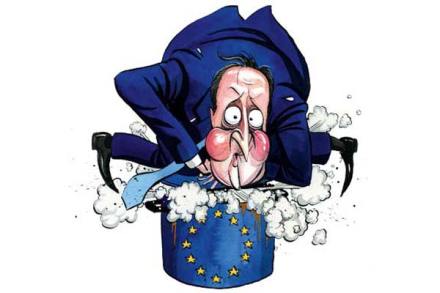
Last week at PMQs, Ed Miliband had great fun, mocking the wait for David Cameron’s Europe speech. He lampooned the Prime Minister as the weak leader of a divided party. It was a performance that disturbed even some normally calm Number 10 aides. But this week, it was Cameron who was relishing PMQs. By the end of the session, he was even telling Dennis Skinner — who normally brings out the Prime Minister’s irritable side — that he might agree with the speech Cameron is  giving in Davos tomorrow. Now that Cameron has set out his position, Miliband is under pressure to follow suit. Miliband appeared to rule out a referendum, responding to Cameron’s taunts with the line ‘No, I don’t want an In/Out referendum.

Cameron’s EU referendum pledge makes winning the Battle for Britain more difficult

From our UK edition

At the risk of seeming parochial, I'd suggest that David Cameron's long-awaited Europe speech and his endorsement of an In or Out referendum has implications and consequences for another referendum campaign closer to home. I suspect he has bought himself some time on the Europe question but this comes at a price. He has made winning the Battle for Britain - to be decided in 2014 - more difficult. The SNP should be very pleased today. Cameron has demolished a couple of core Unionist arguments. He can no longer credibly point to the unknown uncertainties of Scottish independence. Not when he has embraced, even made a point of celebrating, uncertainty regarding Britain's membership of the EU.

Cameron doesn’t want Britain to stay in the EU come what may

From our UK edition

One of the more intriguing lines in David Cameron’s speech this morning was his declaration that ‘when the referendum comes let me say now that if we can negotiate such an arrangement, I will campaign for it with all my heart and soul.’ This begs the question of what Cameron will do if we can’t negotiate such an arrangement. Now, Cameron made clear earlier in the speech that his strong preference and inclination is for Britain to stay in the EU. This seems to apply even if he can’t get everything he asks for in the renegotiation. As he put it: ‘You will not always get what you want. But that does not mean we should leave – not if the benefits of staying and working together are greater.

Sketch: Cameron’s EU climax

From our UK edition

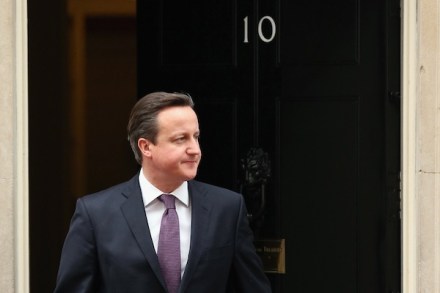
This was no tantric anti-climax. This was a seismic moment in British politics. David Cameron breezed into a London press conference this morning and proceeded to reshape Europe. The wooden lectern he stood at was pale and municipal. He wore a dark suit and a nice purple tie, and his affable pink chops glowed with moderation and good sense. He looked like a council negotiator arriving to settle a hedge dispute between warring neighbours. The Euro-crisis will lead to the restructuring of Europe, he said. He called for a new design that would incorporate more openness, flexibility and competitiveness. And the single market, not the single currency, should lie at its heart.

David Cameron puts Nick Clegg on the spot

From our UK edition

Downing Street always hoped that once David Cameron had given his Europe speech, the pressure would shift on to the other party leaders. They believed that once Cameron had committed himself to a referendum, Ed Miliband and Nick Clegg would be required to say whether or not they’ll match this pledge. But Cameron has put particular pressure on the Deputy Prime Minister by making clear that renegotiation and a referendum will happen if he is Prime Minister after the next election. In other words, this is not up for debate in any 2015 coalition negotiation. Every interviewer can now ask Nick Clegg if he and the Liberal Democrats could be part of a government that was committed to renegotiating Britain’s terms of EU membership and then putting the result to a referendum.

Cameron’s red meat EU speech: five key points

From our UK edition

Cameron has finished delivering his 'red meat' speech on the European Union and answering questions from journalists. You can read the full text here, but here are five key points to take away: 1. The Prime Minister is a pro-European sceptical about the current EU settlement It actually took Cameron a long time to reach his vision of a new Europe because he was so busy praising its history. We had a whistle-stop tour through the EU's creation, dotted with praise for its peacekeeping mission first. He was clearly keen to emphasis his pro-European credentials as much as he was to criticise, saying: 'I am not a British isolationist' and 'I speak as a British Prime Minister with a positive vision for the future of the European Union'.

David Cameron’s EU speech: full text

From our UK edition

This morning I want to talk about the future of Europe. But first, let us remember the past. Seventy years ago, Europe was being torn apart by its second catastrophic conflict in a generation. A war which saw the streets of European cities strewn with rubble. The skies of London lit by flames night after night. And millions dead across the world in the battle for peace and liberty. As we remember their sacrifice, so we should also remember how the shift in Europe from war to sustained peace came about. It did not happen like a change in the weather. It happened because of determined work over generations. A commitment to friendship and a resolve never to re-visit that dark past - a commitment epitomised by the Elysee Treaty signed 50 years ago this week.

David Cameron’s EU speech: the Coffee House guide

From our UK edition

Downing Street has tonight released the following extracts from David Cameron's speech on the European Union, which he will deliver tomorrow at 8am. Here's your guide to what we know so far: 1. An unwilling EU could sleepwalk Britain out of the union 'I speak as British Prime Minister with a positive vision for the future of the European Union. A future in which Britain wants, and should want, to play a committed and active part. 'If we don’t address these challenges, the danger is that Europe will fail and the British people will drift towards the exit. 'I do not want that to happen. I want the European Union to be a success. And I want a relationship between Britain and the EU that keeps us in it. 'That is why I am here today. To acknowledge the nature of the challenges we face.

Schools can teach good character and the 3 Rs

From our UK edition

Education debates are riddled with false choices, as Michael Barber notes in his recently published essay Oceans of Innovation. It's academic or vocational; it’s best practice or innovation; it’s the three Rs or character development. These are the choices, we are told, that must be made. It plays well for those in pursuit of the politics of dividing lines but it is detrimental in policy terms. I want to see rigorous academic and vocational routes for young people in 14- 19 education. That is why Labour will bring forward a Technical Baccalaureate, with a strong focus on technical education and with Maths and English to 18 for all. If we are to succeed as a nation, we need to equip young people with the skills, knowledge and resilience for the jobs of the future.

Tim Loughton vs the Department for Education, round 2

From our UK edition

The battle between Tim Loughton and the Education department rumbles on, with new foot soldiers joining the fray. The latest shot fired in the war comes from Labour's Stephen Twigg, who has demanded an investigation into the quotes we ran on Coffee House last week from a senior DfE source which described the former minister as a 'lazy incompetent narcissist obsessed only with self-promotion'. Twigg has written to the department's Permanent Secretary Chris Wormald, saying the following: 'You will be aware that both special advisers and civil servants are bound by a code of conduct, which precludes them from making personal attacks.

Cabinet agrees ‘difficult decisions’ due for 2015/16 spending review

From our UK edition

Ministers aren't just getting ready for March's Budget: they're also trying to work out a 'budget setting process' for 2015/16. The content of that slimmed-down departmental spending review formed the discussion at today's Cabinet meeting, with George Osborne and Danny Alexander leading. It's not clear when this spending review will be announced, other than that it will take place in the first half of 2013. But the discussion centred around that old chestnut, the 'difficult decisions'. The Prime Minister's official spokesman said: 'They set out that there was going to be a budget setting process for 15/16 in the first half of this year that the treasury will set out more on that process in due course.

Talk of a leadership challenge to David Cameron is reckless self-indulgence – Spectator Blogs

From our UK edition

For reasons I do not wholly understand, Labour partisans appear reasonably pleased with Ed Miliband. Liberal Democrats may not be especially gruntled with Nicholas Clegg but they do appear to appreciate that there's little point in changing leader now. Which brings us to the Conservative party. And there we discover madness aplenty. Again. For it seems as though more than 50 Tory MPs are sufficiently dissatisfied with David Cameron's leadership that they think a change of leader something worth considering before the next election. This, for all the reasons Robert Colvile suggests and many more he doesn't, would be folly. Madness. Lunacy. Proof that the party is unfit for office. Whatever his shortcomings there are only two things that really matter here: 1.

Restoring the 10p tax rate would be fair and simple

From our UK edition

MPs will today debate taxes and the living wage - in particular, my campaign to restore the 10p rate of income tax. For Conservatives, a 'starter' rate of 10p would help us to counter the Labour war-cry that the Coalition is only interested cutting taxes for millionaires. It would prove to the electorate, that this Government is on a moral mission to help the poor, by boosting the cash income of a worker on minimum wage by more than £250 a year. As Tim Montgomerie puts it: 'We must declare very loudly and clearly that tax cuts for the working poor will be our priority as the economy picks up.' As an economic reform, it would be hugely cheaper than raising the personal allowance to £12,500 and it would be symbolic of the Coalition’s mission to repair our economy.

The Succession to the Crown Bill is a constitutional can of worms

From our UK edition

Today, the Succession to the Crown Bill will receive its second reading in the House of Commons. If one had to think of one person who would welcome this plan to 'modernise' the Monarchy, it would have to be that arch-Blairite, Baroness Jay of Paddington. But she popped up yesterday in her capacity as chair of the Lords’ Constitution Committee, to warn of the potential 'unintended consequences' of the Bill and to decry the use of the emergency fast track procedure to rush it through. Surely some mistake? Actually, no. Baroness Jay arguably knows more than anybody about tinkering with the constitution, having made it her life’s work.

Labour opposes benefit cuts: for now, anyway

From our UK edition

Last night's debate on the bill capping benefit rises at 1 per cent was far more revelatory than it might first have appeared. It wasn't Labour's conclusion that the Tories were evil and the Lib Dems (those that turned up, at least: there were nine rebels, but a further 11 Lib Dem MPs were mysteriously absent) just as bad. But the most interesting revelation was the way the party handled this exchange: Charlie Elphicke: Is it therefore the right hon. Gentleman’s and the Opposition’s policy that uprating should be not by 1%, but by inflation? Is that a commitment? Stephen Timms: Uprating should indeed be in line with inflation, as it always was in the past. This was significant.

Tory MPs to press Theresa May on Bulgarian and Romanian migrants

From our UK edition

Tory backbenchers will raise concerns about the government's preparations for the lifting of controls on Bulgarian and Romanian migrants at a meeting with the Home Secretary in the next few weeks, I understand. Conservative MPs are becoming increasingly nervous about the situation, fearing that if handled poorly, it could have a particularly bad impact on the party's performance in the 2014 European elections, as the transitional controls end on 31 December 2013. One of those worried backbenchers is former ministerial aide Stewart Jackson, who tells me he is considering introducing a modified version of the 10-Minute Rule Bill that he brought before the House in October.

David Cameron redoubles his commitment to interventionism

From our UK edition

David Cameron’s Commons statement on Algeria just now was the most interventionist speech he has made since the one he delivered at the Foreign Policy Centre during his 2005 leadership bid. But this speech is far more important than that one because it is what he actually believes; the 2005 speech was written by Michael Gove and was given more to tick the leadership contest’s foreign policy box than anything else. Listening to Cameron today, it is clear that the events of recent days have led him to redouble his commitment to interventionism. Indeed, in his talk of the ‘generational challenge’ and the need to ‘beat them [the terrorists] militarily’ one could hear echoes of Blair and Bush post 9/11.

Boosting the private sector in Wales

From our UK edition

Wales, sadly is one of the poorest regions of the United Kingdom. GVA stands at 75 per cent that of the UK average. Just 1 in 16 people earn more than £35,000. There is an over reliance on the public sector, and we must boost growth in our private sector. Too often the approach seems to be to sit back and expect an outside investor to come in and provide our future success, but we need to harness the talent and the enterprise we have here already. Today, the Welsh Conservatives launched a new policy aimed at helping our striving small business owners to access finance – imperative for the growth, maintenance and success of any business – and in a way which is straightforward and local. Wales has an aspiring business community where 99.