Uk politics

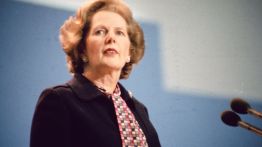
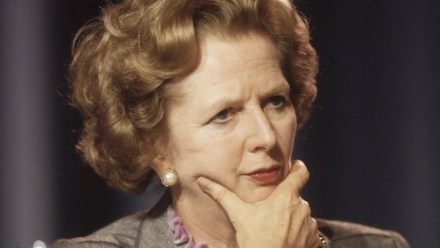
Margaret Thatcher in quotes

From our UK edition

"I don't think there will be a woman Prime Minister in my lifetime." - 1975 'To those waiting with bated breath for that favourite media catchphrase, the U-turn, I have only one thing to say. You turn if you want to. The lady's not for turning.' 'I always cheer up immensely if an attack is particularly wounding because I think, well, if they attack one personally, it means they have not a single political argument left.' 'If you want something said, ask a man. If you want something done, ask a woman.' 'I am extraordinarily patient, provided I get my own way in the end.' 'To cure the British disease with socialism was like trying to cure leukaemia with leeches.

Archive: Margaret Thatcher: clear choice for the Tories

From our UK edition

The Spectator was the only national publication to fully support Margaret Thatcher in the first ballot of the Tory leadership contest. Patrick Cosgrave explain why in this political column from 23 January 1975: If I start with a reference to the sorry condition of the Tory Party, I hope readers will not immediately turn to another page, on the grounds that this record has been played too often. For I want to add that, if only the Tories can take a fairly cool look at themselves, it will quickly be apparent that the condition is not as serious as all that; and that it is certainly capable of repair. Housman's ancient "three minutes of thought" will suffice to show that there is only one direction in which the Tories can go.

Tributes pour in for Margaret Thatcher

From our UK edition

Margaret Thatcher died this morning following a stroke.  Downing Street said this afternoon that the former Conservative Prime Minister's funeral will have the same status as the Queen Mother and Princess Diana, with full military honours, a service at St Paul's Cathedral, followed by a private cremation. She will not lie in state, in accordance with her wishes. The flag over No.10 is flying at half mast and  the tributes are flowing in. David Cameron's tribute is posted below. Here are some others:- Barack Obama: 'With the passing of Baroness Margaret Thatcher, the world has lost one of the great champions of freedom and liberty, and America has lost a true friend.

David Cameron makes the case for reform in Europe

From our UK edition

Germany has elections on the way, Spain is just about holding a lid on its economic crisis while keeping a wary eye on the uphill struggle that its neighbour Portugal faces to avoid a second bailout, and François Hollande has his own political crisis to deal with (and is apparently also mourning the death of a camel). So is now really the best time for David Cameron to pitch up in Madrid, Paris and Berlin to argue for reform of the European Union? The PM visits the first two cities today, with a meeting with Angela Merkel planned for later this week on the same topic.

Right to reply: Mayor Lutfur Rahman responds to Nick Cohen

From our UK edition

The below is a response from the Mayor of Tower Hamlets Lutfur Rahman, in response to a blog written by Nick Cohen. Nick Cohen has attacked me as a ‘bully’ for reporting to the police some threatening tweets by Rob Marchant, a blogger who used to work for the Labour Party. I make no apology to Cohen in respect of my response to such outbursts. Unsurprisingly, as a prominent Muslim figure, I frequently receive abuse and threats — mainly from racist extremists of the EDL-ilk.

Liam Byrne tries to answer Labour’s welfare question

From our UK edition

One can’t help but feel sorry for Liam Byrne. He is a fish out of water in Ed Miliband’s Labour party, something he implicitly acknowledged when he announced his intention to run for Mayor of Birmingham. But then Birmingham voted against having a mayor so he had to stay in the shadow Cabinet, albeit having lost control of Labour’s policy review. In The Observer today, Byrne floats the idea of increasing the contributory element in welfare. Now, Labour keep musing about this without setting out any details. I suspect this is because it’ll be very expensive if it simply leads to higher payments for those who’ve paid in over the years.

David Cameron and the Union

From our UK edition

Alex Massie asks why I didn’t mention the Union in my piece in this week’s magazine on what David Cameron’s legacy will be. It is a good question. Indeed, one former Cameron aide told me that he thought that the likely preservation of the Union would be Cameron’s greatest achievement. But the reason I didn’t mention it was because Cameron’s strategy on Scotland has been to keep a relatively low profile. He has, deliberately, not made it his fight. He realised that Alex Salmond wanted to present himself as the opposition to an English Tory Prime Minister who was, in Nationalist-speak, imposing his will on Scotland—and has simply refused to play that role.

Tories go on tax offensive

From our UK edition

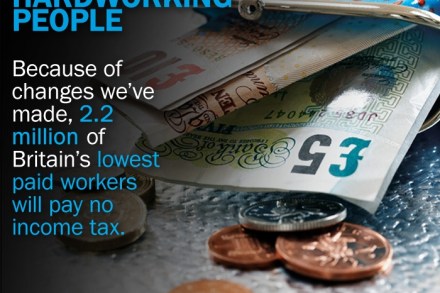
It's 45p day in Westminster, and Ed Balls is trying to make the most of the end of a 50p rate his own party only imposed for a month or so before it left government. The story hasn't made it to the front pages, aside from the Mirror getting cross about Nick Clegg going on holiday with millionaires in a ski resort, and the Tories are also out on the attack over other changes which affect many more taxpayers than that totemic top tax rate. They've produced this series of posters reminding voters of the good tax bits of the Budget. This is important: one of the biggest gripes of even loyal Tory backbenchers and ministers is that the government is achieving radical reforms, but isn't all that good at selling them.

The Philpott case is horrific; so is the attempt to hijack it for any political purpose

From our UK edition

The sorry truth of the Philpott case is that almost nothing can be learnt from it. Everything would be so much simpler if there were clear public policy conclusions that could be drawn from the horrors of this case. But there are not. How could there be if we're expected to mine a case like this for meaning? It is almost always a mistake to draw firm conclusions from extreme examples of any given phenomenon. The perils of the small sample size should be well enough understood by now to make this clear. It is even dafter to presume too much on the back of a monstrous case such as this. A recap: Mick Philpott had spawned no fewer than 17 children by at least five different women. He did not work. Instead his family relied upon the safety net.

David Cameron’s Legacy? Preserving the Union or presiding over the Break-Up of Britain

From our UK edition

Politics is at least partially a matter of perspective. The same object can look very different depending upon the angle from which it is viewed. Which brings me to Brother Forsyth's latest column. I bow to no-one in my admiration for James's reporting and astute analysis. Nor do I dispute much of what he says in his analysis of David Cameron's legacy. No, what's interesting is what isn't there. The Union. I know. Scots go on and on and on about this stuff. It is true that the Caledonian gene is strong on self-absorption.

Welfare Reform is this government’s most difficult but most popular policy.

From our UK edition

I always enjoy Peter Oborne's columns not least because his opinions are as entertaining, predictably unpredictable, quixotic and changeable as his cricket captaincy. This is not a bad thing. This week he's back in full-on Cameron as Disraeli mode, arguing that the coalition's reforms of education (in England, though sadly the Peter and the Telegraph refer to "Britain's schools") and welfare (across the UK) are so important that success here dwarfs any failure anywhere else. I think he may be right. Coincidentally, I've an article in today's Scotsman that, though chiefly concerned with Iain Duncan Smith and welfare reform, makes passing reference to Gove too.

Key David Cameron aide to quit Downing Street

From our UK edition

Sky News has revealed tonight that Rohan Silva, one of the Prime Minister’s key advisers, is leaving Downing Street. Silva might not be a household name but he has been a hugely influential figure there these past few years. In opposition, he worked for George Osborne before moving to work for David Cameron in government. He has been the driving force behind spending transparency, Tech City and crime maps. There have been few more pro-enterprise and pro-reform voices in this government. His departure is a big blow to Tory radicalism. One of the things that marked Silva out was a thirst for new ideas that is all too rare in British politics.

Independent Scotland: neoliberal nirvana or Scandinavian paradise?

From our UK edition

So, an independent Scotland. Neoliberal nirvana or Scandinavian paradise? True, these are not the only choices available but as a useful shorthand for the size of the state and its optimal take of national revenues it will do for the time being. That is, should taxes rise, fall or remain much as they are at present? What external pressures will hamper Edinburgh's ability to set its own course, free as the wind? And, for that matter, whose dreams are most likely to be confounded and whose worst fears most liable to be misplaced? That was the subject of an article I wrote for the Scotsman at the weekend. The gist of it: The battle for independence has entered a new phase.

Over 100 Tory MPs demand EU referendum bill: exclusive details

From our UK edition

Tory backbenchers have written again to the Prime Minister demanding legislation guaranteeing a referendum in the next Parliament. Conservative MP John Baron delivered the letter, which bears more than 100 backbench signatures, to Downing Street this morning. While its existence was reported in the Sunday papers, Baron has now spoken exclusively to Coffee House about the letter's contents. I understand that though Baron and his colleagues working on the plan approached only backbenchers (and those include former ministers who left the government in September's reshuffle), a number of ministers and PPSs have also approached them to express sympathy with the idea, and there are several individual letters from PPSs going to David Cameron as well.

Is Boris really ready to lead the Tory party?

From our UK edition

Boris needs to pay attention. As James Allen said, 'Circumstances do not make the man, they reveal him.' Given his colourful character, discussion so far about Boris’s leadership potential has focused on the man himself; but politics is about being in the right place at the right time, as Churchill would attest. Unprecedented levels of national debt, a stagnant economy, a healthcare system that isn’t delivering, a Eurozone that may yet collapse into meltdown, a chronic housing shortage, endemic low productivity and a state that has stretched its tentacles into so many areas of people’s lives it is proving extremely difficult to disentangle – these are just a taste of some of the challenges Britain is facing and it’s not clear how Boris would handle them.

Trenton Oldfield: why I disrupted the Boat Race, and what it achieved

From our UK edition

Trenton Oldfield has written in this week's Spectator that he won't be attending today's Boat Race but just in case, we learn today that Royal Marine Commandoes will be patrolling the Thames with thermal imaging equipment to look out for copycat stunt artists. Whatever it cost to imprison Oldfield will be as nothing compared to the cost of discouraging his epigones - real, or imagined. Having made such an impact, what does Oldfield think now? In this week's View from 22 podcast, he has what we can fairly call a sparky debate with Douglas Murray, a contributing editor for the Spectator. It's not for the faint-hearted.

George Osborne won’t be moved

From our UK edition

Today’s Sunday Telegraph front page has sparked off a flutter of speculation about whether George Osborne might be moved as Chancellor. I suspect that the short answer to this question is no. Osborne and Cameron are inextricably linked and to move him would be akin to the Prime Minister declaring that both his political and economic strategies have been wrong. He would not long survive such an admission. I also sense that Osborne’s stock in the parliamentary party is recovering from the battering it took with last year’s Budget. The fact that this year’s Budget was doorstep-ready, has survived the Labour and media onslaught and gone down relatively well with the voters has helped him with MPs.

What Tory MPs want and what the Tory party needs

From our UK edition

Matthew Parris’s column in The Times today is a good counter-blast to the idea that all Tory backbenchers are craving more policies that are bolder. As Parris points out, many of those defending seats against Laboour don’t want that. Indeed, if you had left it to these MPs I very much doubt that the government would have cut the 50p tax rate. He is also right that the desire to remove David Cameron—as opposed to grumble about him—is extremely limited. It is, though, as one senior MP pointed out to me earlier, worth noting that most Tory members of the Cabinet are in extremely safe seats. It is hard to imagine Witney going Labour, while Neil Hamilton had to be caught up in cash for questions before Tatton left the Tory fold.

Eric Hobsbawm: a life-long apologist for the Soviet Union

From our UK edition

In last week's Spectator, Sam Leith reviewed Eric Hobsawm's Fractured Times. Our ex-political editor and drink critic Bruce Anderson thinks Leith has missed a basic point about Hobsbawm's career. Here is Anderson's riposte in full: In his review of Eric Hobsbawm's 'Fractured Times' (Spectator, 23 March). Sam Leith misses the basic point: the basic treason. Throughout his career, Professor Hobsbawm was an apologist for the Soviet Union. This was forgivable in the 1930s, During that desperate decade, many thoughtful people despaired of liberal democracy and believed that they had found solace in Moscow. But after 1945, as the evidence mounted, Eric the Red kept the faith.