Uk politics

An alternative reaction to Margaret Thatcher’s death

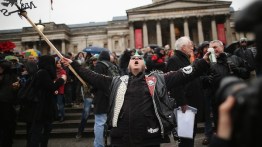
On my way home last night, I dropped by Windrush Square in Brixton to observe an alternative reaction to Baroness Thatcher’s death. It was easy to find the party simply by following the cacophony. Around 200 people turned out to engage in a cold evening of drinking, dancing and heckling. Three competing sound systems blasted music against occasional shouts of ‘Maggie Maggie Maggie, dead dead dead’. Was the crowd attempting to make a serious point or was it just an excuse for a drunken party? These pictures should give you an impression of the impromptu event: Ironically from what I could see, many in the crowd appeared rather too young to remember Thatcher: some

Tory Thatcher tributes will mark the next stage in battle for party’s soul

MPs will pay tribute to Margaret Thatcher in the Commons tomorrow. One set of speeches worth listening to with some care will be those from the 2010 intake of Conservative MPs, raised during the Thatcher years, and often considered the group most enthusiastic about keeping her flame alive in the party. It is also likely that from this group will emerge the next Conservative leader. They are a confident bunch, bursting with ideas, books and essays about how to reinvigorate Conservatism. Paying tribute to the former Prime Minister will also be an opportunity for some of them to pay tribute to her policies, and perhaps her conviction in driving through

David Cameron places himself in Margaret Thatcher’s tradition

‘For many of us, she was, and is, an inspiration’, David Cameron said of Margaret Thatcher in his tribute to her. It was him, firmly — and proudly — placing himself in her tradition. Cameron has moved in Thatcher’s political direction as leader. He has become —partly, through circumstance and necessity — less interested in being a unifying figure, and more interested in getting things done. There has, in recent years, been an end to any attempts to distance the party from her legacy. Thatcher’s life-story is a truly remarkable one. Cameron rightly dwelled on the sexism she had to take on to become Tory leader. But she also had

David Cameron’s tribute to Margaret Thatcher: full text

Today we lost a great leader, a great Prime Minister and a great Briton. Margaret Thatcher didn’t just lead our country – she saved our country. And we should never forget that the odds were stacked against her. She was the shopkeeper’s daughter from Grantham who made it to the highest office in the land. There were people who said she couldn’t make it; who stood in her way; who said a woman couldn’t lead. She defied them all. She fought her way to a seat in Parliament…to the leadership of her Party…and then to lead our country…winning the backing of the British people three times in a row. She will be remembered for

Spineless Spice Girl deletes Thatcher tribute after Twitter abuse

The political tributes and barbs cast after the news of Margaret Thatcher’s death have been covered on Coffee House today, but what of the world’s other great egos: those in showbiz? Steerpike was impressed by Meryl Streep, who having played Thatcher in the controversial 2011 biographical film ‘The Iron Lady’, is slightly better placed than her Hollywood comrades to pass comment. Streep told the Washington Post: ‘to me she was a figure of awe for her personal strength and grit,’ and while she acknowledged Thatcher’s detractors, the actress has some rather sound opinions: ‘Her steadfast, almost emotional loyalty to the pound sterling has helped the UK weather the storms of European

Margaret Thatcher: How the Left responded to her death

In 1983, a Spectator piece argued that ‘the most faithful followers of the Thatcher cult are to be found within the Labour Party’. Baroness Thatcher’s passing was always going to be as much of a test for the Left as it would be a sad day for the Right. The Labour leadership knew this, and took care to craft statements and tweets which, while acknowledging the glaringly obvious political differences, praised Thatcher the woman. The party has suspended its political campaigning ahead of the local elections as a mark of respect. Ed Miliband’s tribute in particular made clear that he had no sympathy with those in his party tempted to

Lutfur Rahman: Not a ‘bully’, just ‘sly’ and ‘unappetising’

For the record, I did not accuse Rahman of being a ‘bully,’ as he tells Spectator readers. I accused the Mayor of Tower Hamlets of being ‘sly’ and ‘unappetising’. His letter to the Spectator bears me out, I think. As does his ludicrous allegation that Rob Marchant and other Labour Party activists were threatening to murder him. In an insinuating passage, he links Marchant – a principled man, and anti-racist – to the English Defence League. Look at how he does it: ‘Unsurprisingly, as a prominent Muslim figure, I frequently receive abuse and threats – mainly from racist extremists of the EDL-ilk. That and the sheer violence of Marchant’s language

‘An -ism has been named after her’: Charles Moore on Baroness Thatcher

Margaret Thatcher was always the candidate from the outside, both because of her background and because of her sex, and so it was an extraordinary event in the middle of the 1970s that what was considered the stuffiest of the political parties chose her and once that had happened, of course it was transformative. It was transformative, not only for the Conservative party but much more importantly for the country. Her approach to industrial relations was very controversial. The model that the Tories tended to have at that time was that you had to have some sort of compact with the union leaders in order to hold wages down and

Margaret Thatcher in quotes

“I don’t think there will be a woman Prime Minister in my lifetime.” – 1975 ‘To those waiting with bated breath for that favourite media catchphrase, the U-turn, I have only one thing to say. You turn if you want to. The lady’s not for turning.’ ‘I always cheer up immensely if an attack is particularly wounding because I think, well, if they attack one personally, it means they have not a single political argument left.’ ‘If you want something said, ask a man. If you want something done, ask a woman.’ ‘I am extraordinarily patient, provided I get my own way in the end.’ ‘To cure the British disease

How Margaret Thatcher transformed politics and this country

Margaret Thatcher is the most significant British political figure of the past 50 years. In her time in office, she transformed the British economy, promoted the vigorous virtues and offered strength and support to the dissidents of Eastern Europe and. On top of all this, she was — of course — Britain’s first female Prime Minister. In future, people will find it hard to believe just how nationalised Britain’s economy was before the Thatcher revolution. As she said in her 1982 conference speech, ‘How absurd it will seem in a few years’ time that the State ran Pickford’s removals and Gleneagles Hotel.’ With the benefit of hindsight, it is easy

Archive: Margaret Thatcher: clear choice for the Tories

The Spectator was the only national publication to fully support Margaret Thatcher in the first ballot of the Tory leadership contest. Patrick Cosgrave explain why in this political column from 23 January 1975: If I start with a reference to the sorry condition of the Tory Party, I hope readers will not immediately turn to another page, on the grounds that this record has been played too often. For I want to add that, if only the Tories can take a fairly cool look at themselves, it will quickly be apparent that the condition is not as serious as all that; and that it is certainly capable of repair. Housman’s ancient

Tributes pour in for Margaret Thatcher

Margaret Thatcher died this morning following a stroke.  Downing Street said this afternoon that the former Conservative Prime Minister’s funeral will have the same status as the Queen Mother and Princess Diana, with full military honours, a service at St Paul’s Cathedral, followed by a private cremation. She will not lie in state, in accordance with her wishes. The flag over No.10 is flying at half mast and  the tributes are flowing in. David Cameron’s tribute is posted below. Here are some others:- Barack Obama: ‘With the passing of Baroness Margaret Thatcher, the world has lost one of the great champions of freedom and liberty, and America has lost a true

David Cameron makes the case for reform in Europe

Germany has elections on the way, Spain is just about holding a lid on its economic crisis while keeping a wary eye on the uphill struggle that its neighbour Portugal faces to avoid a second bailout, and François Hollande has his own political crisis to deal with (and is apparently also mourning the death of a camel). So is now really the best time for David Cameron to pitch up in Madrid, Paris and Berlin to argue for reform of the European Union? The PM visits the first two cities today, with a meeting with Angela Merkel planned for later this week on the same topic. He wants to make

Right to reply: Mayor Lutfur Rahman responds to Nick Cohen

The below is a response from the Mayor of Tower Hamlets Lutfur Rahman, in response to a blog written by Nick Cohen. Nick Cohen has attacked me as a ‘bully’ for reporting to the police some threatening tweets by Rob Marchant, a blogger who used to work for the Labour Party. I make no apology to Cohen in respect of my response to such outbursts. Unsurprisingly, as a prominent Muslim figure, I frequently receive abuse and threats — mainly from racist extremists of the EDL-ilk. That and the sheer violence of Marchant’s language in discussing me (‘I will load the revolver and we can all take turns … [makes mental note to keep revolver well

Liam Byrne tries to answer Labour’s welfare question

One can’t help but feel sorry for Liam Byrne. He is a fish out of water in Ed Miliband’s Labour party, something he implicitly acknowledged when he announced his intention to run for Mayor of Birmingham. But then Birmingham voted against having a mayor so he had to stay in the shadow Cabinet, albeit having lost control of Labour’s policy review. In The Observer today, Byrne floats the idea of increasing the contributory element in welfare. Now, Labour keep musing about this without setting out any details. I suspect this is because it’ll be very expensive if it simply leads to higher payments for those who’ve paid in over the

David Cameron and the Union

Alex Massie asks why I didn’t mention the Union in my piece in this week’s magazine on what David Cameron’s legacy will be. It is a good question. Indeed, one former Cameron aide told me that he thought that the likely preservation of the Union would be Cameron’s greatest achievement. But the reason I didn’t mention it was because Cameron’s strategy on Scotland has been to keep a relatively low profile. He has, deliberately, not made it his fight. He realised that Alex Salmond wanted to present himself as the opposition to an English Tory Prime Minister who was, in Nationalist-speak, imposing his will on Scotland—and has simply refused to

Tories go on tax offensive

It’s 45p day in Westminster, and Ed Balls is trying to make the most of the end of a 50p rate his own party only imposed for a month or so before it left government. The story hasn’t made it to the front pages, aside from the Mirror getting cross about Nick Clegg going on holiday with millionaires in a ski resort, and the Tories are also out on the attack over other changes which affect many more taxpayers than that totemic top tax rate. They’ve produced this series of posters reminding voters of the good tax bits of the Budget. This is important: one of the biggest gripes of

The Philpott case is horrific; so is the attempt to hijack it for any political purpose

The sorry truth of the Philpott case is that almost nothing can be learnt from it. Everything would be so much simpler if there were clear public policy conclusions that could be drawn from the horrors of this case. But there are not. How could there be if we’re expected to mine a case like this for meaning? It is almost always a mistake to draw firm conclusions from extreme examples of any given phenomenon. The perils of the small sample size should be well enough understood by now to make this clear. It is even dafter to presume too much on the back of a monstrous case such as