Uk politics

Warsi resignation: David Cameron replies

From our UK edition

[audioplayer src="http://traffic.libsyn.com/spectator/TheViewFrom22_07_August_2014_v4.mp3" title="Douglas Murray and Tim Stanley discuss Baroness Warsi's resignation" startat=462] Listen [/audioplayer]Dear Sayeeda, Thank you for your letter today, in which you set out your reasons for resigning from the Government. I was sorry to receive this. I realise that this must not have been an easy decision for you to make and very much regret that we were not able to speak about your decision beforehand. I understand your strength of feeling on the current crisis in the Middle East – the situation in Gaza is intolerable.

Baroness Warsi’s resignation letter: the key points

From our UK edition

[audioplayer src="http://traffic.libsyn.com/spectator/TheViewFrom22_07_August_2014_v4.mp3" title="Douglas Murray and Tim Stanley discuss Baroness Warsi's resignation" startat=462] Listen [/audioplayer]Now that Baroness Warsi has revealed her letter to the Prime Minister in which she resigns over Gaza, here are the key criticisms that she levels at the government. They are notably not just about Operation Protective Edge and the British government's response to it. She doesn't resign until the penultimate paragraph, after a long letter that is clearly designed to cause maximum damage. 1. British policy in the Middle East generally is 'morally indefensible'.

The argument about Britain in Europe is just the same as the argument about Scotland in Britain

From our UK edition

I know some readers have tired of Scotland's independence debate. That is understandable, even forgivable. It has, after all, been rumbling along for 40 years. There may only be six weeks of campaigning left but these arguments won't go away. You'll be hearing them again and again for the next few years at least. This is true even if Scotland does vote Yes next month. Because the argument about Scotland's place within the Union is really not very different from the argument about Britain's place within the European Union. Of course the similarities are not absolute but they are significant enough to be striking.

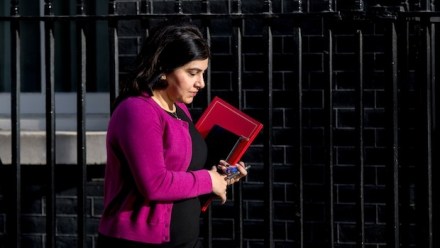
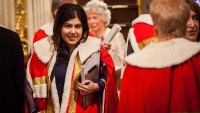
Baroness Warsi resigns

From our UK edition

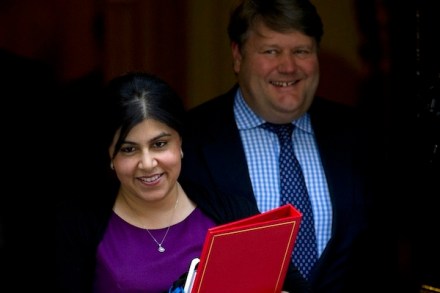
[audioplayer src="http://traffic.libsyn.com/spectator/TheViewFrom22_07_August_2014_v4.mp3" title="Douglas Murray and Tim Stanley discuss Baroness Warsi's resignation" startat=462] Listen [/audioplayer]After disagreeing with the Prime Minister on a great deal for a great while, Baroness Warsi has this morning resigned from the government, citing its position on Gaza. She tweeted a few minutes ago: With deep regret I have this morning written to the Prime Minister & tendered my resignation. I can no longer support Govt policy on #Gaza — Sayeeda Warsi (@SayeedaWarsi) August 5, 2014 There had been a concerted campaign in the Conservative party from senior figures with a great deal of influence to get Warsi moved.

Osborne’s choice: important projects or welfare

From our UK edition

George Osborne can't quite help himself. Today he's continuing his Northern charm offensive, which has been impressively choreographed. He gave a speech back in June in which he said he wanted to create a 'Northern powerhouse', involving cities working together. Just a few weeks later, a group of councils in the North pops up with a plan to improve transport links across the region. Ta da! But the Chancellor couldn't quite resist, when he was asked about the merits of this plan on the Today programme, making another strategic, political move, and linking welfare spending to the debate about regenerating the North.

Two Sober Men Fight Over A Thistle

From our UK edition

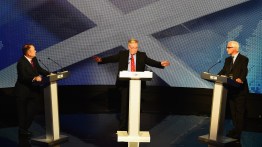
Never before have so many waited so keenly to hear Alistair Darling speak. Tonight's the night, however, and the fate of a nation hangs upon his words. Or so some folk would have us believe. Anyway: two hours of Alistair Darling, live on prime time television. We chosen people, we. In truth, Darling is still the Other Guy in tonight's debate with Alex Salmond just as the Better Together campaign has been the Other Lot for most of the independence referendum campaign. What he says and what they do matter; just not nearly as much as what Alex Salmond says and what the Yes campaign does. They are the fellows making the running; they are the crew with the point to prove and the people to convince.

Why the Miliband wreath row is unfair and unseemly

From our UK edition

So Ed Miliband is in trouble with some angry people over whether or not he took enough trouble over signing a remembrance wreath. Here is the offending wreath, on the right besides the Prime Minister's which bears a personal message. Messages on the wreaths laid by David Cameron and Ed Miliband. #WW1Centenary #c4news pic.twitter.com/gDNMxvc2tQ — Ciaran Jenkins (@C4Ciaran) August 4, 2014   Mark Ferguson at LabourList reports Labour sources saying they were just handed the wreath at the very last minute, and had no chance to add a personal message. Nick Clegg's wreath was similarly bland.

Is David Cameron still afraid of Brexit?

From our UK edition

Boris Johnson's speech this week is one of the few domestic issues really animating Westminster. He will argue that the UK should not be 'frightened' of leaving the EU, supposedly in contrast to David Cameron, who has always made clear that he wants to remain in the bloc. But it's worth remembering that Cameron himself has started to shift recently on how he'd vote in the 2017 referendum. When he returned to the Commons after losing his fight against Jean-Claude Juncker's bid to become President of the European Commission, Cameron changed his language on that vote.

Time is running out for Alex Salmond and the Nationalists

From our UK edition

Nicola Sturgeon, the SNP deputy leader, is busy claiming that post the Glasgow games the momentum will be with the Yes side in the referendum. But this claim is contradicted by the Survation poll in today’s Mail on Sunday which shows support for Yes marginally down on last month. The Yes campaign’s last best chance to gain the ‘big mo’ that it needs comes in Tuesday night’s debate between Alex Salmond and Alistair Darling. Alex has written about why he doesn’t think this debate will be a game changer, but with a million Scots expected to tune in, Salmond isn’t going to have a better opportunity to try and turn things round. But the dilemma for Salmond is how to approach this debate.

Balls tries to defuse the tax bombshell

From our UK edition

Ed Balls' interview with the Telegraph today is a demonstration of what he learnt working for Gordon Brown in opposition. He is at pains to deny that he is planning any major tax rises; he doesn’t want to give the Tories the chance to claim Labour are planning a ‘tax bombshell’. He stresses that he understands that ‘People feel they are paying too much tax already’ and emphasises that he ‘would rather all tax rates were lower’. He also explicitly rules out a National Insurance increase to pay for extra spending on the NHS and a so-called ‘death tax’. Interestingly, Balls also restates his desire to limit EU immigration. He says he wants ‘fair movement not free movement’ of workers.

Podcast: The lure of the crowd, anti-Semitism and Cameron’s uncertain future

From our UK edition

Hell, as one of Jean-Paul Sartre’s characters said, is other people. Unless, that is, you happen to be British and born after about 1980, in which case hell is the opposite: being alone for more than about five minutes. In this week’s View from 22 podcast, Ross Clark looks at the rise of crowd culture. We have succumbed to the lure of the crowd, he says. Lara Prendergast suggests social media is to blame. In this week’s Spectator, Melanie Phillips argues that anti-Israel protests over the Gaza war have convulsed Europe in the worst scenes of open Jew-hatred since the 1930s. The silence from the political class in the face of this is appalling.

Tunes of Numpties: Scottish novelists on independence

From our UK edition

There are many ways to commission fat-headed political analysis but, in my experience, by far the easiest is to ask a novelist his (or her) opinion on the great issues of the day. Better still, ask several. That way you can be sure you'll get something even the student version of the Socialist Worker might think twice before publishing. There are, of course, exceptions. Some of them quite close to home, in my view. Nevertheless (as Miss Spark so often said) the general rule applies: asking writers for their views on politics is no more useful or sensible than asking gravediggers or sheep shearers their opinion. It may be interesting; it is not likely to be valuable. Or, to put it more kindly, expertise in writing fiction does not necessarily translate into expertise in analysing politics.

Who cares whether English commentators like or respect Scotland?

From our UK edition

Because the Commonwealth Games are a thing and because newspapers need to fill their pages every day it is natural, even unavoidable, that they have in recent days been stuffed with pundits pontificating on the political significance of the games. Being a mere and humble freelance hack I wrote one such piece for the Daily Mail earlier this week even though I also stand by my suspicion that the political implications of these games are much too easily and keenly exaggerated. But that does not mean all such commentary is worthless or lacking interest. Here, for instance, is Lesley Riddoch writing in today's edition of the Scotsman: [A] subtle and powerful political point has been made with every waking moment of these Games.

David Ruffley to stand down as an MP

From our UK edition

David Ruffley has announced that he is standing down as an MP at the next election. Ruffley’s decision follows the story about him being cautioned by the police following a domestic incident with his partner going from being a local story to a national one, driven in large part by the indefatigable Guido Fawkes. Ruffley’s decision to resign has spared the Conservatives what would have been a difficult decision. On the one hand, there was the issue of domestic violence and its total unacceptability. On the other, there was the duty of care that the party owed an MP who has had some difficulties in the past few years. But the new chief whip Michael Gove has handled the issue adroitly and come up with the best possible solution to a very difficult problem.

Ed Miliband tries to turn his vices into virtues

From our UK edition

Ed Miliband’s admirers are hailing his speech on Friday as an attempt to change how we think about leadership. It might have been that, but it was also a very political attempt to deal with the ‘Ed problem’, the fact that he trails David Cameron in the leadership stakes by a potentially fatal margin.   There is huge frustration in Miliband’s circle that, as one puts it, voters say that they don’t like spin and then say they won’t vote for Ed as he’s bad at it. But for all Miliband’s decrying of modern politics emphasis on presentation, he has—at times—tried to play the image game just as hard as any other politician.

A full separation of powers could reinvigorate parliament

From our UK edition

Last summer, parliament was recalled after President Assad’s forces used chemical weapons in Syria. David Cameron wanted the Commons to support air strikes against the Syrian regime in response. But the Commons refused, defeating the government motion. Whatever you thought of the decision, it was a bold move by MPs. They had demonstrated that even on matters of war and peace, the traditional preserves of the executive, they were prepared to stand athwart the Prime Minister. The decision changed Western foreign policy, but not perceptions of parliament. Almost a year on, the public are still cynical about the institution and MPs remain deeply unsure of the worth of what they are doing.

Our spies have stopped chasing subversives. That’s why we’re in so much trouble

From our UK edition

Peter Clarke’s powerful report on the Trojan Horse affair in Birmingham schools is confirmation of the weakness of David Cameron in demoting Michael Gove. When Mr Gove appointed Mr Clarke to conduct the inquiry, there was execration — even from the local police chief — about how wickedly provocative it was to put a policeman with counter-terrorism experience into the role. But Mr Clarke was just the man and his inquiry has swiftly and efficiently uncovered serious problems of Islamist bullying and infiltration. Too late to reap a political reward, Mr Gove is vindicated. The next time this problem arises — and there undoubtedly will be a next time in another British city — what minister will have the courage to do what he did?

Parliament’s next crisis: a dangerous shortage of middle-aged men

From our UK edition

[audioplayer src="http://traffic.libsyn.com/spectator/TheViewFrom22_24_July_2014_v4.mp3" title="James Forsyth and Paul Goodman discuss why so many MPs are leaving the Commons" startat=873] Listen [/audioplayer]The House of Commons is off for the summer. But few MPs and ministers expect to make it through to September without the House being recalled because of the grim international situation. This has been the worst year for the West in foreign policy terms since 1979.

The Ukip shuffle: Can the party become more than a one man band?

From our UK edition

Nigel Farage has started his long awaited reshuffle of the Ukip top team tonight. Patrick O’Flynn, the former Daily Express journalist, becomes the party’s economics spokesman. Given O’Flynn’s writings, we can be pretty sure that he’ll make taking the middle class out of the 40p tax band one of Ukip’s defining policies. Steven Woolfe becomes migration spokesman. His tweets tonight indicate that his main emphasis will be how EU membership skews Britain’s immigration policy in favour of low skilled EU citizens and against high skilled people from the rest of the world. There’s no word yet on the other front bench roles. There’ll be particular interest in what role Diane James, the personification of the new more professional Ukip, gets.