Uk politics

Team Boris are catching ‘interesting fish’

From our UK edition

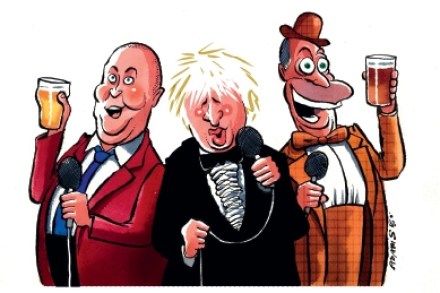
Who are the latest contenders in the Tory leadership battle and how much support do they have? That’s the question that Tory MPs and pundits love to chew over, even though there is no contest. The latest fixation is whether George Osborne has rowed behind the Boris campaign. James looked at this yesterday, revealing that Boris might quite fancy taking over from David Cameron after an EU referendum in 2017. Of course, the funny thing is that there isn’t a leadership contest because David Cameron is currently secure as Prime Minister.

Green Party up to 11 per cent in latest Ashcroft poll

From our UK edition

After overtaking Ukip in membership stakes, the Greens are now snapping at its heels in the polls. According to Lord Ashcroft's latest poll, 11 per cent are now intending to vote Green — up from eight per cent last week. As the chart above shows, this puts them four points behind Ukip. The party has come a long way since the last election, where they gained just 0.9 per cent of the vote. As Natalie Bennett acknowledged this morning, the Green Party is getting more help from David Cameron than it ever imagined. The natural assumption is that the Green vote is primarily coming from Labour — but its vote has remained steady from last week's poll. The Tories' lead, six points ahead of Labour last week, appears to have been an outlier.

Archbishop John Sentamu is wrong about free schools on every count

From our UK edition

John Sentamu, the Archbishop of York, has never been shy about courting publicity. He frequently churns out controversial opinion pieces for the red-tops and, just in case they don’t receive enough attention, he’s in the habit of re-issuing them as 'press releases'. (You can see a list of the most recent here). He has opinions on almost everything, from same-sex marriage (against) to William and Kate’s decision to live together before their wedding (in favour). But with his latest outburst about free schools, the tabloid bishop has jumped the shark. Free schools, according to Sentamu, only benefit the well-off and divert millions of pounds from more deserving neighbouring state schools.

Watch: Green leader Natalie Bennett backs Cameron on TV debates

From our UK edition

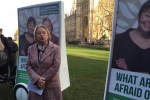
What are you afraid of boys? The Green Party posed this question on Westminster's College Green this morning as they launched a new poster campaign (driven around on pedal bikes, natch) calling for the Greens to be involved in the TV leaders debates. Leader Natalie Bennett also announced that the party's membership is up to 44,175 today — 52,000 including Scotland. I asked Bennett how she feels about being used by the Prime Minister for his own political gains. She doesn’t seem to mind too much: ‘Mr Cameron is certainly speaking for his own political advantage – but he’s only able to do that because it’s a fair and responsible thing to say.

Parties stick in comfort zones for another Monday of campaigning

From our UK edition

It’s another election Monday and the three parties are still hanging about in their comfort zones, even though they appear to have moved on to other topics. David Cameron is talking about the economy, but with a softer, nicer-sounding edge that has riled some on the Left because it involves him talking about full employment, which is something Beveridge was a fan of, and pay rises, which is something Labour says it wants more (while backing the public sector pay freeze).The Prime Minister will give a speech promising to expand the start-up loans to help 50,000 more entrepreneurs set up business using a £300 million pot. The Prime Minister wants to paint his party as ‘the party of small businesses.

Why is Nick Clegg so happy?

From our UK edition

Nick Clegg always seems oddly upbeat when he’s doing interviews about just how badly his party could do in the General Election. Today when Andrew Marr asked him about Iain Dale’s prediction the Lib Dems will lose at least half their seats, Clegg said ‘I really don’t think thats going to happen’ and that ‘we will do so much better than the pundits are predicting’. The Lib Dems currently have 56 seats (the 57th, Mike Hancock, had the whip withdrawn last year), and this election forecast suggests they’ll end up with 27. The sense in the party is that this will be just about OK, but go much lower than 25 and Clegg’s in real trouble.

The coalition government is not blame for the latest NHS ‘crisis’

From our UK edition

Of all the accusations thrust at the Conservatives by Labour over the NHS in recent weeks, their weakest has been the attempt to blame the Government’s reforms to the NHS for the pressures it is facing. Some will recall that we have been here before. In winter 2010, waiting times lengthened as the NHS was shaken by a serious flu outbreak. On that occasion, a shortage of critical care beds in the [pre-reform] NHS inherited from Labour meant that huge numbers of operations had to be cancelled. Though the problem was rapidly rectified, that did not stop Labour calling out a ‘crisis’ on the NHS, and blaming the reforms even before they had started.

Why Boris and the Tory leadership are playing nicely

From our UK edition

For most of this parliament, Downing Street has been thoroughly paranoid about Boris Johnson and his intentions. Any attempt by the Mayor to reach out to Tory MPs was met with deep suspicion. But now, the Tory leadership is actively pushing Boris to see Tory MPs — he was even invited to join the Whips for a Whips Supper at Boisdale last week. This is all evidence of the unspoken deal between Boris and the Tory leadership. He will be loyal and campaign hard for Cameron. In exchange, it will allow him to cultivate Tory MPs; helping him to rectify his biggest weakness ahead of any Tory leadership contest. These arrangements suit everyone involved.

Cameron and Obama: Friends4eva

From our UK edition

David Cameron and Barack Obama have just finished giving a rather cutesy and extremely verbose press conference following the reinvigorating of their bromance/serious talks on the economy and counter-terrorism. The pair structured their opening statements to mirror one another, with each opening with a little tribute to the other. Obama said Cameron was a ‘great friend’ and ‘one of my closest and trusted partners in the world, while Cameron said Obama was a ‘great friend to Britain and to me personally’. A good friend indeed: Obama is basically doing everything he can to help Cameron be re-elected in this country. One of the most useful quotes is the one from the President that the US and the UK economies are the ones that stand out in the world.

David Cameron’s transatlantic election campaigning

From our UK edition

This trip to Washington couldn't have gone much better for David Cameron. Not only has he had serious meaty talks with President Obama about the importance of tackling terrorism and cyberterrorism, but he also seems to have the President on side when it comes to Tory-sounding language about the need for a strong economy. But it's not just Obama who has been helping Cameron as he campaigns in the General Election from across the Atlantic. Christine Lagarde, whose organisation has not always been a friend to the Tories in the past few years, has given Cameron the best possible support he could hope for (as well as a slightly awkward photo in which the Prime Minister seems to be expounding passionately on an important topic while Lagarde is trying to not chuckle about something).

David Cameron has a very strange idea of freedom

From our UK edition

Last Sunday, David Cameron marched through Paris in solidarity, so it seemed, with those who stand up for free speech. Anyone who thought he meant it must now be crying out, ‘Je suis un right Charlie!’ Hardly had the march finished than the Prime Minister had rediscovered his other side: the one which reacts to terror by threatening yet more surveillance, more state control. He has promised to revive, in the Conservative manifesto, the ‘-snooper’s charter’ which would allow the state to retain indefinitely information about every email we ever send, every telephone call we ever make. Not only that. He added a further measure: he wants to ban all kinds of encrypted communications which the security forces struggle to decipher.

How can the Church keep earning its right to intervene in politics?

From our UK edition

Given the political parties are already well underway with their General Election campaigns, the Church of England couldn’t have waited much later to dispense its advice on how to campaign and what to campaign about. In this week’s Spectator, the Archbishop of York gets on with handing out some of that advice, telling me that politicians are behaving like men arguing at a urinal over who is ‘the biggest of the men’ and explaining why he’s edited what appears to be a pretty lefty collection of essays called On Rock or Sand? Firm Foundations for Britain’s Future. You can read the full interview here.

How parliament is failing to hold the EU to account

From our UK edition

Today MPs hold a short Commons debate on the proposed transatlantic trade and investment partnership – TTIP. As a pan-EU trade deal with the US it is being negotiated by the European Commission, with a mandate and direction from member state governments including our own. Despite the fierce extra-parliamentary debate the planned deal has provoked, this will be only the third time in the 18 months since negotiations started when there will be any debate at all in the House of Commons chamber. In total, the three debates will amount to less than one day’s full business on a binding treaty that could have wide-ranging effects on our national economy from aerospace to agriculture, metals to motor vehicles and public services to pharmaceuticals.

Why the Greek election could decide Britain’s next government

From our UK edition

Before the eurozone crisis, Greek elections didn’t receive much attention in Westminster. At the moment, however, the polls from Athens are being studied by every politico from the Prime Minister down. How Greece votes on the 25 January could determine the result of our election. If anti-austerity Syriza triumphs, the eurozone crisis will move from a chronic phase into another acute one. For the second election in a row, the backdrop to a British poll and possible coalition negotiation would be talk of debt defaults and bank runs, as Athens struggles with the eurozone straitjacket. Syriza does not want Greece to leave the euro. But it does want the ‘fiscal waterboarding’ to stop, as its leader Alexis Tsipras puts it.

Archbishop John Sentamu on why politicians are like men arguing at a urinal

From our UK edition

‘I shoot further than you, I am the biggest of the men!’ says John Sentamu, Archbishop of York. He is talking about the way politicians conduct themselves in the immigration debate. ‘We have got to be more grown up about it and not be like people who are screaming at each other across banks of a river,’ he says. ‘They mustn’t do what some people call male diplomacy which is always around the urinal… that kind of argument, it doesn’t work!’ Sentamu prefers a still small voice of calm from politicians, even if his own voice is booming and indomitable. His is never more than a few words away from a chuckle or a joke. This week sees the publication of a collection of essays called On Rock or Sand?

The Tories are likely to ‘weaponise’ in the lead up to the election

From our UK edition

David Cameron did, as James says, manage to avoid debating the rather more electorally damaging issue of the A&E crisis at Prime Minister’s Questions today because Ed Miliband chose to talk about the TV debates instead. But he still had a good opportunity to raise the Labour leader’s refusal to confirm or deny that he had said he wanted to ‘weaponise’ the NHS as an issue. When Labour’s Toby Perkins asked him whether he was ashamed of what happens when the Tories run the NHS, Cameron replied: ‘Now he quite rightly says it’s very important that we conduct this debate in a very good and civilised way. Now at the weekend, the leader of the Opposition was asked seven times whether he had used the phrase that he wanted to weaponise the NHS.

PMQs sketch: EU referendum, the Greens and A&E

From our UK edition

Would he say no to saying no? The first question at PMQs, from Gregg McClymont, was about Cameron’s vote in the EU referendum, (if it ever happens). McClymont wants the PM to rule out ruling out Britain’s participation in the economic suicide pact based in Brussels. Nope, said Cameron. He went on to boast that ever since he floated his referendum theory, foreign firms have been swarming to our shores and setting up shop in Britain. We might export this solution to the Eurozone. Make the referendum EU-wide and the investment gods will squirt prosperity into every crack and cranny of this seized-up continent. In/out dominated Miliband’s questions too, as the Labour leader taunted Cameron over the TV debates.

The debate about TV debates dominated today’s PMQs

From our UK edition

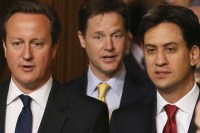
PMQs today was dominated by the debate about debates. After a few statesmanlike questions about the aftermath of the Paris terrorist attacks, Miliband started to needle Cameron about his reluctance to take part in TV debates while Labour MPs made chicken noises. Cameron claimed that he was happy to take part in TV debates as long as the Greens were included and accused Labour of being ‘chicken when it comes to the Greens’; he seemed to back one 5-way debate and one head to head between him and Miliband. Downing Street believes this to be a perfectly defensible position but Cameron is taking a risk by setting it out so clearly because those running the Tory campaign would really prefer no debates at all.