Uk politics

Andy Burnham’s car crash interview shows why Labour can’t be trusted with the NHS

From our UK edition

If Labour is weaponising the NHS, maybe it needs to sharpen its tools. Shadow Health Secretary Andy Burnham had a difficult and ill-tempered interview on Newsnight yesterday about what he actually thinks about private sector involvement in the NHS. When asked about the role he sees for the private sector under his reshaped health service, Burnham said private companies would not be entirely excluded: 'There is still a role for private and voluntary providers but I also did say very clearly that the market is not the answer.' Presented with a graph (below) showing how private sector outsourcing grew to four per cent under Labour — but rose two per cent under the coalition — Burnham was unable to say what he thinks is the right level: 'There isn't a right percentage.

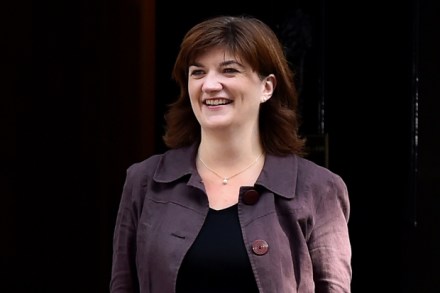
Nicky Morgan: British values test isn’t just about Muslim schools

From our UK edition

Nicky Morgan has launched a rather strident defence of the government’s ‘British values’ agenda this evening, after fears that it is being used to punish schools unfairly. The Education Secretary recently announced that the Christian Durham Free School would close after Ofsted inspectors said teachers were failing to challenge ‘racist words and sexually derogative and homophobic terms’ and that it was failing to promote the values set out by ministers. In a speech to think tank Politeia, Morgan said: ‘I’m afraid I have no sympathy for those who say that British values need not apply to them, that this should purely be a special test for schools in predominantly Muslim communities or our inner cities.

Labour fails to turn up to work for Treasury questions

From our UK edition

The Commons is pretty quiet at the moment, draining of energy earlier and earlier in the week as MPs head out to their constituencies. So quiet, in fact, that Labour seems to have given up on using departmental question times as a forum for making government ministers uncomfortable or piling any political pressure on their opposite numbers. Yesterday’s Work and Pensions Questions were pretty lacklustre from an opposition attack point of view, but today’s Treasury questions were far worse. Tory MPs had turned up with piles of sickly sweet loyal questions to ask, most running along the lines of ‘is the Chancellor aware that he’s doing a fantastic job?

David Cameron wriggles further away from the TV debates

From our UK edition

David Cameron had clearly planned his answers to his Today programme so that a casual listener might think that he really is very keen for the TV debates to take place. He sounded ever so earnest, and repeatedly said that he does want the debates to take place. But when Justin Webb asked the crucial question - which was tell us you're going to do the TV debates, rather than that you just want them to happen - the Prime Minister's pretence was exposed. listen to ‘Cameron: Debates ‘take all the life out of the campaign’’ on audioBoom He doesn't want the TV debates to happen, and now that his original condition of the Greens being included has been met, he is attaching more conditions before he will say 'I will do these debates'.

Labour’s weak welfare attack leaves Tories to chant tribal slogans in Commons

From our UK edition

Today’s Work and Pensions Questions was taken almost exclusively by Esther McVey - to the extent that when Steve Webb finally got the chance to answer a question, he joked that he had started to ‘feel unemployed’ while waiting for his big moment. Even Iain Duncan Smith only got one good stint at the despatch box, when Rachel Reeves asked him about the progress of Universal Credit. But the rest of the session was McVey Question Time. Tory MPs are naturally in a tribal mood at the moment, and so all most of them want to talk about was the jobs fairs they’re all holding in their constituencies.

Danny Alexander: David Cameron is an ‘enemy of aspiration’

From our UK edition

As coalition rows go, today’s ‘spat’ over who is most supportive of aspirational voters really is the more boring for a while. David Cameron has been talking about Britain’s ‘tax moment’ (hopefully with an accompanying PPB with Burt Bacharach as the soundtrack), but Danny Alexander wants to pick a fight with his Coalition colleague. Last night the Chief Secretary to the Treasury released analysis saying the Coalition’s decision to increase the personal tax allowance has benefitted more than 8 million households to the tune of £1,330, and claiming credit for the Lib Dems. This was a deliberate act of sabotage ahead of the Prime Minister’s own ‘tax moment’.

UK politicians squabble over whose point the Greek elections prove

From our UK edition

What are the lessons for British politicians from Syriza's victory in the European elections? They're certainly very keen to tell voters what lessons we should be drawing. Last night Nigel Farage focused on the failure of Europe, while David Cameron pointed to the importance of a strong - you guessed it - long term economic plan. This morning George Osborne underlined that point on the Today programme, saying: 'I certainly understand that if you have unemployment at 25%, if your economy has shrunk by 20%, as the Greek economy has over recent years, you are looking for other answers, alternatives – because ultimately this is just the latest chapter in the eurozone crisis.

How will the Greek elections change the political debate in the UK?

From our UK edition

If you were looking for clues as to how the result of the Greek elections will affect our politics in the United Kingdom, here’s a handy hint. This is the statement Nigel Farage has released, before the official result has even been declared: ‘This is a desperate cry for help from the Greek people, millions of whom have been impoverished by the Euro experiment. An extraordinary game of poker will now begin with Chancellor Merkel, with the ECB powerless to do much than be an observer.' Ukip will want to make the result and fallout from this election about the failure of European elites and the slow death of the euro.

Watch: Natalie Bennett demonstrates how Green policies don’t add up

From our UK edition

Do the Green Party's policies stack up? Although its membership and prominence have rocketed in recent weeks, little focus has been put on what the party campaigns for. Green leader Natalie Bennett was subjected to a dissection of her party’s principles on the Sunday Politics today (watch above) and demonstrated why most of its proposals are pipe dreams. Bennett said her party wants to ensure ‘nobody is living in fear’ but exactly how they would pay for that remains unanswered. One of its policies would be a ‘Citizens’ Income’, ensuring everyone has a minimum weekly income of £72.

Greece votes, Europe waits

From our UK edition

Greek voters are currently going to the polls in an election that will have profound consequences for the Eurozone. If the anti-austerity Syriza party wins, as the polls suggest it will—and its lead has actually been increasing in the past few days, the Eurozone crisis will enter a new and more acute phase. Syriza will demand a softening of the terms of the Greek bailout. But the Merkel government, the European Central Bank and the European Commission are adamant that they’ll be no leeway given. With Merkel already deeply unhappy about the ECB’s quantitative easing programme, she isn’t going to sign off on any concessions to Athens.

Labour signs up to debates as broadcasters threaten an empty chair

From our UK edition

So the broadcasters have done what many thought they’d be too afraid to do and have threatened to empty chair David Cameron - or anyone else who refuses to take part - in the TV debates. In a statement released this afternoon, BBC, ITV, Sky and Channel 4 said ‘in the event that any of the invited party leaders decline to participate, debates will take place with the party leaders who accept the invitation’. They have also said the debates will all take place within the short campaign, which Cameron didn’t want either. Labour has said it will sign up to the debates, while others continue to grumble. But naturally David Cameron has said very little.

Conservative Central Office appears to be working for the SNP

From our UK edition

Even by the standards of the Conservative and Unionist (sic) party this is an impressively stupid poster. Do they really want to encourage Scots to vote for the SNP? Evidently they do. Of course we know why. Every seat Labour lose in Scotland makes it less and less likely Labour will emerge from the election as the largest party. Consequently, every SNP gain makes it a little more likely David Cameron will have a chance of cobbling together a second ministry. But, my god, think of the price at which that comes. In their desperation to stop Miliband the Tories are prepared to risk the future of the United Kingdom. They might win this election but at the expense of losing their country. As Pyrrhic conquests go, that takes some beating.

Confusing politics encourages leadership intrigues

From our UK edition

This election is going to be terribly confusing, something the latest TV debate proposals from the broadcasters highlight very nicely indeed. The debates are starting to resemble an episode of Take Me Out with the number of parties who'll be standing behind lecterns growing - and calls for even more to join. One of the things that's adding to the confusion is that no party appears to have the momentum, and what momentum there is has become difficult to discern in the usual ways as Parliament is emptying on a Wednesday night as MPs head off to take part in 650 by-elections. Because no one party has momentum, both main parties are as fascinated with who could lead them next as they are with whether they might be in government.

Can George Osborne pass his own 13 tests?

From our UK edition

Before George Osborne took to wearing hard hats and hi-vis jackets, he used to revel in his status as a political insider. In 2004, he wrote a piece for The Spectator setting out his model for forecasting the result of UK General Elections. Adapted from an academic model for predicting US Presidential Elections, it set out the ’13 keys to Number 10’ and argued that if a government held six of these it would win re-election. Here are Osborne’s 13 tests and how the government is doing on them: 1. Real per capita economic growth during the parliament equals or exceeds the mean growth during the previous two parliaments. Yes: the coalition will just hit this target if the OBR’s forecasts are correct. 2. The economy is not in recession during the election campaign.

Labour rising star: Party cannot afford to sound like ‘the moaning man in the pub’

From our UK edition

Liz Kendall is a real rising star in the Labour party. Few colleagues have a bad word to say about her, and indeed many have a great deal of good words. Tonight the House magazine publishes an interview with the Shadow Health Minister that contains a number of rather strong comments that she’s made about the party that she has a good chance of one day leading. The line that’ll get most attention is this: ‘You can’t be the moaning man in the pub. Actually the moaning man in the pub often has a real point underneath it all. But mostly you end up not listening.

If you’re going to have seven parties in the TV debates, you’ve got to include the DUP

From our UK edition

Having seven parties in two of the TV debates, as the broadcasters are reportedly proposing, is an admission that what matters is not whether the party will provide the Prime Minister but whether it might have influence in a hung parliament. On this basis, there is no justification for excluding the DUP. The DUP currently have eight seats in the Commons, more than Plaid Cymru, Ukip and the Greens put together. Even after the next election, the DUP are likely to have more MPs than any of these parties. It is baffling that the broadcasters have ended up concluding that Plaid Cymru, who have fewer MPs than the DUP and also only stand in one part of the United Kingdom, deserve an invitation but the DUP don’t.

Broadcasters to propose new set of TV election debates

From our UK edition

The broadcasters have reportedly come up with a new set of proposals for the TV debates in order to force David Cameron to sign up. The Radio Times reports that they now want to hold one debate where the Prime Minister will face Ed Miliband, and two debates that feature almost everyone - Conservatives, Labour, the Lib Dems, the Greens, Ukip, SNP and Plaid Cymru. This doesn’t just answer Cameron’s stipulation that the Greens must be involved, but answers the next question that would then be posed, which is what about the nationalist parties. Unless he suddenly starts talking about the importance of George Galloway, the Prime Minister will find it very, very difficult to wriggle away from these debates.

Tories run two rickety databases in target seats

From our UK edition

The Conservatives are running two voter databases, neither of which are fully functioning, in their key constituencies, Coffee House has learned. The party had been trying to get rid of its frail database Merlin, which keeps breaking during by-elections and at other crucial moments, in time for the General Election. But it hasn’t quite managed it yet, and is instead running Merlin alongside a new, but not fully-tested, database called VoteSource. Candidates in target seats say VoteSource is currently working for them, but that it is lacking some of the functions it was supposed to have by this point and they do not know how it will cope with big changes in data. They are running their data on both Merlin and VoteSource in case one breaks.

Podcast: Comedy meets politics and Osborne’s 13 tests for No.10

From our UK edition

Why has politics turned into stand-up comedy? On this week’s View from 22 podcast, Andrew Watts and Jesse Norman MP discuss this week’s Spectator cover feature on how these two worlds are colliding. What does the increased influence of comedy mean for our faith in politics? Aside from notably humorous politicians like Boris Johnson, how funny are MPs generally? And which member of the Labour shadow cabinet is deemed so funny he could be a professional stand-up? James Forsyth and Isabel Hardman also look at 13 tests to make it into Downing Street set by George Osborne — in 2004. Based on a Spectator piece he wrote earlier in his Parliamentary career, how many of these tests does his government pass? And by his own measures, will the Conservatives end up back in No.