Tv

Why has it all gone wrong for The Night Manager?

From our UK edition

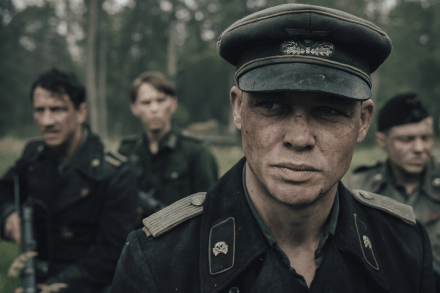
The Night Manager is finally back after ten years with three major drawbacks: no Elizabeth Debicki for the sex scenes; no Tom Hollander for the comedy scenes; and no Hugh Laurie for the evil-kingpin-in-his-toothsome-mountaintop-lair scenes, I nearly claimed. But only because at the very beginning of the new season the Laurie character’s grizzled body is identified by Olivia Colman (in her most irritating performance ever, as a dowdy but capable MI6 officer with a gratingly suburban accent). And I didn’t want to spoil the coming plot twist in case any of you were foolish enough to have fallen for this blatant case of Chekhov’s misidentified corpse.

The steady-as-she-goes Golden Globes

So, One Battle After Another is going to sweep the Oscars. That was fairly certain before last night’s Golden Globe awards, but it is now essentially guaranteed. Paul Thomas Anderson’s loose Thomas Pynchon adaptation won best film in the musical/comedy category, as well as Best Director, Best Screenplay – over the hotly tipped Sinners, which had been expected to win the award as a consolation prize – and Best Supporting Actress for the scene-stealing Teyana Taylor as the superbly named Perfidia Beverly Hills. Those of us who would have liked to see Amy Madigan take that award for her indelibly creepy performance in Weapons will have been disappointed, but in truth the Globes threw up a modest number of surprises.

golden globes

Lucy Worsley’s sleuthing is rather impressive

From our UK edition

Lucy Worsley’s Victorian Murder Club opened with its presenter unexpectedly channelling that gravelly voiced bloke who used to do all those film trailers beginning ‘In a world…’. ‘The London Thames,’ she intoned as gruffly and menacingly as she could, ‘winding silently through the capital. But in Victorian times...’ dramatic pause ‘...it had a sinister side.’ She then introduced ‘a story that has haunted me since I first heard it’ – possibly, you couldn’t help thinking, from a TV producer keen to find her another true-crime project. In the late 1880s, a serial killer dismembered several women while also taunting the police and never being found.

Enough with torture-porn TV

From our UK edition

Has anyone got to the end of Malice yet? I’m halfway through – at the time of writing, anyway – and am dearly hoping that I might bump into someone at a party who will blurt out all the plot details and spare me the misery of having to sit it out to the bitter end. The Fawn thinks I’m being a wuss, grumbling that I never used to be this squeamish about gory, psychologically harrowing torture-porn TV. Maybe so, but the older I get, the more I wonder: what am I actually gaining by spending six hours on a sofa writhing my way through a horrid story about a made-up psychopath doing terrible things to a made-up family and their made-up pets? Wouldn’t I be better just re-reading Anna Karenina?

The cardinals spill the beans on the conclave 

From our UK edition

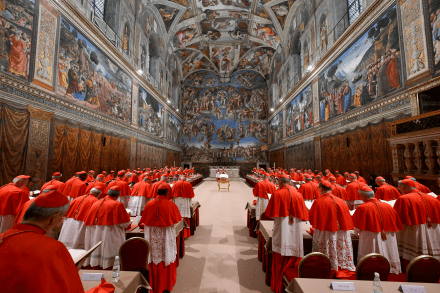
Secrets of the Conclave seemed rather optimistically titled, given that everybody at this year’s papal election had made a solemn vow before God not to divulge any. But, while we duly heard nothing about backstage politicking – apart from regular assurances that none took place – this respectful and quietly charming documentary did succeed in humanising the strange process of picking a new pope, and even in supplying a few gentle revelations. It transpires, for example, that Catholic cardinals suffer from the same anxiety about phonelessness as the rest of us, with the requirement to hand in their mobiles before entering the Sistine Chapel initially causing feelings of slight panic.

The Beast in Me is surprisingly addictive

From our UK edition

The Beast in Me is one of those ‘taut psychological thrillers’ that everyone talks about in the office. This might sound disparaging – as it is, obviously – but I have to admit that, having succumbed in desperation (because, as usual, there is so little else on), I did find the show pretty addictive and unusually satisfying. What makes it stand out is that it doesn’t go for the obvious. Yes, its heroine – played by Claire Danes – is feisty, talented and capable. But she’s also whiny, uptight and really quite unsympathetic, as perhaps screenwriter Gabe Rotter intended when he gave her the weirdly repellant name Aggie Wiggs.

The new Stranger Things is loopy and sweet

So, the new – and supposedly final – season of Stranger Things has arrived in Netflix, just in time for Thanksgiving. Expectations have been through the roof that this installment will not be a turkey, but the good (stranger?) thing about the series so far is that it has maintained a remarkably high level of quality since it began in 2016. This is by no means a given for an Eighties-inflected fantasy show that is so devoted (the cynics might and have said slavishly) to all things that Steven Spielberg produced in that decade that the bearded one might have sued for plagiarism, were it not for the fact that the homage remains an affectionate and heartfelt, rather than cynical, one.

stranger things

Gothic lives matter: BBC2’s Civilisations reviewed

From our UK edition

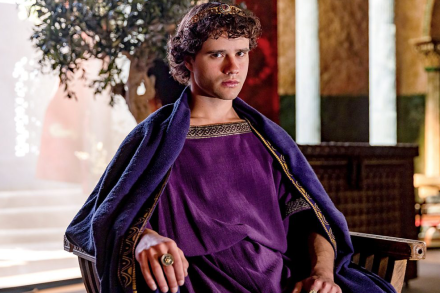
Anybody growing weary of the debate surrounding the BBC’s unexamined assumptions and biases about modern politics might have expected to find some relief in a scholarly documentary about the sack of Rome in AD 410. Sad to say, though, the first episode of Civilisations: Rise and Fall offered very little of it. Of course, it’s not unusual for history programmes to want to prove that the people in the past were Just Like Us. But in this case the parallels drawn/rather desperately imposed were a particularly uncanny fit with those same pesky assumptions and biases.

Pluribus is a mess

From our UK edition

Pluribus is another drama set in the dystopian future. But on this occasion the integrity of the entire human race depends not on someone ordinary and likeable who could almost be you, but on a bolshie, misanthropic middle-aged lesbian called Carol. Carol (Rhea Seehorn from Better Call Saul) is so grumpy that when in flashback we see her wife Helen treating her to an expensive jaunt to a romantic ice hotel in Scandinavia, she refuses to snuggle beneath the fur bedspread, sip designer vodka and gaze at the Northern Lights above. Instead, all she wants to notice is that sitting on a bed made of blocks of ice makes her want to pee. But now Helen is gone and Carol is one of only 12 people in the entire world who remain normal.

Vince Gilligan wins again with Pluribus

Say what you will about Breaking Bad and Better Call Saul creator Vince Gilligan, but there are few showrunners who are better at starting a series off with a bang. Who could forget the spectacle, from the pilot episode of Breaking Bad, of Bryan Cranston’s pants-less, intense-looking Walter White, addressing his family – and by extension, the audience – by saying “My name is Walter Hartwell White. I live at 308 Negra Arroyo Lane, Albuquerque, New Mexico, 87104. To all law-enforcement entities, this is not an admission of guilt?" Or Bob Odenkirk’s half-hapless, half-sly Jimmy McGill, aka Saul Goodman, leading a black-and-white half-life in Omaha, Nebraska, as we slowly, inexorably observe the circumstances that have led to his downfall?

pluribus

Bleak but gripping: Channel 4’s Trespasses reviewed

From our UK edition

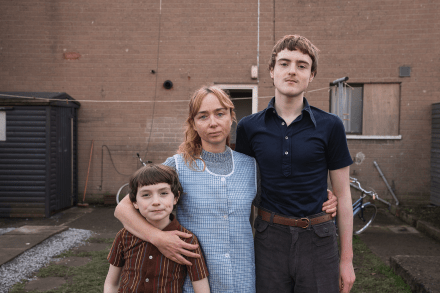
Yeats famously summarised Ireland in the four words, ‘Great hatred, little room’. But, as Louise Kennedy’s 2022 debut novel Trespasses showed, in 1970s Northern Ireland the hatred had grown even greater and the room even littler. Channel 4’s faithful adaptation began – as it would continue over its four parts this week – with the suffocating omnipresence of sectarianism. As 24-year-old Cushla (Lola Petticrew) drove through her small town, everything she saw screamed Catholicism or Protestantism: the graffiti, the flags, the ash on children’s foreheads at the start of Lent. By night, Cushla worked in a bar where the punters were either nervously or aggressively aware of each other’s religion.

Film and TV are run by satanists

From our UK edition

I once came up with a brilliant idea for a children’s Sunday-evening TV series. It would follow the adventures of young Jesus in Britain, circa AD 16, and his rich, tin-trading great uncle Joseph of Arimathea. There’d be dragons and giants and lots demonic figures, all trying to kill the boy Messiah before He achieved his true purpose. And young Jesus would continually be constrained from using any of His real powers because it was all a secret and His time had not yet come. If you’re clever, you can probably guess the title. But it’s never going to get made because a) I haven’t written it and b) the film and TV worlds are run by satanists. Not literal satanists, perhaps. Well, not all of them.

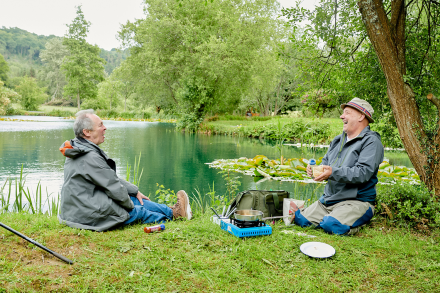
The joy of Mortimer and Whitehouse: Gone Fishing

From our UK edition

If you didn’t already know that Down Cemetery Road was based on a novel Mick Herron wrote before the Slough House series – later adapted into TV’s Slow Horses – it mightn’t be too difficult to guess. After all, main character Zoë Boehm (Emma Thompson, no less) is a cynical sixty-something with a dodgy hygiene regime, who works in a ferociously shabby office and communicates mainly through the medium of the heartless yet undeniably funny wisecrack – but who nonetheless shouldn’t be underestimated by the arse-covering intelligence services she’s up against. She is, in other words, a female version of Slow Horses’ Jackson Lamb (also played by an Oscar-winning Brit).

A great comedy about a terrible sport

From our UK edition

I’m trying to think of things I’m less interested in than American football. The plant-based food section? Taking up my GP’s offer of a free Covid booster? Ed Miliband’s nostril depilation regime? No, apart from maybe baseball, I can’t think of anything so soul-crushingly tedious as a rigged game where men in shoulder pads and portcullised helmets shout numbers, bash into one another, then wait half an hour while the referee decides whether or not they’re allowed to throw a spinny ball and maybe one day end up being Taylor Swift’s latest boyfriend.

Is there anything menopausal women can’t do?

From our UK edition

Is there anything menopausal women can’t do (on television)? Last Sunday, as a couple of them were still working on the daring theft of a Salvador Dali painting in ITV1’s Frauds, BBC1 launched Riot Women in which five others form a punk band. Meanwhile, two regular features of British TV remain actresses lamenting the lack of older women starring in drama series – and older women starring in drama series. Virtually all these shows also recall the headline from the American satirical magazine The Onion: ‘Women empowered by whatever a woman does.’ And that’s certainly true of Riot Women, written by Sally Wainwright (Happy Valley, Gentleman Jack etc.) and therefore set in the Calder Valley, with the author’s message never hard to detect.

The Chair Company is the workplace comedy we need right now

If you watched The Paper and, like most of its viewers, remained unimpressed by its comparatively limp updating of The Office – and I’m still haunted by the sheer awfulness of Sabrina Impacciatore’s performance in it – then you’ll be delighted to hear that Tim Robinson’s new show, The Chair Company, which is made by HBO, is the dark workplace comedy that the world needs right now. While it’s too early to say whether it’s a true classic along the lines of The Office, or a less impressive but still enjoyable achievement, it represents another success for Robinson, who is inexorably turning himself into one of the most interesting comedians and writers in the industry.

The dying art of costume design

From our UK edition

At the receptionist’s desk in Cosprop’s studio and costume warehouse, a former Kwik Fit garage, the sloping bleakness of Holloway Road is held at bay by a small chandelier, brassy lighting and a bound guest book. It’s a bit stagey, like a filmset for a cheap foreign hotel or an expensive shrink’s office, quite out of place in the real north London high street. But as the entrance to a costume house that builds worlds and people out of bits of fabric, feathers and jewels, it’s appropriate. Suspend all disbelief, ye who enter here. Cosprop was founded by the costume designer John Bright in 1965.

Excruciating: Netflix’s House of Guinness reviewed

From our UK edition

First the surprising news: not a single one of the four Guinness siblings in 1868 Dublin is black; and only 25 per cent of them – surely a record for Netflix – is gay. Now the bad: despite these oversights, House of Guinness remains very recognisably the work of Steven Knight, the Peaky Blinders screenwriter who once set a drama in 1919 Birmingham and said to himself: ‘I know just what this period needs to make it more echt: a cameo appearance by dub poet Benjamin Zephaniah.’ As a Brummie (more or less), I loathed Peaky Blinders.

The Emmys are a waste of time

On NPR, they were busy ignoring the Charlie Kirk assassination story by focusing on what really matters: this year’s Emmy Awards, which took place in Beverly Hills. I realized I didn’t recognize a single show – or actor. Then I remembered that I haven’t watched an actual television series in years. What is there to watch? At its core, the reason is because everyone in Hollywood hates you The Emmys are a celebration of TV stars I’ve never heard of, shows I don’t watch and a never-ending succession of narcissists delivering the same woke diatribes into the microphone. You hate Trump, too? That’s one we’ve never heard before, how original. The nation is eager to hear from the best supporting actress winner about how the right must atone for causing Kirk’s death.

Emmys